

Y O L K OF T H E H E N ' S EGG
253
periblast arises during cleavage from a circle of true (endodermal) cells
that become cut off from the embryo. These subsequently lose their cell
walls and become syncytial.
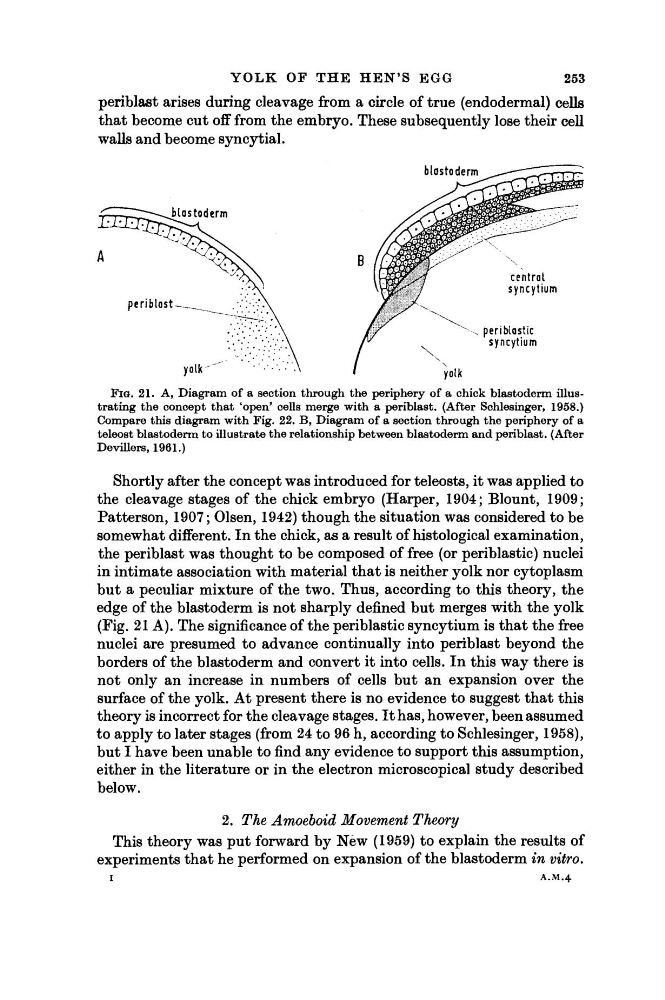
FIG. 21. A, Diagram of a section through the periphery of a chick blastoderm illustrating the concept that 'open' cells merge with a periblast. (After Schlesinger, 1958.)
Compare this diagram with Fig. 22. B, Diagram of a section through the periphery of a
teleost blastoderm to illustrate the relationship between blastoderm and periblast. (After
De villers, 1961.)
Shortly after the concept was introduced for teleosts, it was applied to
the cleavage stages of the chick embryo (Harper, 1904; Blount, 1909;
Patterson, 1907 ; Olsen, 1942) though the situation was considered to be
somewhat different. In the chick, as a result of histological examination,
the periblast was thought to be composed of free (or periblastic) nuclei
in intimate association with material that is neither yolk nor cytoplasm
but a peculiar mixture of the two. Thus, according to this theory, the
edge of the blastoderm is not sharply defined but merges with the yolk
(Fig. 21 A). The significance of the periblastic syncytium is that the free
nuclei are presumed to advance continually into periblast beyond the
borders of the blastoderm and convert it into cells. In this way there is
not only an increase in numbers of cells but an expansion over the
surface of the yolk. At present there is no evidence to suggest that this
theory is incorrect for the cleavage stages. I t has, however, been assumed
to apply to later stages (from 24 to 96 h, according to Schlesinger, 1958),
but I have been unable to find any evidence to support this assumption,
either in the literature or in the electron microscopical study described
below.
2. The Amoeboid Movement Theory
This theory was put forward by New (1959) to explain the results of
experiments that he performed on expansion of the blastoderm in vitro.
I
A.M.4
253
periblast arises during cleavage from a circle of true (endodermal) cells
that become cut off from the embryo. These subsequently lose their cell
walls and become syncytial.
FIG. 21. A, Diagram of a section through the periphery of a chick blastoderm illustrating the concept that 'open' cells merge with a periblast. (After Schlesinger, 1958.)
Compare this diagram with Fig. 22. B, Diagram of a section through the periphery of a
teleost blastoderm to illustrate the relationship between blastoderm and periblast. (After
De villers, 1961.)
Shortly after the concept was introduced for teleosts, it was applied to
the cleavage stages of the chick embryo (Harper, 1904; Blount, 1909;
Patterson, 1907 ; Olsen, 1942) though the situation was considered to be
somewhat different. In the chick, as a result of histological examination,
the periblast was thought to be composed of free (or periblastic) nuclei
in intimate association with material that is neither yolk nor cytoplasm
but a peculiar mixture of the two. Thus, according to this theory, the
edge of the blastoderm is not sharply defined but merges with the yolk
(Fig. 21 A). The significance of the periblastic syncytium is that the free
nuclei are presumed to advance continually into periblast beyond the
borders of the blastoderm and convert it into cells. In this way there is
not only an increase in numbers of cells but an expansion over the
surface of the yolk. At present there is no evidence to suggest that this
theory is incorrect for the cleavage stages. I t has, however, been assumed
to apply to later stages (from 24 to 96 h, according to Schlesinger, 1958),
but I have been unable to find any evidence to support this assumption,
either in the literature or in the electron microscopical study described
below.
2. The Amoeboid Movement Theory
This theory was put forward by New (1959) to explain the results of
experiments that he performed on expansion of the blastoderm in vitro.
I
A.M.4