

188
H E N R I E T T E HERLANT-MEEWIS
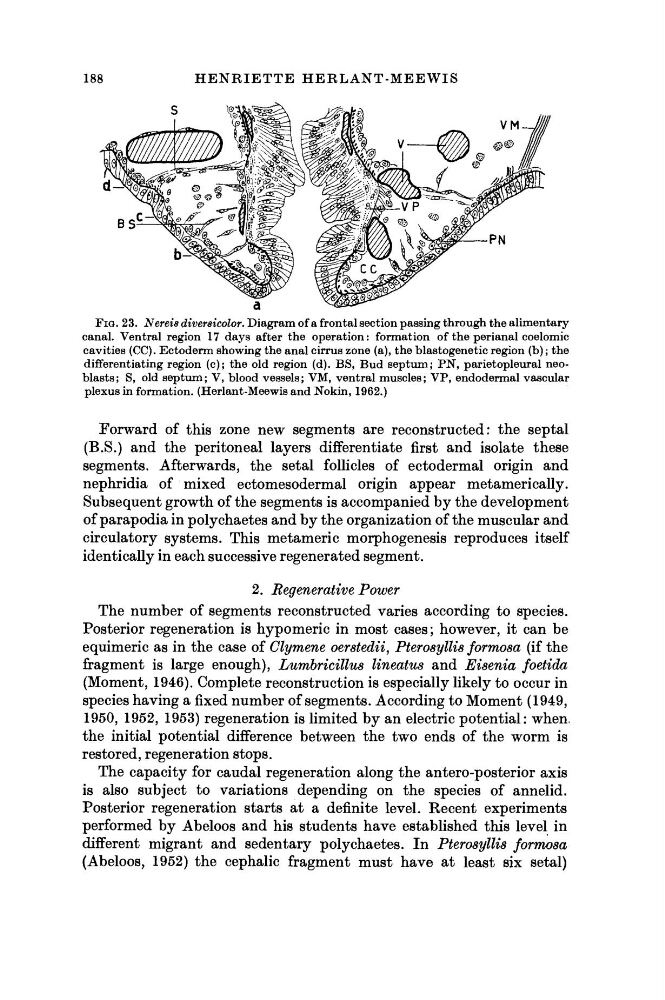
FIG. 23. Nereis diversicolor. Diagram of a frontal section passing through the alimentary
canal. Ventral region 17 days after the operation: formation of the perianal coelomic
cavities (CC). Ectoderm showing the anal cirrus zone (a), the blastogenetic region (b) ; the
differentiating region (c); the old region (d). BS, Bud septum; PN, parietopleural neoblasts; S, old septum; V, blood vessels; VM, ventral muscles; VP, endodermal vascular
plexus in formation. (Herlant-Meewis and Nokin, 1962.)
Forward of this zone new segments are reconstructed: the septal
(B.S.) and the peritoneal layers differentiate first and isolate these
segments. Afterwards, the setal follicles of ectodermal origin and
nephridia of mixed ectomesodermal origin appear metamerically.
Subsequent growth of the segments is accompanied by the development
of parapodia in polychaetes and by the organization of the muscular and
circulatory systems. This metameric morphogenesis reproduces itself
identically in each successive regenerated segment.
2. Begenerative Power
The number of segments reconstructed varies according to species.
Posterior regeneration is hypomeric in most cases; however, it can be
equimeric as in the case of Clymene oerstedii, Pterosyllis formosa (if the
fragment is large enough), Lumbricillus lineatus and Eisenia foetida
(Moment, 1946). Complete reconstruction is especially likely to occur in
species having a fixed number of segments. According to Moment (1949,
1950, 1952, 1953) regeneration is limited by an electric potential: when
the initial potential difference between the two ends of the worm is
restored, regeneration stops.
The capacity for caudal regeneration along the antero-posterior axis
is also subject to variations depending on the species of annelid.
Posterior regeneration starts at a definite level. Recent experiments
performed by Abeloos and his students have established this level in
different migrant and sedentary polychaetes. In Pterosyllis formosa
(Abeloos, 1952) the cephalic fragment must have at least six setal)
H E N R I E T T E HERLANT-MEEWIS
FIG. 23. Nereis diversicolor. Diagram of a frontal section passing through the alimentary
canal. Ventral region 17 days after the operation: formation of the perianal coelomic
cavities (CC). Ectoderm showing the anal cirrus zone (a), the blastogenetic region (b) ; the
differentiating region (c); the old region (d). BS, Bud septum; PN, parietopleural neoblasts; S, old septum; V, blood vessels; VM, ventral muscles; VP, endodermal vascular
plexus in formation. (Herlant-Meewis and Nokin, 1962.)
Forward of this zone new segments are reconstructed: the septal
(B.S.) and the peritoneal layers differentiate first and isolate these
segments. Afterwards, the setal follicles of ectodermal origin and
nephridia of mixed ectomesodermal origin appear metamerically.
Subsequent growth of the segments is accompanied by the development
of parapodia in polychaetes and by the organization of the muscular and
circulatory systems. This metameric morphogenesis reproduces itself
identically in each successive regenerated segment.
2. Begenerative Power
The number of segments reconstructed varies according to species.
Posterior regeneration is hypomeric in most cases; however, it can be
equimeric as in the case of Clymene oerstedii, Pterosyllis formosa (if the
fragment is large enough), Lumbricillus lineatus and Eisenia foetida
(Moment, 1946). Complete reconstruction is especially likely to occur in
species having a fixed number of segments. According to Moment (1949,
1950, 1952, 1953) regeneration is limited by an electric potential: when
the initial potential difference between the two ends of the worm is
restored, regeneration stops.
The capacity for caudal regeneration along the antero-posterior axis
is also subject to variations depending on the species of annelid.
Posterior regeneration starts at a definite level. Recent experiments
performed by Abeloos and his students have established this level in
different migrant and sedentary polychaetes. In Pterosyllis formosa
(Abeloos, 1952) the cephalic fragment must have at least six setal)