

186
H E N R I E T T E H E R L A N T - M E E W I S
A
B
C
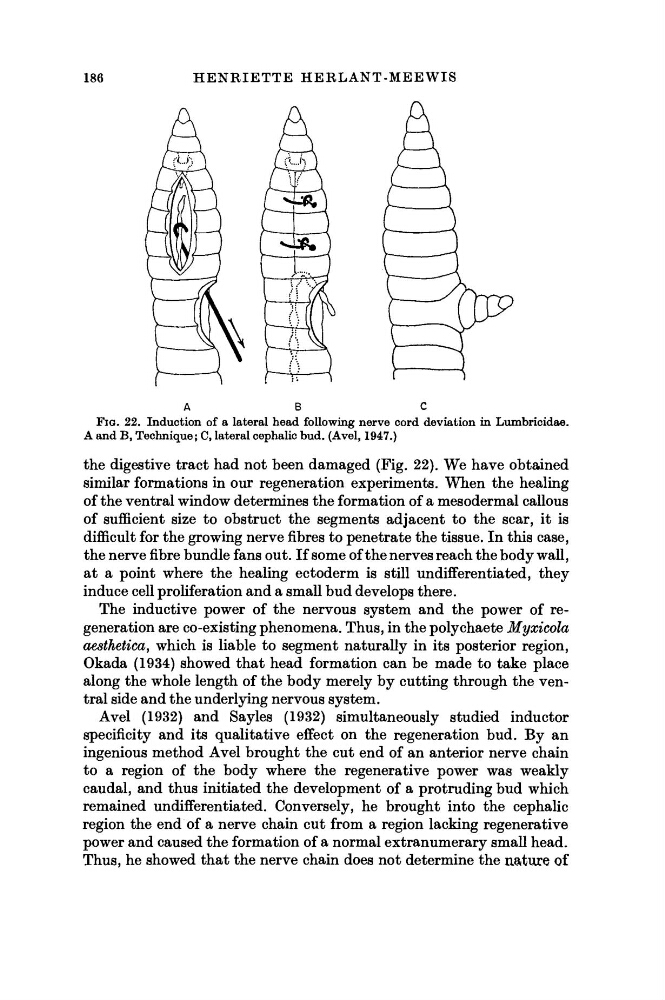
FIG. 22. Induction of a lateral head following nerve cord deviation in Lumbricidae.
A and B, Technique; C, lateral cephalic bud. (Avel, 1947.)
the digestive tract had not been damaged (Fig. 22). We have obtained
similar formations in our regeneration experiments. When the healing
of the ventral window determines the formation of a mesodermal callous
of sufficient size to obstruct the segments adjacent to the scar, it is
difficult for the growing nerve fibres to penetrate the tissue. In this case,
the nerve fibre bundle fans out. If some of the nerves reach the body wall,
at a point where the healing ectoderm is still undifFerentiated, they
induce cell proliferation and a small bud develops there.
The inductive power of the nervous system and the power of regeneration are co-existing phenomena. Thus, in the polychaete Myxicola
aesthetica, which is liable to segment naturally in its posterior region,
Okada (1934) showed that head formation can be made to take place
along the whole length of the body merely by cutting through the ventral side and the underlying nervous system.
Avel (1932) and Sayles (1932) simultaneously studied inductor
specificity and its qualitative effect on the regeneration bud. By an
ingenious method Avel brought the cut end of an anterior nerve chain
to a region of the body where the regenerative power was weakly
caudal, and thus initiated the development of a protruding bud which
remained undifFerentiated. Conversely, he brought into the cephalic
region the end of a nerve chain cut from a region lacking regenerative
power and caused the formation of a normal extranumerary small head.
Thus, he showed that the nerve chain does not determine the nature of
H E N R I E T T E H E R L A N T - M E E W I S
A
B
C
FIG. 22. Induction of a lateral head following nerve cord deviation in Lumbricidae.
A and B, Technique; C, lateral cephalic bud. (Avel, 1947.)
the digestive tract had not been damaged (Fig. 22). We have obtained
similar formations in our regeneration experiments. When the healing
of the ventral window determines the formation of a mesodermal callous
of sufficient size to obstruct the segments adjacent to the scar, it is
difficult for the growing nerve fibres to penetrate the tissue. In this case,
the nerve fibre bundle fans out. If some of the nerves reach the body wall,
at a point where the healing ectoderm is still undifFerentiated, they
induce cell proliferation and a small bud develops there.
The inductive power of the nervous system and the power of regeneration are co-existing phenomena. Thus, in the polychaete Myxicola
aesthetica, which is liable to segment naturally in its posterior region,
Okada (1934) showed that head formation can be made to take place
along the whole length of the body merely by cutting through the ventral side and the underlying nervous system.
Avel (1932) and Sayles (1932) simultaneously studied inductor
specificity and its qualitative effect on the regeneration bud. By an
ingenious method Avel brought the cut end of an anterior nerve chain
to a region of the body where the regenerative power was weakly
caudal, and thus initiated the development of a protruding bud which
remained undifFerentiated. Conversely, he brought into the cephalic
region the end of a nerve chain cut from a region lacking regenerative
power and caused the formation of a normal extranumerary small head.
Thus, he showed that the nerve chain does not determine the nature of