

184
H E N R I E T T E HERLANT-MEEWIS
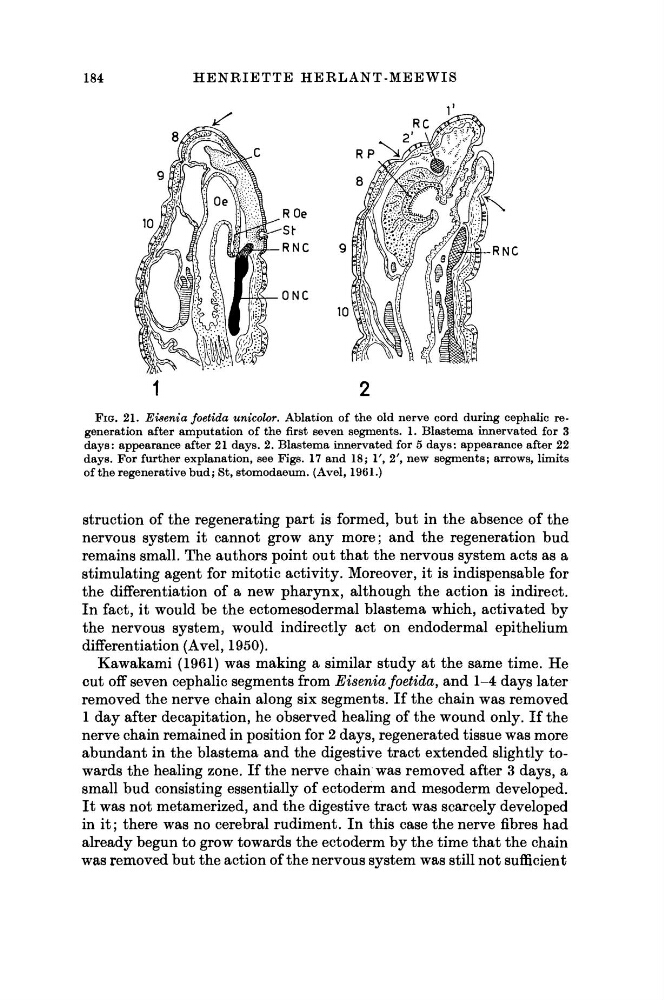
FIG. 21. Eisenia foetida unicolor. Ablation of the old nerve cord during cephalic regeneration after amputation of the first seven segments. 1. Blastema innervated for 3
days: appearance after 21 days. 2. Blastema innervated for 5 days: appearance after 22
days. For further explanation, see Figs. 17 and 18; 1', 2', new segments; arrows, limits
of the regenerative bud; St, stomodaeum. (Avel, 1961.)
struction of the regenerating part is formed, but in the absence of the
nervous system it cannot grow any more; and the regeneration bud
remains small. The authors point out that the nervous system acts as a
stimulating agent for mitotic activity. Moreover, it is indispensable for
the differentiation of a new pharynx, although the action is indirect.
In fact, it would be the ectomesodermal blastema which, activated by
the nervous system, would indirectly act on endodermal epithelium
differentiation (Avel, 1950).
Kawakami (1961) was making a similar study at the same time. He
cut off seven cephalic segments from Eisenia foetida, and 1-4 days later
removed the nerve chain along six segments. If the chain was removed
1 day after decapitation, he observed healing of the wound only. If the
nerve chain remained in position for 2 days, regenerated tissue was more
abundant in the blastema and the digestive tract extended slightly towards the healing zone. If the nerve chain was removed after 3 days, a
small bud consisting essentially of ectoderm and mesoderm developed.
I t was not metamerized, and the digestive tract was scarcely developed
in it; there was no cerebral rudiment. In this case the nerve fibres had
already begun to grow towards the ectoderm by the time that the chain
was removed but the action of the nervous system was still not sufficient
H E N R I E T T E HERLANT-MEEWIS
FIG. 21. Eisenia foetida unicolor. Ablation of the old nerve cord during cephalic regeneration after amputation of the first seven segments. 1. Blastema innervated for 3
days: appearance after 21 days. 2. Blastema innervated for 5 days: appearance after 22
days. For further explanation, see Figs. 17 and 18; 1', 2', new segments; arrows, limits
of the regenerative bud; St, stomodaeum. (Avel, 1961.)
struction of the regenerating part is formed, but in the absence of the
nervous system it cannot grow any more; and the regeneration bud
remains small. The authors point out that the nervous system acts as a
stimulating agent for mitotic activity. Moreover, it is indispensable for
the differentiation of a new pharynx, although the action is indirect.
In fact, it would be the ectomesodermal blastema which, activated by
the nervous system, would indirectly act on endodermal epithelium
differentiation (Avel, 1950).
Kawakami (1961) was making a similar study at the same time. He
cut off seven cephalic segments from Eisenia foetida, and 1-4 days later
removed the nerve chain along six segments. If the chain was removed
1 day after decapitation, he observed healing of the wound only. If the
nerve chain remained in position for 2 days, regenerated tissue was more
abundant in the blastema and the digestive tract extended slightly towards the healing zone. If the nerve chain was removed after 3 days, a
small bud consisting essentially of ectoderm and mesoderm developed.
I t was not metamerized, and the digestive tract was scarcely developed
in it; there was no cerebral rudiment. In this case the nerve fibres had
already begun to grow towards the ectoderm by the time that the chain
was removed but the action of the nervous system was still not sufficient