

182
H E N R I E T T E H E R L A N T - M E E W I S
assumed that the regenerative power of the nervous system is greater
in one than in the other. The quantitative effect of the nervous system
in the region of the wound has been recognized by several authors:
Okada and Kawakami (1943) showed that if several nerve fibres are
implanted in the scar tissue, regeneration is more intense and can lead
to the reconstruction of seven or eight cephalic segments where only five
would normally be found. On the other hand, Kawakami (1961) showed
that if only half of the nerve chain is removed along a few segments
posterior to the amputation surface, small incomplete buds are often
developed. Finally, the same author made a close study of the relations
between the number of existing nerve fibres near the scar tissue and the
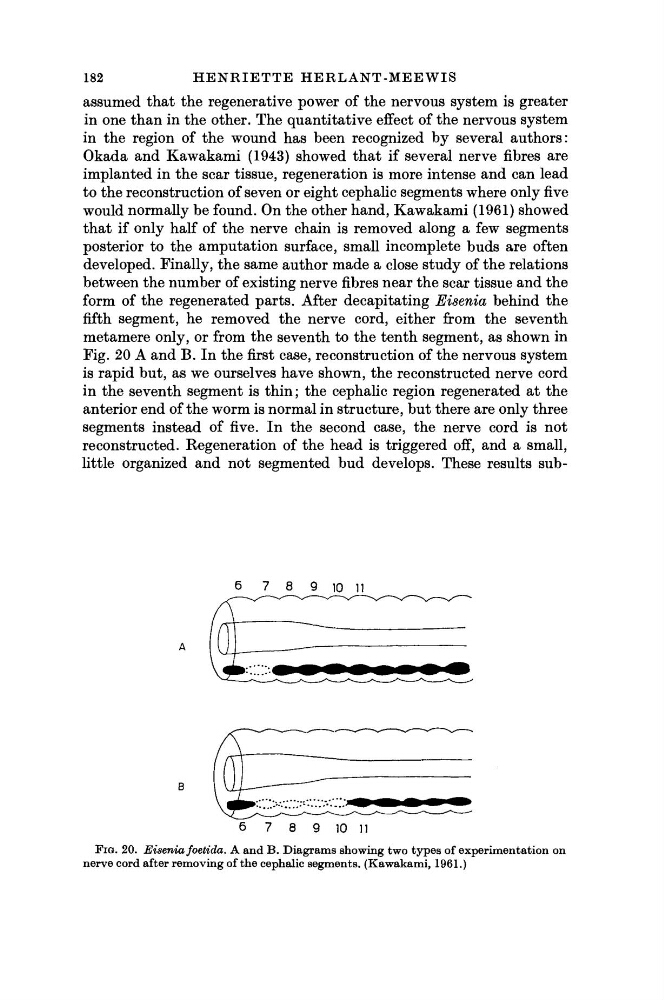
form of the regenerated parts. After decapitating Eisenia behind the
fifth segment, he removed the nerve cord, either from the seventh
metamere only, or from the seventh to the tenth segment, as shown in
Fig. 20 A and B. In the first case, reconstruction of the nervous system
is rapid but, as we ourselves have shown, the reconstructed nerve cord
in the seventh segment is thin ; the cephalic region regenerated at the
anterior end of the worm is normal in structure, but there are only three
segments instead of five. In the second case, the nerve cord is not
reconstructed. Regeneration of the head is triggered off, and a small,
little organized and not segmented bud develops. These results sub6
7 8 9 10 11
6
7 8 9 10 11
FIG. 20. Eisenia foetida. A and B. Diagrams showing two types of experimentation on
nerve cord after removing of the cephalic segments. (Kawakami, 1961.)
H E N R I E T T E H E R L A N T - M E E W I S
assumed that the regenerative power of the nervous system is greater
in one than in the other. The quantitative effect of the nervous system
in the region of the wound has been recognized by several authors:
Okada and Kawakami (1943) showed that if several nerve fibres are
implanted in the scar tissue, regeneration is more intense and can lead
to the reconstruction of seven or eight cephalic segments where only five
would normally be found. On the other hand, Kawakami (1961) showed
that if only half of the nerve chain is removed along a few segments
posterior to the amputation surface, small incomplete buds are often
developed. Finally, the same author made a close study of the relations
between the number of existing nerve fibres near the scar tissue and the
form of the regenerated parts. After decapitating Eisenia behind the
fifth segment, he removed the nerve cord, either from the seventh
metamere only, or from the seventh to the tenth segment, as shown in
Fig. 20 A and B. In the first case, reconstruction of the nervous system
is rapid but, as we ourselves have shown, the reconstructed nerve cord
in the seventh segment is thin ; the cephalic region regenerated at the
anterior end of the worm is normal in structure, but there are only three
segments instead of five. In the second case, the nerve cord is not
reconstructed. Regeneration of the head is triggered off, and a small,
little organized and not segmented bud develops. These results sub6
7 8 9 10 11
6
7 8 9 10 11
FIG. 20. Eisenia foetida. A and B. Diagrams showing two types of experimentation on
nerve cord after removing of the cephalic segments. (Kawakami, 1961.)