

REGENERATION IN ANNELIDS
175
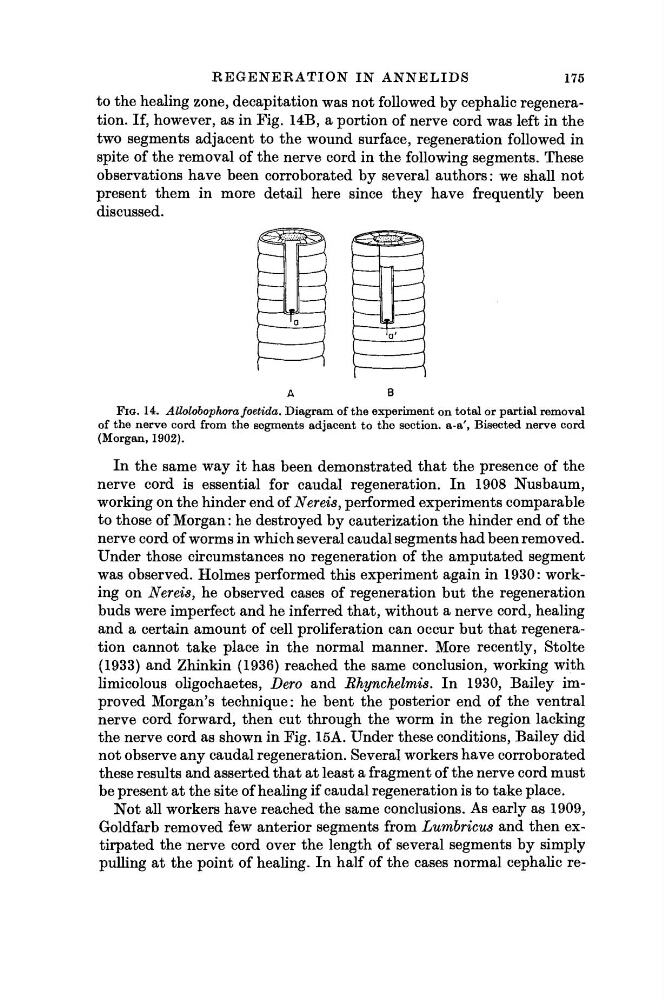
to the healing zone, decapitation was not followed by cephalic regeneration. If, however, as in Fig. 14B, a portion of nerve cord was left in the
two segments adjacent to the wound surface, regeneration followed in
spite of the removal of the nerve cord in the following segments. These
observations have been corroborated by several authors : we shall not
present them in more detail here since they have frequently been
discussed.
FIG. 14. Allolobophorafoetida. Diagram of the experiment on total or partial removal
of the nerve cord from the segments adjacent to the section, a-a', Bisected nerve cord
(Morgan, 1902).
In the same way it has been demonstrated that the presence of the
nerve cord is essential for caudal regeneration. I n 1908 Nusbaum,
working on the hinder end of Nereis, performed experiments comparable
to those of Morgan : he destroyed by cauterization the hinder end of the
nerve cord of worms in which several caudal segments had been removed.
Under those circumstances no regeneration of the amputated segment
was observed. Holmes performed this experiment again in 1930: working on Nereis, he observed cases of regeneration but the regeneration
buds were imperfect and he inferred that, without a nerve cord, healing
and a certain amount of cell proliferation can occur but that regeneration cannot take place in the normal manner. More recently, Stolte
(1933) and Zhinkin (1936) reached the same conclusion, working with
limicolous oligochaetes, Dero and Bhynchelmis. In 1930, Bailey improved Morgan's technique : he bent the posterior end of the ventral
nerve cord forward, then cut through the worm in the region lacking
the nerve cord as shown in Fig. 15A. Under these conditions, Bailey did
not observe any caudal regeneration. Several workers have corroborated
these results and asserted that at least a fragment of the nerve cord must
be present at the site of healing if caudal regeneration is to take place.
Not all workers have reached the same conclusions. As early as 1909,
Goldfarb removed few anterior segments from Lumbricus and then extirpated the nerve cord over the length of several segments by simply
pulling at the point of healing. In half of the cases normal cephalic re-
175
to the healing zone, decapitation was not followed by cephalic regeneration. If, however, as in Fig. 14B, a portion of nerve cord was left in the
two segments adjacent to the wound surface, regeneration followed in
spite of the removal of the nerve cord in the following segments. These
observations have been corroborated by several authors : we shall not
present them in more detail here since they have frequently been
discussed.
FIG. 14. Allolobophorafoetida. Diagram of the experiment on total or partial removal
of the nerve cord from the segments adjacent to the section, a-a', Bisected nerve cord
(Morgan, 1902).
In the same way it has been demonstrated that the presence of the
nerve cord is essential for caudal regeneration. I n 1908 Nusbaum,
working on the hinder end of Nereis, performed experiments comparable
to those of Morgan : he destroyed by cauterization the hinder end of the
nerve cord of worms in which several caudal segments had been removed.
Under those circumstances no regeneration of the amputated segment
was observed. Holmes performed this experiment again in 1930: working on Nereis, he observed cases of regeneration but the regeneration
buds were imperfect and he inferred that, without a nerve cord, healing
and a certain amount of cell proliferation can occur but that regeneration cannot take place in the normal manner. More recently, Stolte
(1933) and Zhinkin (1936) reached the same conclusion, working with
limicolous oligochaetes, Dero and Bhynchelmis. In 1930, Bailey improved Morgan's technique : he bent the posterior end of the ventral
nerve cord forward, then cut through the worm in the region lacking
the nerve cord as shown in Fig. 15A. Under these conditions, Bailey did
not observe any caudal regeneration. Several workers have corroborated
these results and asserted that at least a fragment of the nerve cord must
be present at the site of healing if caudal regeneration is to take place.
Not all workers have reached the same conclusions. As early as 1909,
Goldfarb removed few anterior segments from Lumbricus and then extirpated the nerve cord over the length of several segments by simply
pulling at the point of healing. In half of the cases normal cephalic re-