

REGENERATION IN ANNELIDS
165
lasts only 2 days. Not all of the neoblasts reach the blastemal region
Some may stop along the way to repair mesodermal tissue damaged by
radiation. In cases of extensive damage, it is possible for all migrating
neoblasts to be used up in this manner. Further activation in the more
anterior segments is then observed. Five days after transection of
Lumbriculus, septal cells in segments 10-15 become activated in turn.
After 6 days a score of neoblasts may be found migrating, and on
the 7th day, several of them may have reached the blastema and may
have changed into replacement cells ; by the 8th day this new migration
has terminated. If it is admitted that amputation triggers off the first
migration, there is as yet no satisfactory explanation for the second
migration. Whatever the cause, these experiments demonstrate most
clearly that neoblasts can migrate towards the wound-healing zone.
They also prove that neoblasts play an active part in morphogenesis of
the regeneration bud. In fact, irradiation has also affected ecto- and
endodermal blastocytes. In the initial stages the regeneration bud is very
narrow and consists essentially of the ectoderm and the digestive tract;
the walls are thin and lack glandular elements. The nervous system and
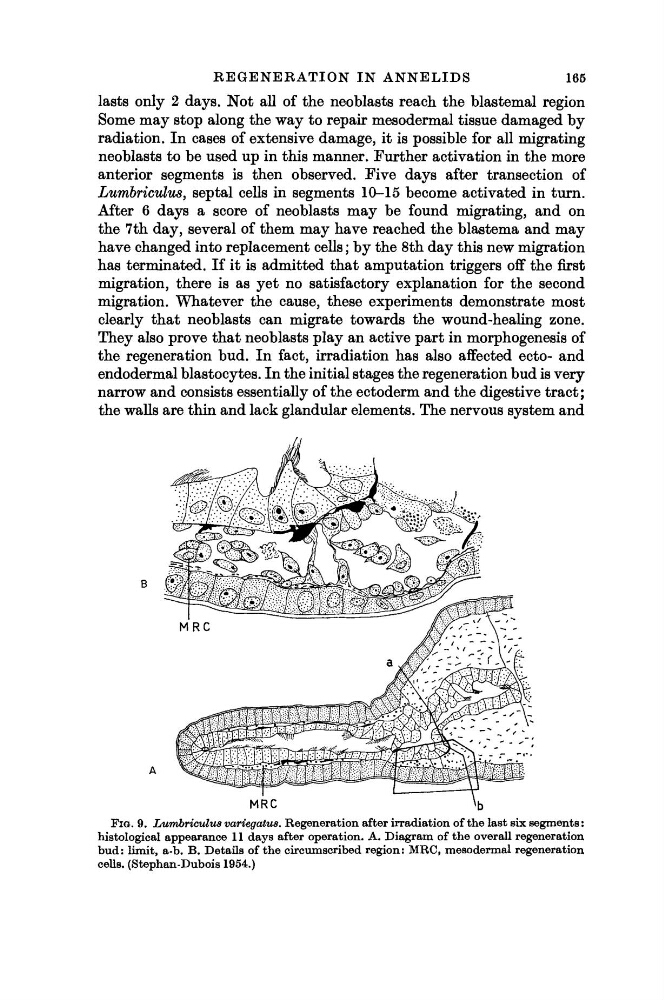
FIG. 9. Lumbriculvs variegatus. Regeneration after irradiation of the last six segments :
histological appearance 11 days after operation. A. Diagram of the overall regeneration
bud: limit, a-b. B. Details of the circumscribed region: MRC, mesodermal regeneration
cells. (Stephan-Dubois 1954.)
165
lasts only 2 days. Not all of the neoblasts reach the blastemal region
Some may stop along the way to repair mesodermal tissue damaged by
radiation. In cases of extensive damage, it is possible for all migrating
neoblasts to be used up in this manner. Further activation in the more
anterior segments is then observed. Five days after transection of
Lumbriculus, septal cells in segments 10-15 become activated in turn.
After 6 days a score of neoblasts may be found migrating, and on
the 7th day, several of them may have reached the blastema and may
have changed into replacement cells ; by the 8th day this new migration
has terminated. If it is admitted that amputation triggers off the first
migration, there is as yet no satisfactory explanation for the second
migration. Whatever the cause, these experiments demonstrate most
clearly that neoblasts can migrate towards the wound-healing zone.
They also prove that neoblasts play an active part in morphogenesis of
the regeneration bud. In fact, irradiation has also affected ecto- and
endodermal blastocytes. In the initial stages the regeneration bud is very
narrow and consists essentially of the ectoderm and the digestive tract;
the walls are thin and lack glandular elements. The nervous system and
FIG. 9. Lumbriculvs variegatus. Regeneration after irradiation of the last six segments :
histological appearance 11 days after operation. A. Diagram of the overall regeneration
bud: limit, a-b. B. Details of the circumscribed region: MRC, mesodermal regeneration
cells. (Stephan-Dubois 1954.)