

BEGENERATION IN ANNELIDS
157
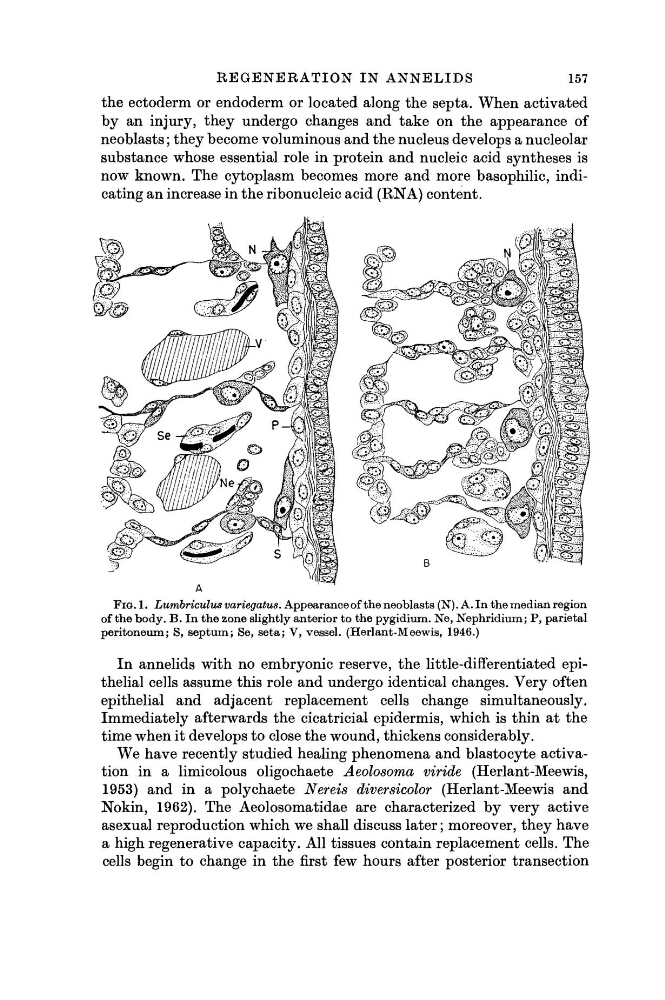
the ectoderm or endoderm or located along the septa. When activated
by an injury, they undergo changes and take on the appearance of
neoblasts ; they become voluminous and the nucleus develops a nucleolar
substance whose essential role in protein and nucleic acid syntheses is
now known. The cytoplasm becomes more and more basophilic, indicating an increase in the ribonucleic acid (RNA) content.
FIG. 1. Lumbriculus variegatus. Appearance of the neoblasts (N). A. In the median region
of the body. B. In the zone slightly anterior to the pygidium. Ne, Nephridium; P, parietal
peritoneum; S, septum; Se, seta; V, vessel. (Herlant-Meewis, 1946.)
In annelids with no embryonic reserve, the little-differentiated epithelial cells assume this role and undergo identical changes. Very often
epithelial and adjacent replacement cells change simultaneously.
Immediately afterwards the cicatricial epidermis, which is thin at the
time when it develops to close the wound, thickens considerably.
We have recently studied healing phenomena and blastocyte activation in a limicolous oligochaete Aeolosoma viride (Herlant-Meewis,
1953) and in a polychaete Nereis diversicolor (Herlant-Meewis and
Nokin, 1962). The Aeolosomatidae are characterized by very active
asexual reproduction which we shall discuss later ; moreover, they have
a high regenerative capacity. All tissues contain replacement cells. The
cells begin to change in the first few hours after posterior transection
157
the ectoderm or endoderm or located along the septa. When activated
by an injury, they undergo changes and take on the appearance of
neoblasts ; they become voluminous and the nucleus develops a nucleolar
substance whose essential role in protein and nucleic acid syntheses is
now known. The cytoplasm becomes more and more basophilic, indicating an increase in the ribonucleic acid (RNA) content.
FIG. 1. Lumbriculus variegatus. Appearance of the neoblasts (N). A. In the median region
of the body. B. In the zone slightly anterior to the pygidium. Ne, Nephridium; P, parietal
peritoneum; S, septum; Se, seta; V, vessel. (Herlant-Meewis, 1946.)
In annelids with no embryonic reserve, the little-differentiated epithelial cells assume this role and undergo identical changes. Very often
epithelial and adjacent replacement cells change simultaneously.
Immediately afterwards the cicatricial epidermis, which is thin at the
time when it develops to close the wound, thickens considerably.
We have recently studied healing phenomena and blastocyte activation in a limicolous oligochaete Aeolosoma viride (Herlant-Meewis,
1953) and in a polychaete Nereis diversicolor (Herlant-Meewis and
Nokin, 1962). The Aeolosomatidae are characterized by very active
asexual reproduction which we shall discuss later ; moreover, they have
a high regenerative capacity. All tissues contain replacement cells. The
cells begin to change in the first few hours after posterior transection