

B E G E N E R A T I O N I N L O W E R P L A N T S
115
As in the investigations on the problem of apical dominance in higher
plants, attempts were made in lower plants to replace the effect of the
apical meristem in correlative inhibition by means of indoleacetic acid
(IAA). MacQuarrie and von Maltzahn (1959) carried out experiments
with gametophores of Splachnum ampullaceum. Small blocks of 2% agar
containing various concentrations of IAA were placed on the tips of
decapitated gametophores of Splachnum ampullaceum immediately
following decapitation. The blocks were replaced twice per day over a
4-day period after which the amount of reactivation was examined.
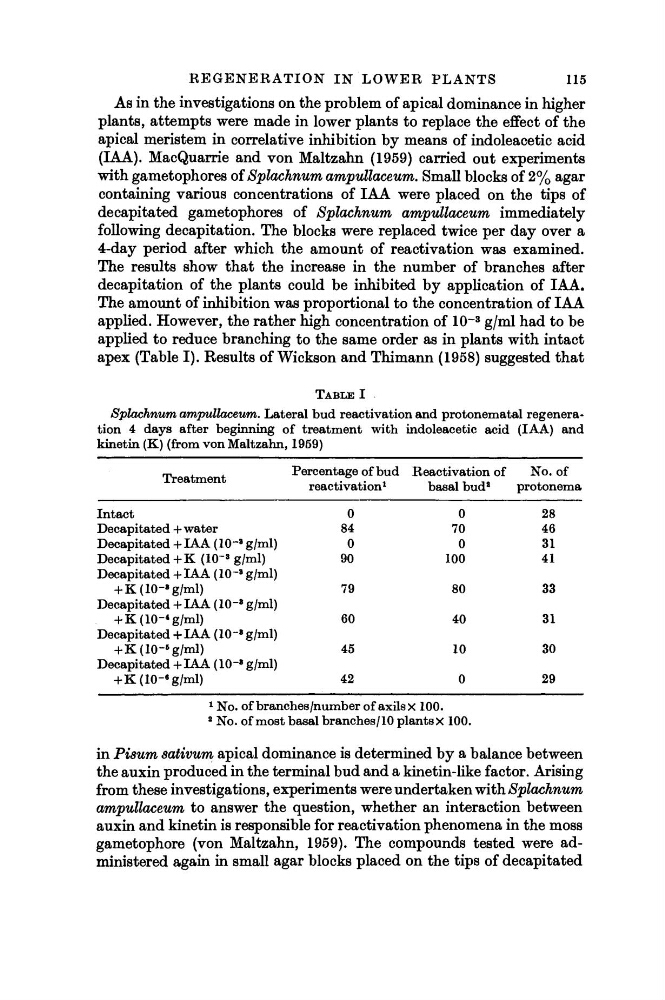
The results show that the increase in the number of branches after
decapitation of the plants could be inhibited by application of IAA.
The amount of inhibition was proportional to the concentration of IAA
applied. However, the rather high concentration of 103
g/ml had to be
applied to reduce branching to the same order as in plants with intact
apex (Table I). Results of Wickson and Thimann (1958) suggested that
TABLE I
Splachnum ampullaceum. Lateral bud reactivation and protonematal regeneration 4 days after beginning of treatment with indoleacetic acid (IAA) and
kinetin (K) (from von Maltzahn, 1959)
T
,
Percentage of bud Reactivation of
No. of
reactivation
1
basal bud
a
protonema
Intact
Decapitated + water
Decapitated +IAA (10~
8 g/ml)
Decapitated+K (10~
8 g/ml)
Decapitated +IAA (10~
8 g/ml)
+K(108 g/ml)
Decapitated + IAA (10~
8 g/ml)
+ K (10-* g/ml)
Decapitated +IAA (10"
8 g/ml)
+ K (10-* g/ml)
Decapitated +IAA (10~
8 g/ml)
+K(10e g/ml)
0
84
0
90
79
60
45
42
0
70
0
100
80
40
10
0
28
46
31
41
33
31
30
29
1 No. of branches/number of axils X 100.
2 No. of most basal branches/10 plants X 100.
in Pisum sativum apical dominance is determined by a balance between
the auxin produced in the terminal bud and a kinetin-like factor. Arising
from these investigations, experiments were undertaken with Splachnum
ampullaceum to answer the question, whether an interaction between
auxin and kinetin is responsible for reactivation phenomena in the moss
gametophore (von Maltzahn, 1959). The compounds tested were administered again in small agar blocks placed on the tips of decapitated
115
As in the investigations on the problem of apical dominance in higher
plants, attempts were made in lower plants to replace the effect of the
apical meristem in correlative inhibition by means of indoleacetic acid
(IAA). MacQuarrie and von Maltzahn (1959) carried out experiments
with gametophores of Splachnum ampullaceum. Small blocks of 2% agar
containing various concentrations of IAA were placed on the tips of
decapitated gametophores of Splachnum ampullaceum immediately
following decapitation. The blocks were replaced twice per day over a
4-day period after which the amount of reactivation was examined.
The results show that the increase in the number of branches after
decapitation of the plants could be inhibited by application of IAA.
The amount of inhibition was proportional to the concentration of IAA
applied. However, the rather high concentration of 103
g/ml had to be
applied to reduce branching to the same order as in plants with intact
apex (Table I). Results of Wickson and Thimann (1958) suggested that
TABLE I
Splachnum ampullaceum. Lateral bud reactivation and protonematal regeneration 4 days after beginning of treatment with indoleacetic acid (IAA) and
kinetin (K) (from von Maltzahn, 1959)
T
,
Percentage of bud Reactivation of
No. of
reactivation
1
basal bud
a
protonema
Intact
Decapitated + water
Decapitated +IAA (10~
8 g/ml)
Decapitated+K (10~
8 g/ml)
Decapitated +IAA (10~
8 g/ml)
+K(108 g/ml)
Decapitated + IAA (10~
8 g/ml)
+ K (10-* g/ml)
Decapitated +IAA (10"
8 g/ml)
+ K (10-* g/ml)
Decapitated +IAA (10~
8 g/ml)
+K(10e g/ml)
0
84
0
90
79
60
45
42
0
70
0
100
80
40
10
0
28
46
31
41
33
31
30
29
1 No. of branches/number of axils X 100.
2 No. of most basal branches/10 plants X 100.
in Pisum sativum apical dominance is determined by a balance between
the auxin produced in the terminal bud and a kinetin-like factor. Arising
from these investigations, experiments were undertaken with Splachnum
ampullaceum to answer the question, whether an interaction between
auxin and kinetin is responsible for reactivation phenomena in the moss
gametophore (von Maltzahn, 1959). The compounds tested were administered again in small agar blocks placed on the tips of decapitated