

98
A L F R E D J . C O U L O M B R E
Sup.
Sup.
Post
Ant.
Ant,
Post.
Right eye
L e f t e y
e
A
Position of the choroid fissure
Axes of the crossed polarizer
and analyzer
.
!
iSup.
Ant.
Ant.
Post.
Left | eye
.
Body
mid-plane
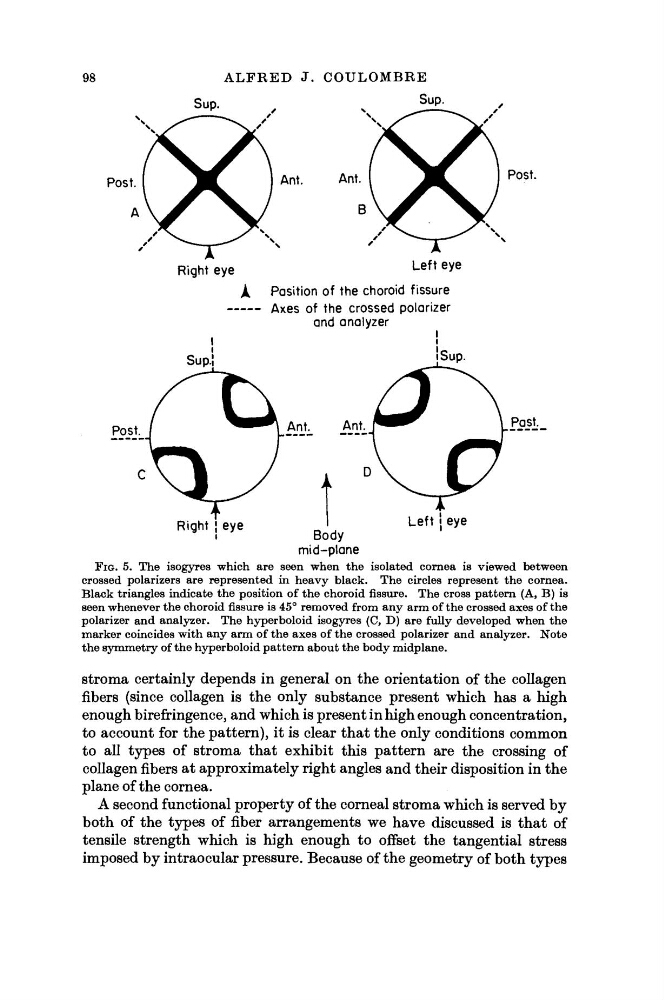
FIG. 5. The isogyres which are seen when the isolated cornea is viewed between
crossed polarizers are represented in heavy black. The circles represent the cornea.
Black triangles indicate the position of the choroid fissure. The cross pattern (A, B) is
seen whenever the choroid fissure is 45° removed from any arm of the crossed axes of the
polarizer and analyzer. The hyperboloid isogyres (C, D) are fully developed when the
marker coincides with any arm of the axes of the crossed polarizer and analyzer. Note
the symmetry of the hyperboloid pattern about the body midplane.
stroma certainly depends in general on the orientation of the collagen
fibers (since collagen is the only substance present which has a high
enough birefringence, and which is present in high enough concentration,
to account for the pattern), it is clear that the only conditions common
to all types of stroma that exhibit this pattern are the crossing of
collagen fibers at approximately right angles and their disposition in the
plane of the cornea.
A second functional property of the corneal stroma which is served by
both of the types of fiber arrangements we have discussed is that of
tensile strength which is high enough to offset the tangential stress
imposed by intraocular pressure. Because of the geometry of both types
A L F R E D J . C O U L O M B R E
Sup.
Sup.
Post
Ant.
Ant,
Post.
Right eye
L e f t e y
e
A
Position of the choroid fissure
Axes of the crossed polarizer
and analyzer
.
!
iSup.
Ant.
Ant.
Post.
Left | eye
.
Body
mid-plane
FIG. 5. The isogyres which are seen when the isolated cornea is viewed between
crossed polarizers are represented in heavy black. The circles represent the cornea.
Black triangles indicate the position of the choroid fissure. The cross pattern (A, B) is
seen whenever the choroid fissure is 45° removed from any arm of the crossed axes of the
polarizer and analyzer. The hyperboloid isogyres (C, D) are fully developed when the
marker coincides with any arm of the axes of the crossed polarizer and analyzer. Note
the symmetry of the hyperboloid pattern about the body midplane.
stroma certainly depends in general on the orientation of the collagen
fibers (since collagen is the only substance present which has a high
enough birefringence, and which is present in high enough concentration,
to account for the pattern), it is clear that the only conditions common
to all types of stroma that exhibit this pattern are the crossing of
collagen fibers at approximately right angles and their disposition in the
plane of the cornea.
A second functional property of the corneal stroma which is served by
both of the types of fiber arrangements we have discussed is that of
tensile strength which is high enough to offset the tangential stress
imposed by intraocular pressure. Because of the geometry of both types