

96
ENRICO URBAN!
the activity of acid and alkaline phosphatases does not differ from that
observed in the species already described.
During this period of development total nitrogen decreases slightly
(Fig. 19) but total lipid and total carbohydrates decrease much more
rapidly, although at different rates (Urbani and Bellini, 1959).
Our views on the embryonic development of amphibians and
Artemia salina apply also to these results.
C. Musca domestic^ L
Several studies were conducted in our laboratory by Russo-Caia
and associates on the larval growth and metamorphosis of Musca
domestica L. We will confine ourselves to the data which relate directly
to the problems at hand (Cecere, 1960; Ciavattini et ah, 1959; Rimatori
and Ciavattini, 1960; Russo-Caia, 1960a, b, c; Russo-Caia and Cecere,
1960a).
The metamorphosis of amphibians and insects, through the destruction of larval structures, leads to the formation of organisms with
entirely different features. Histolysis and histogenesis take place
simultaneously in both classes. (Agrell, 1947, 1949, 1953; Needham,
D. M., 1929; Needham, J., 1931, 1942; Wigglesworth, 1950, 1954, 1957)
and the individual behaves like a 'closed box', utilizing pre-existing
materials only.
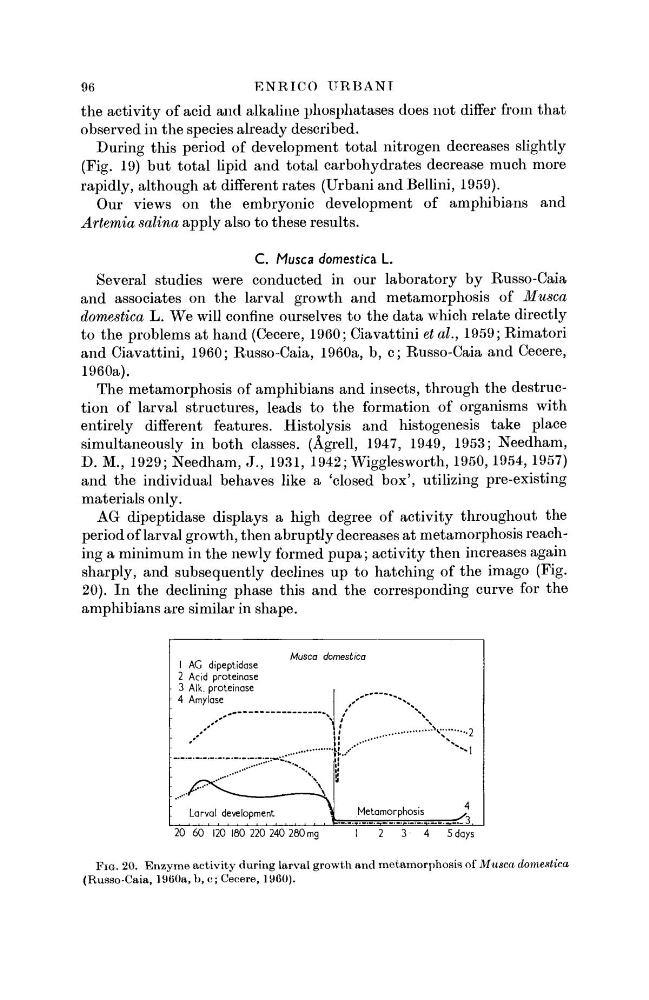
AG dipeptidase displays a high degree of activity throughout the
period of larval growth, then abruptly decreases at metamorphosis reaching a minimum in the newly formed pupa; activity then increases again
sharply, and subsequently declines up to hatching of the imago (Fig.
20). In the declining phase this and the corresponding curve for the
amphibians are similar in shape.
1 AC dipeptidase
2 Acid proteinase
3 Alk. proteinase
4 Amylase
Musca domestica
Larval development
Metamorphosis
.^
20 60 120 180 220 240 280 mg
5 days
FIG. 20. Enzyme activity during larval growth and metamorphosis of Musca domestica
(Russo-Caia, 1960a, b, c; Cecere, 1960).
ENRICO URBAN!
the activity of acid and alkaline phosphatases does not differ from that
observed in the species already described.
During this period of development total nitrogen decreases slightly
(Fig. 19) but total lipid and total carbohydrates decrease much more
rapidly, although at different rates (Urbani and Bellini, 1959).
Our views on the embryonic development of amphibians and
Artemia salina apply also to these results.
C. Musca domestic^ L
Several studies were conducted in our laboratory by Russo-Caia
and associates on the larval growth and metamorphosis of Musca
domestica L. We will confine ourselves to the data which relate directly
to the problems at hand (Cecere, 1960; Ciavattini et ah, 1959; Rimatori
and Ciavattini, 1960; Russo-Caia, 1960a, b, c; Russo-Caia and Cecere,
1960a).
The metamorphosis of amphibians and insects, through the destruction of larval structures, leads to the formation of organisms with
entirely different features. Histolysis and histogenesis take place
simultaneously in both classes. (Agrell, 1947, 1949, 1953; Needham,
D. M., 1929; Needham, J., 1931, 1942; Wigglesworth, 1950, 1954, 1957)
and the individual behaves like a 'closed box', utilizing pre-existing
materials only.
AG dipeptidase displays a high degree of activity throughout the
period of larval growth, then abruptly decreases at metamorphosis reaching a minimum in the newly formed pupa; activity then increases again
sharply, and subsequently declines up to hatching of the imago (Fig.
20). In the declining phase this and the corresponding curve for the
amphibians are similar in shape.
1 AC dipeptidase
2 Acid proteinase
3 Alk. proteinase
4 Amylase
Musca domestica
Larval development
Metamorphosis
.^
20 60 120 180 220 240 280 mg
5 days
FIG. 20. Enzyme activity during larval growth and metamorphosis of Musca domestica
(Russo-Caia, 1960a, b, c; Cecere, 1960).