

88
E N R I C O U R B A N I
entirely ammoniotelic. With the technique used, there is no possibility
of contamination from the outside or loss of ammonia from the culture
water (Gerking, 1955; Morgulis, 1918). These results show that there is a
reduction in nitrogen content, unquestionably due to protein combustion, in the early stages of development. This is in agreement with
Munro (1939, 1953), who states that the larvae of several amphibians
are ammoniotelic.
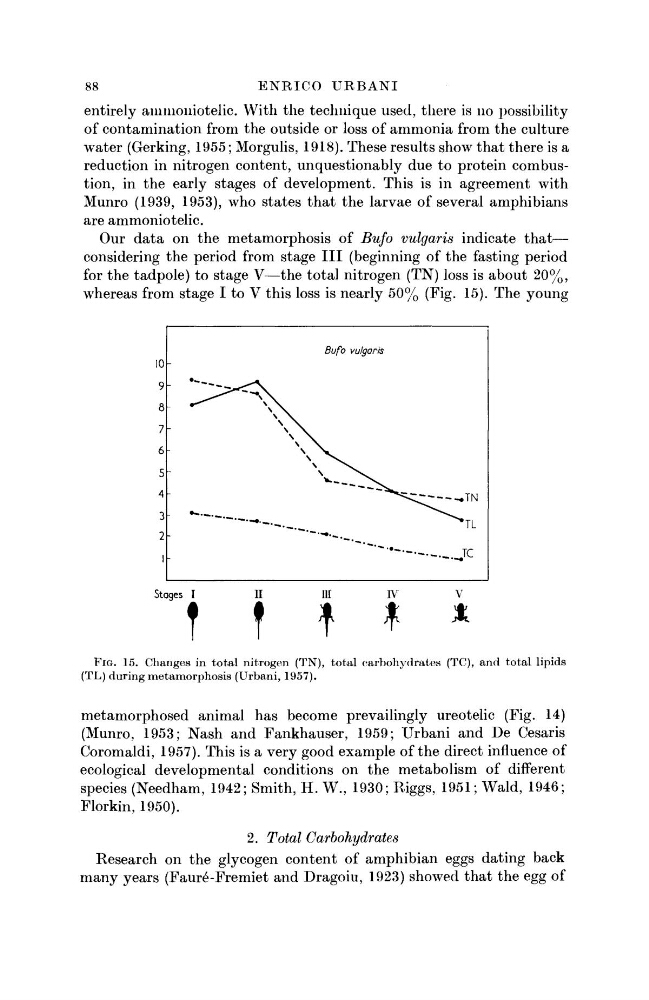
Our data on the metamorphosis of Bufo vulgaris indicate that—
considering the period from stage I I I (beginning of the fasting period
for the tadpole) to stage V—the total nitrogen (TN) loss is about 20%,
whereas from stage I to V this loss is nearly 50% (Fig. 15). The young
10
9
8
7
6
5
4
3
2
I
Stages I
Π
III
IV
V
T
W
>T>
m
Λ
FIG. 15. Changes in total nitrogen (TN), total carbohydrates (TC), and total lipids
(TL) during metamorphosis (Urbani, 1957).
metamorphosed animal has become prevailingly ureotelic (Fig. 14)
(Munro, 1953; Nash and Fankhauser, 1959; Urbani and De Cesaris
Coromaldi, 1957). This is a very good example of the direct influence of
ecological developmental conditions on the metabolism of different
species (Needham, 1942; Smith, H. W., 1930; Riggs, 1951; Wald, 1946;
Florkin, 1950).
2. Total Carbohydrates
Research on the glycogen content of amphibian eggs dating back
many years (Faure-Fremiet and Dragoiu, 1923) showed that the egg of
E N R I C O U R B A N I
entirely ammoniotelic. With the technique used, there is no possibility
of contamination from the outside or loss of ammonia from the culture
water (Gerking, 1955; Morgulis, 1918). These results show that there is a
reduction in nitrogen content, unquestionably due to protein combustion, in the early stages of development. This is in agreement with
Munro (1939, 1953), who states that the larvae of several amphibians
are ammoniotelic.
Our data on the metamorphosis of Bufo vulgaris indicate that—
considering the period from stage I I I (beginning of the fasting period
for the tadpole) to stage V—the total nitrogen (TN) loss is about 20%,
whereas from stage I to V this loss is nearly 50% (Fig. 15). The young
10
9
8
7
6
5
4
3
2
I
Stages I
Π
III
IV
V
T
W
>T>
m
Λ
FIG. 15. Changes in total nitrogen (TN), total carbohydrates (TC), and total lipids
(TL) during metamorphosis (Urbani, 1957).
metamorphosed animal has become prevailingly ureotelic (Fig. 14)
(Munro, 1953; Nash and Fankhauser, 1959; Urbani and De Cesaris
Coromaldi, 1957). This is a very good example of the direct influence of
ecological developmental conditions on the metabolism of different
species (Needham, 1942; Smith, H. W., 1930; Riggs, 1951; Wald, 1946;
Florkin, 1950).
2. Total Carbohydrates
Research on the glycogen content of amphibian eggs dating back
many years (Faure-Fremiet and Dragoiu, 1923) showed that the egg of