

2
V A N C E T A R T A R
morphogenetic behaviour of this animal and indicate resemblances with
other types of development.
II. Development of New Individuals in Stentor
A. The Normal Form
Form may be described as a set of specific parts integrated in certain
geometric and proportionate relations to each other. The shape of
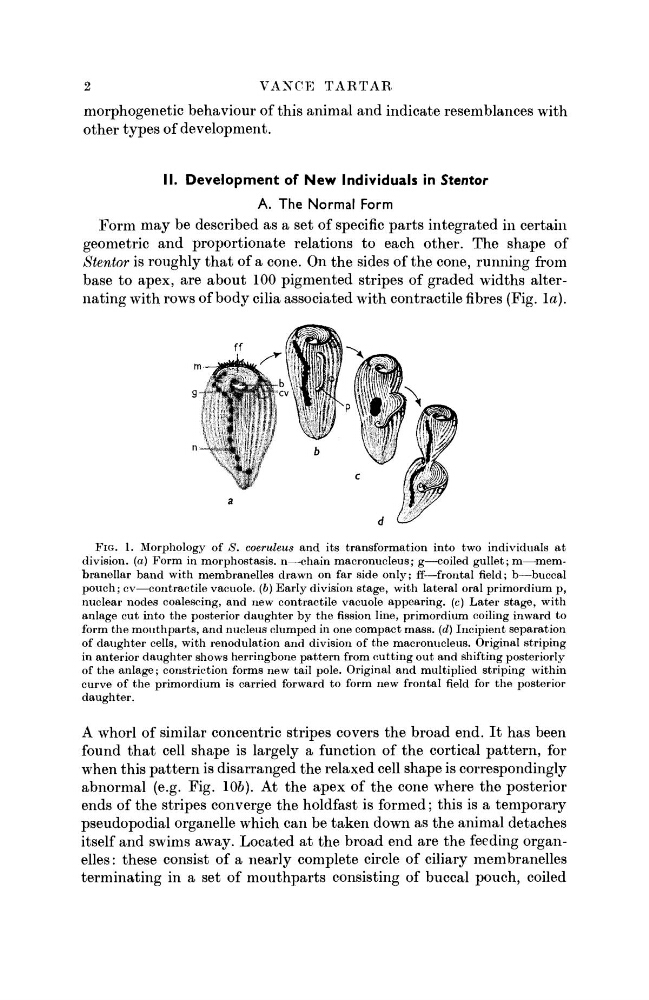
Stentor is roughly that of a cone. On the sides of the cone, running from
base to apex, are about 100 pigmented stripes of graded widths alternating with rows of body cilia associated with contractile fibres (Fig. la).
FIG. 1. Morphology of S. coeruleus and its transformation into two individuals at
division, (a) Form in morphostasis. n—chain macronucleus; g—coiled gullet; m—membranellar band with membranelles drawn on far side only; ff—frontal field; b—buccal
pouch; cv—contractile vacuole. (b) Early division stage, with lateral oral primordium p,
nuclear nodes coalescing, and new contractile vacuole appearing, (c) Later stage, with
anläge cut into the posterior daughter by the fission line, primordium coiling inward to
form the mouthparts, and nucleus clumped in one compact mass, (d) Incipient separation
of daughter cells, with renodulation and division of the macronucleus. Original striping
in anterior daughter shows herringbone pattern from cutting out and shifting posteriorly
of the anläge; constriction forms new tail pole. Original and multiplied striping within
curve of the primordium is carried forward to form new frontal field for the posterior
daughter.
A whorl of similar concentric stripes covers the broad end. It has been
found that cell shape is largely a function of the cortical pattern, for
when this pattern is disarranged the relaxed cell shape is correspondingly
abnormal (e.g. Fig. 106). At the apex of the cone where the posterior
ends of the stripes converge the holdfast is formed; this is a temporary
pseudopodial organelle which can be taken down as the animal detaches
itself and swims away. Located at the broad end are the feeding organelles: these consist of a nearly complete circle of ciliary membranelles
terminating in a set of mouthparts consisting of buccal pouch, coiled
V A N C E T A R T A R
morphogenetic behaviour of this animal and indicate resemblances with
other types of development.
II. Development of New Individuals in Stentor
A. The Normal Form
Form may be described as a set of specific parts integrated in certain
geometric and proportionate relations to each other. The shape of
Stentor is roughly that of a cone. On the sides of the cone, running from
base to apex, are about 100 pigmented stripes of graded widths alternating with rows of body cilia associated with contractile fibres (Fig. la).
FIG. 1. Morphology of S. coeruleus and its transformation into two individuals at
division, (a) Form in morphostasis. n—chain macronucleus; g—coiled gullet; m—membranellar band with membranelles drawn on far side only; ff—frontal field; b—buccal
pouch; cv—contractile vacuole. (b) Early division stage, with lateral oral primordium p,
nuclear nodes coalescing, and new contractile vacuole appearing, (c) Later stage, with
anläge cut into the posterior daughter by the fission line, primordium coiling inward to
form the mouthparts, and nucleus clumped in one compact mass, (d) Incipient separation
of daughter cells, with renodulation and division of the macronucleus. Original striping
in anterior daughter shows herringbone pattern from cutting out and shifting posteriorly
of the anläge; constriction forms new tail pole. Original and multiplied striping within
curve of the primordium is carried forward to form new frontal field for the posterior
daughter.
A whorl of similar concentric stripes covers the broad end. It has been
found that cell shape is largely a function of the cortical pattern, for
when this pattern is disarranged the relaxed cell shape is correspondingly
abnormal (e.g. Fig. 106). At the apex of the cone where the posterior
ends of the stripes converge the holdfast is formed; this is a temporary
pseudopodial organelle which can be taken down as the animal detaches
itself and swims away. Located at the broad end are the feeding organelles: these consist of a nearly complete circle of ciliary membranelles
terminating in a set of mouthparts consisting of buccal pouch, coiled