

46
J. CLAVERT
in the hen, the duck, and the goose, the egg axis is most often horizontal.
In the hen and the duck the axis of the uterine egg tilts downwards
towards the sharp end as often as it does towards the blunt end. The
egg axis of the pigeon is always tilted downwards towards the sharp
end. Those turkeys whose eggs gave embryos that followed the rule of
von Baer, had uterine eggs with horizontal axes ( ± 15°) whereas those
whose embryos were noticeably offset to the right had uterine eggs whose
major axes were noticeably tilted downwards towards the sharp end.
By comparing the statistics of the dominant orientation of embryos
and the position of the egg axis in the uterus one can deduce that
the position in space of the egg axis in the uterus fixes the position of the
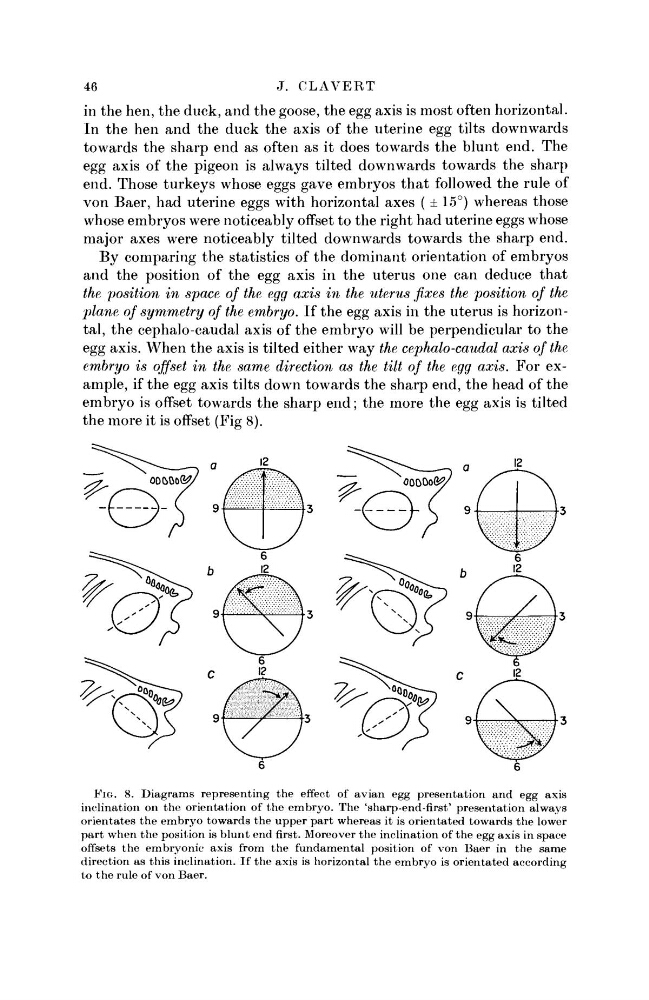
plane of symmetry of the embryo. If the egg axis in the uterus is horizontal, the cephalo-caudal axis of the embryo will be perpendicular to the
egg axis. When the axis is tilted either way the cephalo-caudal axis of the
embryo is offset in the same direction as the tilt of the egg axis. For example, if the egg axis tilts down towards the sharp end, the head of the
embryo is offset towards the sharp end; the more the egg axis is tilted
the more it is offset (Fig 8).
FIG. 8. Diagrams representing the effect of avian egg presentation and egg axis
inclination on the orientation of the embryo. The 'sharp-end-first' presentation always
orientates the embryo towards the upper part whereas it is orientated towards the lower
part when the position is blunt end first. Moreover the inclination of the egg axis in space
offsets the embryonic axis from the fundamental position of von Baer in the same
direction as this inclination. If the axis is horizontal the embryo is orientated according
to the rule of von Baer.
J. CLAVERT
in the hen, the duck, and the goose, the egg axis is most often horizontal.
In the hen and the duck the axis of the uterine egg tilts downwards
towards the sharp end as often as it does towards the blunt end. The
egg axis of the pigeon is always tilted downwards towards the sharp
end. Those turkeys whose eggs gave embryos that followed the rule of
von Baer, had uterine eggs with horizontal axes ( ± 15°) whereas those
whose embryos were noticeably offset to the right had uterine eggs whose
major axes were noticeably tilted downwards towards the sharp end.
By comparing the statistics of the dominant orientation of embryos
and the position of the egg axis in the uterus one can deduce that
the position in space of the egg axis in the uterus fixes the position of the
plane of symmetry of the embryo. If the egg axis in the uterus is horizontal, the cephalo-caudal axis of the embryo will be perpendicular to the
egg axis. When the axis is tilted either way the cephalo-caudal axis of the
embryo is offset in the same direction as the tilt of the egg axis. For example, if the egg axis tilts down towards the sharp end, the head of the
embryo is offset towards the sharp end; the more the egg axis is tilted
the more it is offset (Fig 8).
FIG. 8. Diagrams representing the effect of avian egg presentation and egg axis
inclination on the orientation of the embryo. The 'sharp-end-first' presentation always
orientates the embryo towards the upper part whereas it is orientated towards the lower
part when the position is blunt end first. Moreover the inclination of the egg axis in space
offsets the embryonic axis from the fundamental position of von Baer in the same
direction as this inclination. If the axis is horizontal the embryo is orientated according
to the rule of von Baer.