

E X P E R I M E N T S ON E M B R Y O N I C A O R T I C A R C H E S 363
scarcely visible prominence to half that of the right proximal bulbar
cushion or more. Direct observation in vivo through the transparent
bulbar wall (Fig. 13) showed that its size was constant from 4 days 20 hr
of incubation onwards. The life span of small interstitial cushions is
longer than that of large ones. A diminished blood flow through the
pulmonary portion of the bulb (produced by experimental stenosis of the
pulmonary conus by means of suppression of 6D6S, switching the main
bulk of the blood stream into the aortic stream of the heart bulb) was
without significant influence on its frequency, while an increased blood
flow through the pulmonary portion of the bulb (produced by experimental stenosis of the aortic conus after suppression of 4D3D3S4S)
decreased its frequency significantly.
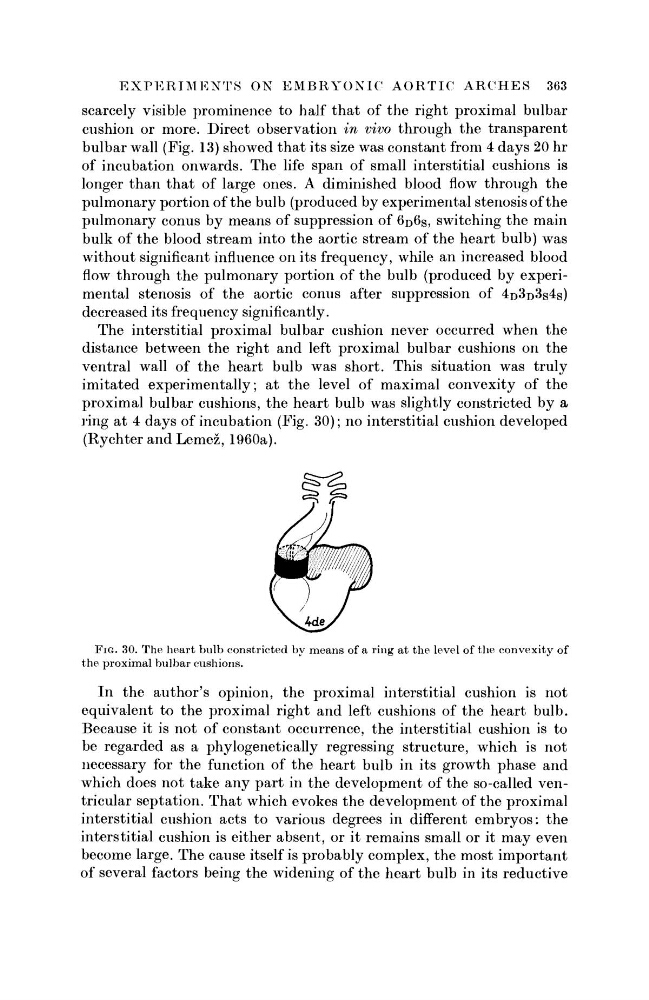
The interstitial proximal bulbar cushion never occurred when the
distance between the right and left proximal bulbar cushions on the
ventral wall of the heart bulb was short. This situation was truly
imitated experimentally; at the level of maximal convexity of the
proximal bulbar cushions, the heart bulb was slightly constricted by a
ring at 4 days of incubation (Fig. 30); no interstitial cushion developed
(Rychter and Lemez, 1960a).
FIG. 30. The heart bulb constricted by means of a ring at the level of the convexity of
the proximal bulbar cushions.
In the author's opinion, the proximal interstitial cushion is not
equivalent to the proximal right and left cushions of the heart bulb.
Because it is not of constant occurrence, the interstitial cushion is to
be regarded as a phylogenetically regressing structure, which is not
necessary for the function of the heart bulb in its growth phase and
which does not take any part in the development of the so-called ventricular septation. That which evokes the development of the proximal
interstitial cushion acts to various degrees in different embryos: the
interstitial cushion is either absent, or it remains small or it may even
become large. The cause itself is probably complex, the most important
of several factors being the widening of the heart bulb in its reductive
scarcely visible prominence to half that of the right proximal bulbar
cushion or more. Direct observation in vivo through the transparent
bulbar wall (Fig. 13) showed that its size was constant from 4 days 20 hr
of incubation onwards. The life span of small interstitial cushions is
longer than that of large ones. A diminished blood flow through the
pulmonary portion of the bulb (produced by experimental stenosis of the
pulmonary conus by means of suppression of 6D6S, switching the main
bulk of the blood stream into the aortic stream of the heart bulb) was
without significant influence on its frequency, while an increased blood
flow through the pulmonary portion of the bulb (produced by experimental stenosis of the aortic conus after suppression of 4D3D3S4S)
decreased its frequency significantly.
The interstitial proximal bulbar cushion never occurred when the
distance between the right and left proximal bulbar cushions on the
ventral wall of the heart bulb was short. This situation was truly
imitated experimentally; at the level of maximal convexity of the
proximal bulbar cushions, the heart bulb was slightly constricted by a
ring at 4 days of incubation (Fig. 30); no interstitial cushion developed
(Rychter and Lemez, 1960a).
FIG. 30. The heart bulb constricted by means of a ring at the level of the convexity of
the proximal bulbar cushions.
In the author's opinion, the proximal interstitial cushion is not
equivalent to the proximal right and left cushions of the heart bulb.
Because it is not of constant occurrence, the interstitial cushion is to
be regarded as a phylogenetically regressing structure, which is not
necessary for the function of the heart bulb in its growth phase and
which does not take any part in the development of the so-called ventricular septation. That which evokes the development of the proximal
interstitial cushion acts to various degrees in different embryos: the
interstitial cushion is either absent, or it remains small or it may even
become large. The cause itself is probably complex, the most important
of several factors being the widening of the heart bulb in its reductive