

SYMMETRIZATION OF THE EGG OF VERTEBRATES 31
made at various places distributed over the whole surface of the egg
demonstrates that the rotation of fertilization is essentially a movement
of the egg cortex on the underlying layers, with some concentration
towards a particular meridian which marks the plane of bilateral
symmetry. The peripheral layer which moves during this rotation
thickens as it approaches the superior pole and this particular meridian.
The amplitude of the movement decreases from the meridian marking
the plane of symmetry to the meridian lying at 90° to this, where there
is none. Before rotation of fertilization, the pigmentary layer terminates
at the level of the vitelline field and has the same thickness throughout.
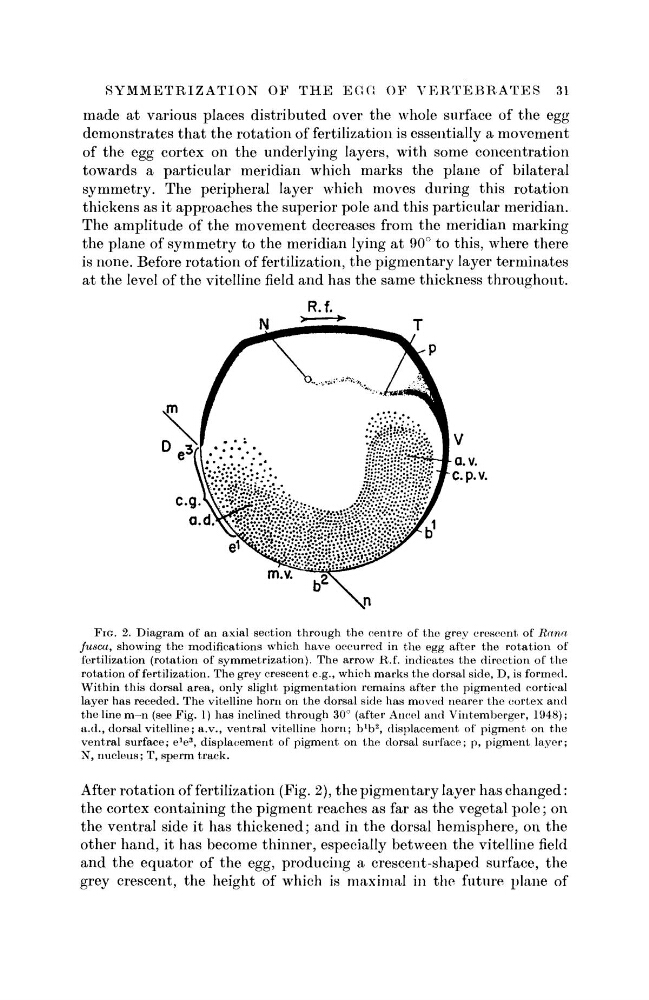
FIG. 2. Diagram of an axial section through the centre of the grey crescent of Rana
fusca, showing the modifications which have occurred in the egg after the rotation of
fertilization (rotation of symmetrization). The arrow R.f. indicates the direction of the
rotation of fertilization. The grey crescent e.g., which marks the dorsal side, D, is formed.
Within this dorsal area, only slight pigmentation remains after the pigmented cortical
layer has receded. The vitelline horn on the dorsal side has moved nearer the cortex and
the line m - n (see Fig. 1) has inclined through 30° (after Ancel and Vintemberger, 1948);
a.d., dorsal vitelline; a.v., ventral vitelline horn; b
1 !)
2 , displacement of pigment on the
ventral surface; e
x e
3 , displacement of pigment on the dorsal surface; p, pigment layer;
N, nucleus; T, sperm track.
After rotation of fertilization (Fig. 2), the pigmentary layer has changed:
the cortex containing the pigment reaches as far as the vegetal pole; on
the ventral side it has thickened; and in the dorsal hemisphere, on the
other hand, it has become thinner, especially between the vitelline field
and the equator of the egg, producing a crescent-shaped surface, the
grey crescent, the height of which is maximal in the future plane of
made at various places distributed over the whole surface of the egg
demonstrates that the rotation of fertilization is essentially a movement
of the egg cortex on the underlying layers, with some concentration
towards a particular meridian which marks the plane of bilateral
symmetry. The peripheral layer which moves during this rotation
thickens as it approaches the superior pole and this particular meridian.
The amplitude of the movement decreases from the meridian marking
the plane of symmetry to the meridian lying at 90° to this, where there
is none. Before rotation of fertilization, the pigmentary layer terminates
at the level of the vitelline field and has the same thickness throughout.
FIG. 2. Diagram of an axial section through the centre of the grey crescent of Rana
fusca, showing the modifications which have occurred in the egg after the rotation of
fertilization (rotation of symmetrization). The arrow R.f. indicates the direction of the
rotation of fertilization. The grey crescent e.g., which marks the dorsal side, D, is formed.
Within this dorsal area, only slight pigmentation remains after the pigmented cortical
layer has receded. The vitelline horn on the dorsal side has moved nearer the cortex and
the line m - n (see Fig. 1) has inclined through 30° (after Ancel and Vintemberger, 1948);
a.d., dorsal vitelline; a.v., ventral vitelline horn; b
1 !)
2 , displacement of pigment on the
ventral surface; e
x e
3 , displacement of pigment on the dorsal surface; p, pigment layer;
N, nucleus; T, sperm track.
After rotation of fertilization (Fig. 2), the pigmentary layer has changed:
the cortex containing the pigment reaches as far as the vegetal pole; on
the ventral side it has thickened; and in the dorsal hemisphere, on the
other hand, it has become thinner, especially between the vitelline field
and the equator of the egg, producing a crescent-shaped surface, the
grey crescent, the height of which is maximal in the future plane of