

MORPHOGENESIS OF FRESH-WATER PLANARIA
325
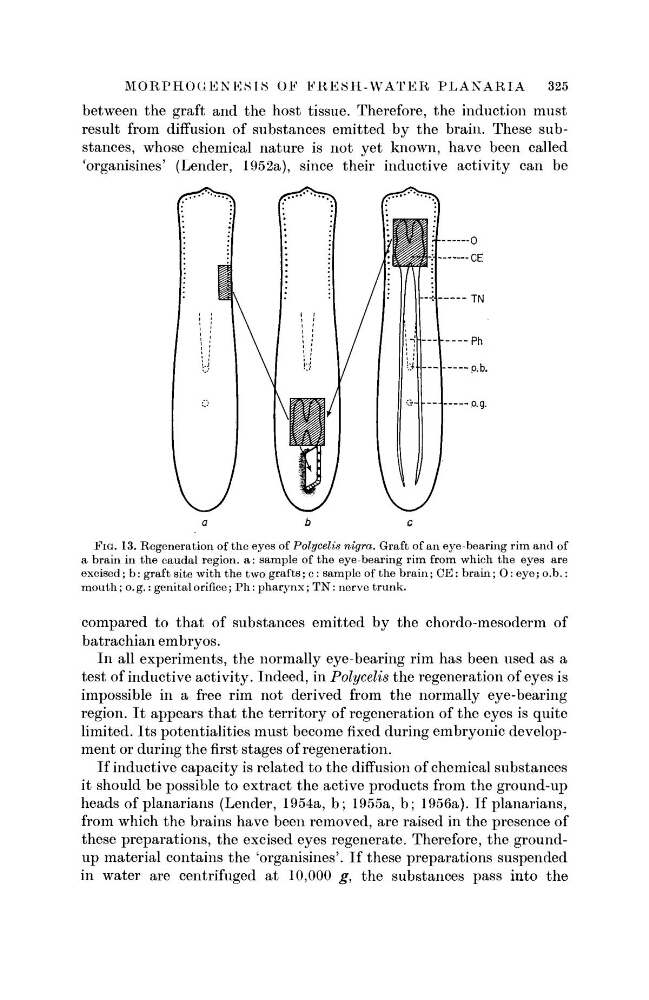
between the graft and the host tissue. Therefore, the induction must
result from diffusion of substances emitted by the brain. These substances, whose chemical nature is not yet known, have been called
Organisines' (Lender, 1952a), since their inductive activity can be
FIG. 13. Regeneration of the eyes of Polycelis nigra. Graft of an eye-bearing rim and of
a brain in the caudal region, a: sample of the eye-bearing rim from which the eyes are
excised; b : graft site with the two grafts; c: sample of the brain; CE: brain; O: eye; o.b.:
mouth; o. g.: genital orifice; P h : pharynx; TN: nerve trunk.
compared to that of substances emitted by the chordo-mesoderm of
batrachian embryos.
In all experiments, the normally eye-bearing rim has been used as a
test of inductive activity. Indeed, in Polycelis the regeneration of eyes is
impossible in a free rim not derived from the normally eye-bearing
region. It appears that the territory of regeneration of the eyes is quite
limited. Its potentialities must become fixed during embryonic development or during the first stages of regeneration.
If inductive capacity is related to the diffusion of chemical substances
it should be possible to extract the active products from the ground-up
heads of planarians (Lender, 1954a, b ; 1955a, b ; 1956a). If planarians,
from which the brains have been removed, are raised in the presence of
these preparations, the excised eyes regenerate. Therefore, the groundup material contains the 'organisines'. If these preparations suspended
in water are centrifuged at 10,000 g, the substances pass into the
325
between the graft and the host tissue. Therefore, the induction must
result from diffusion of substances emitted by the brain. These substances, whose chemical nature is not yet known, have been called
Organisines' (Lender, 1952a), since their inductive activity can be
FIG. 13. Regeneration of the eyes of Polycelis nigra. Graft of an eye-bearing rim and of
a brain in the caudal region, a: sample of the eye-bearing rim from which the eyes are
excised; b : graft site with the two grafts; c: sample of the brain; CE: brain; O: eye; o.b.:
mouth; o. g.: genital orifice; P h : pharynx; TN: nerve trunk.
compared to that of substances emitted by the chordo-mesoderm of
batrachian embryos.
In all experiments, the normally eye-bearing rim has been used as a
test of inductive activity. Indeed, in Polycelis the regeneration of eyes is
impossible in a free rim not derived from the normally eye-bearing
region. It appears that the territory of regeneration of the eyes is quite
limited. Its potentialities must become fixed during embryonic development or during the first stages of regeneration.
If inductive capacity is related to the diffusion of chemical substances
it should be possible to extract the active products from the ground-up
heads of planarians (Lender, 1954a, b ; 1955a, b ; 1956a). If planarians,
from which the brains have been removed, are raised in the presence of
these preparations, the excised eyes regenerate. Therefore, the groundup material contains the 'organisines'. If these preparations suspended
in water are centrifuged at 10,000 g, the substances pass into the