

MORPHOGENESIS OF FRESH-WATER PLANARIA
321
brain in the anterior region of a decapitated Dugesia lugubris. The graft
was able to take the place of the head. After regeneration, the planarian
possessed only one brain. In other cases, the host builds up a regeneration blastema which takes on the appearance of a head, but the brain
does not differentiate or remains very small. Therefore, the presence of a
brain during regeneration inhibits more or less completely the differentiation of another cerebral mass, even though the neoblasts, the material
necessary for regeneration, are present.
Once this fact is established, it becomes possible to study the
mechanism of this inhibition.
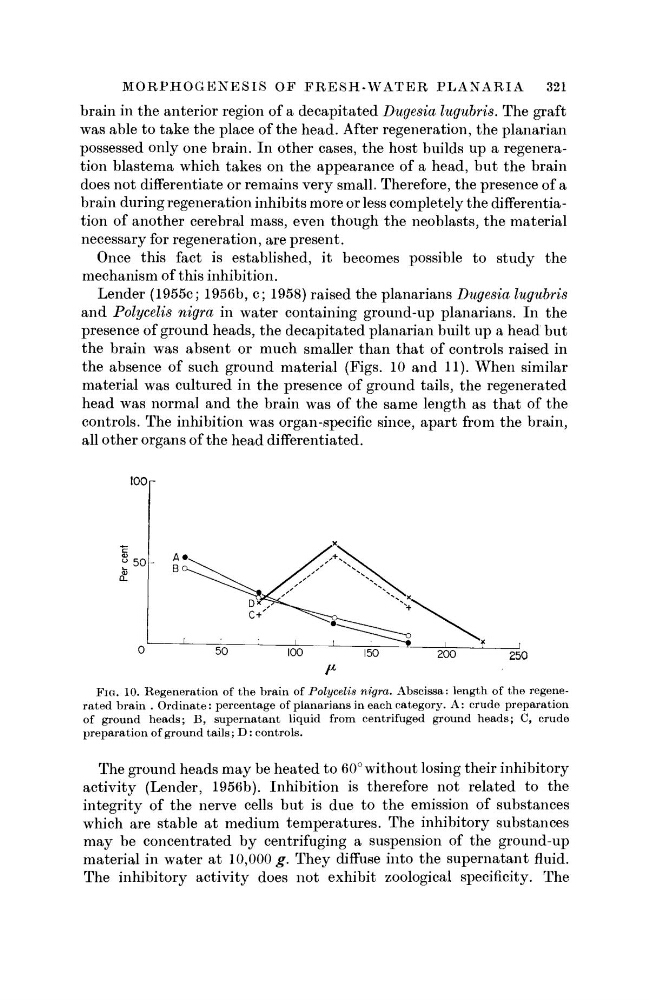
Lender (1955c; 1956b, c; 1958) raised the planarians Dugesia lugubris
and Polycelis nigra in water containing ground-up planarians. In the
presence of ground heads, the decapitated planarian built up a head but
the brain was absent or much smaller than that of controls raised in
the absence of such ground material (Figs. 10 and 11). When similar
material was cultured in the presence of ground tails, the regenerated
head was normal and the brain was of the same length as that of the
controls. The inhibition was organ-specific since, apart from the brain,
all other organs of the head differentiated.
200
250
FIG. 10. Regeneration of the brain of Polycelis nigra. Abscissa: length of the regenerated brain . Ordinate: percentage of planarians in each category. A: crude preparation
of ground heads; B, supernatant liquid from centrifuged ground heads; C, crude
preparation of ground tails; D : controls.
The ground heads may be heated to 60° without losing their inhibitory
activity (Lender, 1956b). Inhibition is therefore not related to the
integrity of the nerve cells but is due to the emission of substances
which are stable at medium temperatures. The inhibitory substances
may be concentrated by centrifuging a suspension of the ground-up
material in water at 10,000 £. They diffuse into the supernatant fluid.
The inhibitory activity does not exhibit zoological specificity. The
321
brain in the anterior region of a decapitated Dugesia lugubris. The graft
was able to take the place of the head. After regeneration, the planarian
possessed only one brain. In other cases, the host builds up a regeneration blastema which takes on the appearance of a head, but the brain
does not differentiate or remains very small. Therefore, the presence of a
brain during regeneration inhibits more or less completely the differentiation of another cerebral mass, even though the neoblasts, the material
necessary for regeneration, are present.
Once this fact is established, it becomes possible to study the
mechanism of this inhibition.
Lender (1955c; 1956b, c; 1958) raised the planarians Dugesia lugubris
and Polycelis nigra in water containing ground-up planarians. In the
presence of ground heads, the decapitated planarian built up a head but
the brain was absent or much smaller than that of controls raised in
the absence of such ground material (Figs. 10 and 11). When similar
material was cultured in the presence of ground tails, the regenerated
head was normal and the brain was of the same length as that of the
controls. The inhibition was organ-specific since, apart from the brain,
all other organs of the head differentiated.
200
250
FIG. 10. Regeneration of the brain of Polycelis nigra. Abscissa: length of the regenerated brain . Ordinate: percentage of planarians in each category. A: crude preparation
of ground heads; B, supernatant liquid from centrifuged ground heads; C, crude
preparation of ground tails; D : controls.
The ground heads may be heated to 60° without losing their inhibitory
activity (Lender, 1956b). Inhibition is therefore not related to the
integrity of the nerve cells but is due to the emission of substances
which are stable at medium temperatures. The inhibitory substances
may be concentrated by centrifuging a suspension of the ground-up
material in water at 10,000 £. They diffuse into the supernatant fluid.
The inhibitory activity does not exhibit zoological specificity. The