

S Y M M E T R I Z A T I O N OF T H E EGG OF V E R T E B R A T E S 29
is the infundibulum of maturation marking the animal pole of the egg.
The inferior pole, in the centre of the vitelline field, is marked by an
inferior polar spot. The: pigmented layer, specific to the upper zone,
ends subequatorially at the same level all round. This limit varies in
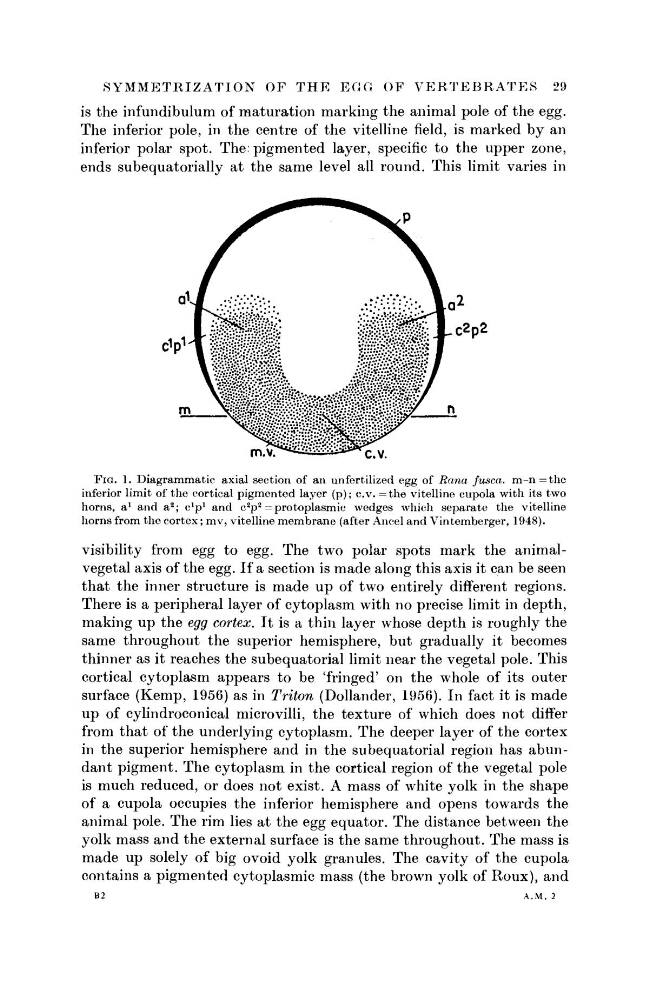
FIG. 1. Diagrammatic axial section of an unfertilized egg of Rana fusca. m - n = t h e
inferior limit of the cortical pigmented layer (p); c.v. =the vitelline cupola with its two
horns, a
1 and a
2 ; ^ p
1 and c
2 p
2 = protoplasmic wedges which separate the vitelline
horns from the cortex; mv, vitelline membrane (after Ancel and Vintemberger, 1948).
visibility from egg to egg. The two polar spots mark the animalvegetal axis of the egg. If a section is made along this axis it can be seen
that the inner structure is made up of two entirely different regions.
There is a peripheral layer of cytoplasm with no precise limit in depth,
making up the egg cortex. It is a thin layer whose depth is roughly the
same throughout the superior hemisphere, but gradually it becomes
thinner as it reaches the subequatorial limit near the vegetal pole. This
cortical cytoplasm appears to be 'fringed' on the whole of its outer
surface (Kemp, 1956) as in Triton (Dollander, 1956). In fact it is made
up of cylindroconical microvilli, the texture of which does not differ
from that of the underlying cytoplasm. The deeper layer of the cortex
in the superior hemisphere and in the subequatorial region has abundant pigment. The cytoplasm in the cortical region of the vegetal pole
is much reduced, or does not exist. A mass of white yolk in the shape
of a cupola occupies the inferior hemisphere and opens towards the
animal pole. The rim lies at the egg equator. The distance between the
yolk mass and the external surface is the same throughout. The mass is
made up solely of big ovoid yolk granules. The cavity of the cupola
contains a pigmented cytoplasmic mass (the brown yolk of Roux), and
B2
A.M. 2
is the infundibulum of maturation marking the animal pole of the egg.
The inferior pole, in the centre of the vitelline field, is marked by an
inferior polar spot. The: pigmented layer, specific to the upper zone,
ends subequatorially at the same level all round. This limit varies in
FIG. 1. Diagrammatic axial section of an unfertilized egg of Rana fusca. m - n = t h e
inferior limit of the cortical pigmented layer (p); c.v. =the vitelline cupola with its two
horns, a
1 and a
2 ; ^ p
1 and c
2 p
2 = protoplasmic wedges which separate the vitelline
horns from the cortex; mv, vitelline membrane (after Ancel and Vintemberger, 1948).
visibility from egg to egg. The two polar spots mark the animalvegetal axis of the egg. If a section is made along this axis it can be seen
that the inner structure is made up of two entirely different regions.
There is a peripheral layer of cytoplasm with no precise limit in depth,
making up the egg cortex. It is a thin layer whose depth is roughly the
same throughout the superior hemisphere, but gradually it becomes
thinner as it reaches the subequatorial limit near the vegetal pole. This
cortical cytoplasm appears to be 'fringed' on the whole of its outer
surface (Kemp, 1956) as in Triton (Dollander, 1956). In fact it is made
up of cylindroconical microvilli, the texture of which does not differ
from that of the underlying cytoplasm. The deeper layer of the cortex
in the superior hemisphere and in the subequatorial region has abundant pigment. The cytoplasm in the cortical region of the vegetal pole
is much reduced, or does not exist. A mass of white yolk in the shape
of a cupola occupies the inferior hemisphere and opens towards the
animal pole. The rim lies at the egg equator. The distance between the
yolk mass and the external surface is the same throughout. The mass is
made up solely of big ovoid yolk granules. The cavity of the cupola
contains a pigmented cytoplasmic mass (the brown yolk of Roux), and
B2
A.M. 2