

MORPHOGENESIS OF FRESH-WATER PLANARIA
319
glands and a copulatory apparatus were seen to appear in the asexual
region. Two explanatory hypotheses were put forward by Kenk: either
the differentiation of the glands and of the genital apparatus occurred at
the expense of neoblasts derived from the sexual region; the neoblasts of
the asexual race, then, would not possess the potentiality of forming a
genital apparatus: or differentiation was induced by hormonal secretions
from the gonads. Kenk considered the latter hypothesis to be the more
plausible.
Analogous, but more complete, experiments were carried out by
Okugawa (1957) on Dugesia gonocephala (Duges). The author used three
sexual forms collected in Japan near Nishioji, Wakayama, and Matsumoto, and one asexual form collected near Kyushu. In the laboratory,
the latter never differentiated genital organs, no matter what the
environmental conditions.
If sexualization is due to the presence of endocrine secretions of the
gonads, one might try to convert the asexual form by culture in the
presence of ground-up sexual planarians. The results of such experiments were negative, as had been shown by Kenk. Okugawa also
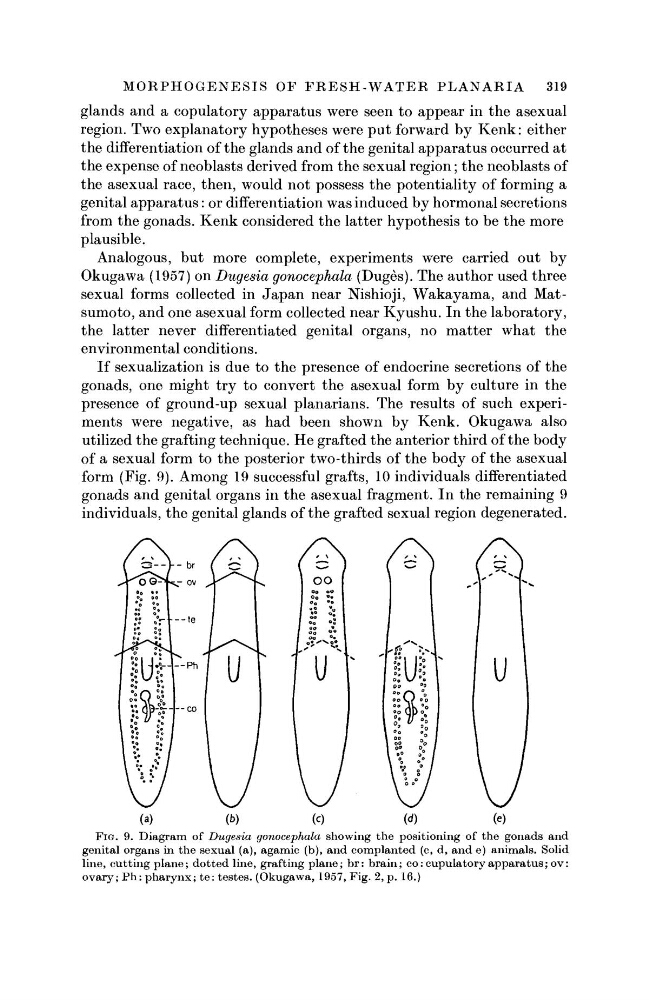
utilized the grafting technique. He grafted the anterior third of the body
of a sexual form to the posterior two-thirds of the body of the asexual
form (Fig. 9). Among 19 successful grafts, 10 individuals differentiated
gonads and genital organs in the asexual fragment. In the remaining 9
individuals, the genital glands of the grafted sexual region degenerated.
(a)
(b)
(c)
(d)
(e)
FIG. 9. Diagram of Dugesia gonocephala showing the positioning of the gonads and
genital organs in the sexual (a), agamic (b), and complanted (c, d, and e) animals. Solid
line, cutting plane; dotted line, grafting plane; br: brain; co: cupulatory apparatus; ov:
ovary; P h : pharynx; te: testes. (Okugawa, 1957, Fig. 2, p. 16.)
319
glands and a copulatory apparatus were seen to appear in the asexual
region. Two explanatory hypotheses were put forward by Kenk: either
the differentiation of the glands and of the genital apparatus occurred at
the expense of neoblasts derived from the sexual region; the neoblasts of
the asexual race, then, would not possess the potentiality of forming a
genital apparatus: or differentiation was induced by hormonal secretions
from the gonads. Kenk considered the latter hypothesis to be the more
plausible.
Analogous, but more complete, experiments were carried out by
Okugawa (1957) on Dugesia gonocephala (Duges). The author used three
sexual forms collected in Japan near Nishioji, Wakayama, and Matsumoto, and one asexual form collected near Kyushu. In the laboratory,
the latter never differentiated genital organs, no matter what the
environmental conditions.
If sexualization is due to the presence of endocrine secretions of the
gonads, one might try to convert the asexual form by culture in the
presence of ground-up sexual planarians. The results of such experiments were negative, as had been shown by Kenk. Okugawa also
utilized the grafting technique. He grafted the anterior third of the body
of a sexual form to the posterior two-thirds of the body of the asexual
form (Fig. 9). Among 19 successful grafts, 10 individuals differentiated
gonads and genital organs in the asexual fragment. In the remaining 9
individuals, the genital glands of the grafted sexual region degenerated.
(a)
(b)
(c)
(d)
(e)
FIG. 9. Diagram of Dugesia gonocephala showing the positioning of the gonads and
genital organs in the sexual (a), agamic (b), and complanted (c, d, and e) animals. Solid
line, cutting plane; dotted line, grafting plane; br: brain; co: cupulatory apparatus; ov:
ovary; P h : pharynx; te: testes. (Okugawa, 1957, Fig. 2, p. 16.)