

THE EARLY EMBRYOGENESIS OF INSECTS
295
to a deviation of processes occurring in an ooplasmic reaction system
which by proper manipulation can be restituted even in egg fragments.
The methods employed, singly and in combination, were ligation and
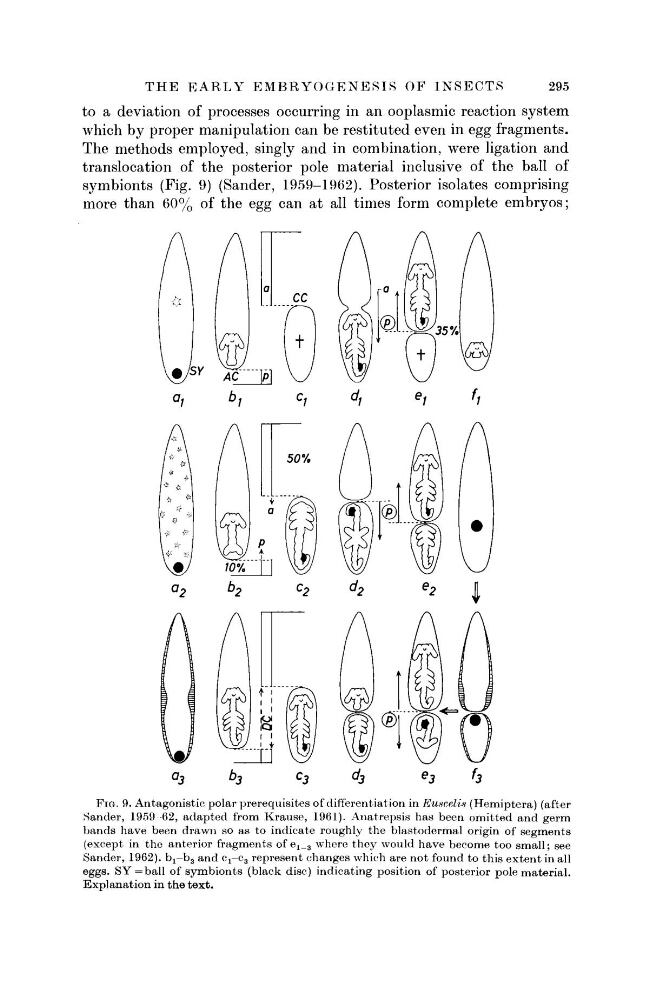
translocation of the posterior pole material inclusive of the ball of
symbionts (Fig. 9) (Sander, 1959-1962). Posterior isolates comprising
more than 60% of the egg can at all times form complete embryos;
FIG. 9. Antagonistic polar prerequisites of differentiation in Euscelis (Hemiptera) (after
Sander, 1959-62, adapted from Krause, 1961). Anatrepsis has been omitted and germ
bands have been drawn so as to indicate roughly the blastodermal origin of segments
(except in the anterior fragments of e x _ 3 where they would have become too small; see
Sander, 1962). b ^ b a and c^Ca represent changes which are not found to this extent in all
eggs. S Y = b a l l of symbionts (black disc) indicating position of posterior pole material.
Explanation in the text.
295
to a deviation of processes occurring in an ooplasmic reaction system
which by proper manipulation can be restituted even in egg fragments.
The methods employed, singly and in combination, were ligation and
translocation of the posterior pole material inclusive of the ball of
symbionts (Fig. 9) (Sander, 1959-1962). Posterior isolates comprising
more than 60% of the egg can at all times form complete embryos;
FIG. 9. Antagonistic polar prerequisites of differentiation in Euscelis (Hemiptera) (after
Sander, 1959-62, adapted from Krause, 1961). Anatrepsis has been omitted and germ
bands have been drawn so as to indicate roughly the blastodermal origin of segments
(except in the anterior fragments of e x _ 3 where they would have become too small; see
Sander, 1962). b ^ b a and c^Ca represent changes which are not found to this extent in all
eggs. S Y = b a l l of symbionts (black disc) indicating position of posterior pole material.
Explanation in the text.