

T H E E A R L Y E M B R Y O G E N E S I S O F I N S E C T S
273
In the panoistic ovariole of Tachycines, the oocyte is rich in RNA; at
first, growth takes place at the whole circumference, the nucleus remaining central in the future CC. Rather late, the eccentric position of the
nucleus indicates the dorso-ventral axis of the egg (v. Kraft, 1960b). In
the poly trophic ovariole of Apis (Bier, 1955 and unpublished; see also
Krause, 1961) on the other hand, the nutritive cell plasm and the products of follicle cells contribute to the extensive growth of those parts of
the oocyte situated behind the nucleus, whereas the region of the CC
may be less developed. Thus proliferative growth appears to be transferred into vitellogenesis, and oogenesis is prolonged so as to include a
proteolytic process which in other insects begins during cleavage or still
later. Since this process starts behind the middle of the egg (around
,s "Short germ"
"Short germ"
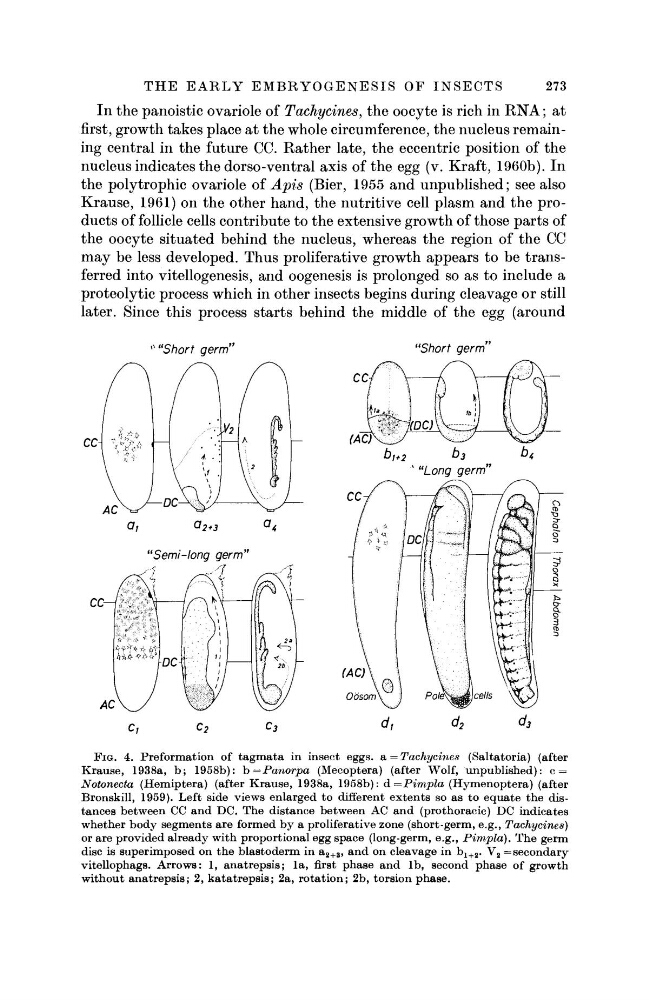
FIG. 4. Preformation of tagmata in insect eggs, a = Tachycines (Saltatoria) (after
Krause, 1938a, b ; 1958b): h=Panorpa
(Mecoptera) (after Wolf, unpublished): c =
Notonecta (Hemiptera) (after Krause, 1938a, 1958b): d=Pimpla (Hymenoptera) (after
Bronskill, 1959). Left side views enlarged to different extents so as to equate the distances between CC and DC. The distance between AC and (prothoracic) DC indicates
whether body segments are formed by a proliferative zone (short-germ, e.g., Tachycines)
or are provided already with proportional egg space (long-germ, e.g., Pimpla). The germ
disc is superimposed on the blastoderm in a 2+3 , and on cleavage in b 1 + 2 . V 2 = secondary
vitellophags. Arrows: 1, anatrepsis; la, first phase and l b , second phase of growth
without anatrepsis; 2, katatrepsis; 2a, rotation; 2b, torsion phase.
273
In the panoistic ovariole of Tachycines, the oocyte is rich in RNA; at
first, growth takes place at the whole circumference, the nucleus remaining central in the future CC. Rather late, the eccentric position of the
nucleus indicates the dorso-ventral axis of the egg (v. Kraft, 1960b). In
the poly trophic ovariole of Apis (Bier, 1955 and unpublished; see also
Krause, 1961) on the other hand, the nutritive cell plasm and the products of follicle cells contribute to the extensive growth of those parts of
the oocyte situated behind the nucleus, whereas the region of the CC
may be less developed. Thus proliferative growth appears to be transferred into vitellogenesis, and oogenesis is prolonged so as to include a
proteolytic process which in other insects begins during cleavage or still
later. Since this process starts behind the middle of the egg (around
,s "Short germ"
"Short germ"
FIG. 4. Preformation of tagmata in insect eggs, a = Tachycines (Saltatoria) (after
Krause, 1938a, b ; 1958b): h=Panorpa
(Mecoptera) (after Wolf, unpublished): c =
Notonecta (Hemiptera) (after Krause, 1938a, 1958b): d=Pimpla (Hymenoptera) (after
Bronskill, 1959). Left side views enlarged to different extents so as to equate the distances between CC and DC. The distance between AC and (prothoracic) DC indicates
whether body segments are formed by a proliferative zone (short-germ, e.g., Tachycines)
or are provided already with proportional egg space (long-germ, e.g., Pimpla). The germ
disc is superimposed on the blastoderm in a 2+3 , and on cleavage in b 1 + 2 . V 2 = secondary
vitellophags. Arrows: 1, anatrepsis; la, first phase and l b , second phase of growth
without anatrepsis; 2, katatrepsis; 2a, rotation; 2b, torsion phase.