

P R O T E I N S I N D E V E L O P M E N T
233
animalized sea urchin and frog embryos, Ranzi, Citterio, Copes and
Samuelli (1957) studied the possibilities of extracting the proteins from
lyophilized embryos and of precipitating them by using the salting-out
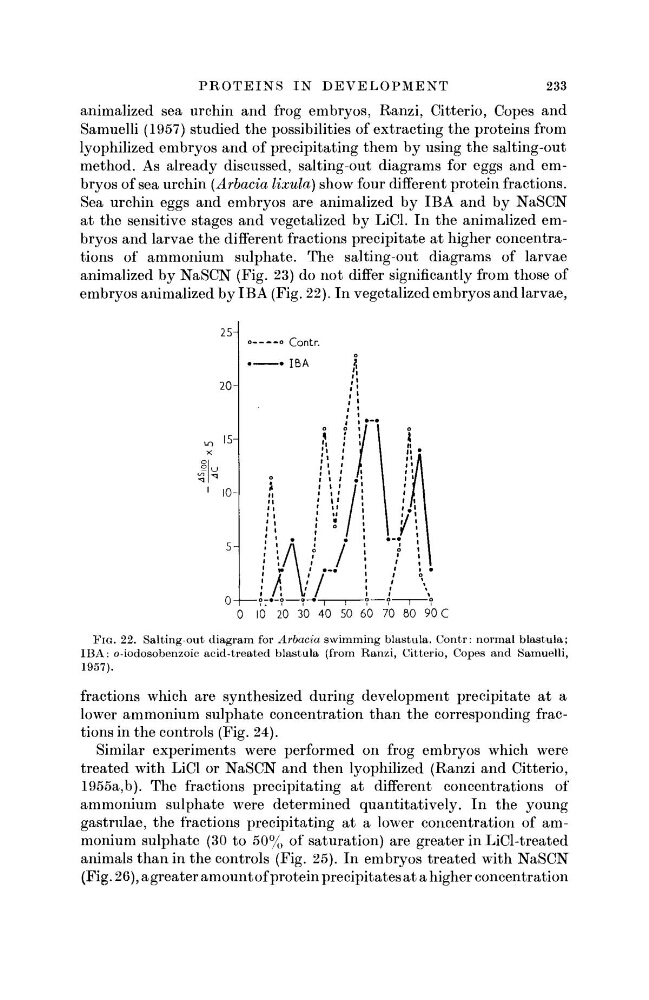
method. As already discussed, salting-out diagrams for eggs and embryos of sea urchin (Arbacia lixula) show four different protein fractions.
Sea urchin eggs and embryos are animalized by IBA and by NaSCN
at the sensitive stages and vegetalized by LiCl. In the animalized embryos and larvae the different fractions precipitate at higher concentrations of ammonium sulphate. The salting-out diagrams of larvae
animalized by NaSCN (Fig. 23) do not differ significantly from those of
embryos animalized by IBA (Fig. 22). In vegetalized embryos and larvae,
ISA
20H
ICH
0 10 20 30 40 50 60 70 80 90 C
FIG. 22. Salting-out diagram for Arbacia swimming blastula. Contr: normal blastula;
IBA: o-iodosobenzoic acid-treated blastula (from Ranzi, Citterio, Copes and Samuelli,
1957).
fractions which are synthesized during development precipitate at a
lower ammonium sulphate concentration than the corresponding fractions in the controls (Fig. 24).
Similar experiments were performed on frog embryos which were
treated with LiCl or NaSCN and then lyophilized (Ranzi and Citterio,
1955a,b). The fractions precipitating at different concentrations of
ammonium sulphate were determined quantitatively. In the young
gastrulae, the fractions precipitating at a lower concentration of ammonium sulphate (30 to 50% of saturation) are greater in LiCl-treated
animals than in the controls (Fig. 25). In embryos treated with NaSCN
(Fig. 26), agreater amount of protein precipitates at a higher concentration
233
animalized sea urchin and frog embryos, Ranzi, Citterio, Copes and
Samuelli (1957) studied the possibilities of extracting the proteins from
lyophilized embryos and of precipitating them by using the salting-out
method. As already discussed, salting-out diagrams for eggs and embryos of sea urchin (Arbacia lixula) show four different protein fractions.
Sea urchin eggs and embryos are animalized by IBA and by NaSCN
at the sensitive stages and vegetalized by LiCl. In the animalized embryos and larvae the different fractions precipitate at higher concentrations of ammonium sulphate. The salting-out diagrams of larvae
animalized by NaSCN (Fig. 23) do not differ significantly from those of
embryos animalized by IBA (Fig. 22). In vegetalized embryos and larvae,
ISA
20H
ICH
0 10 20 30 40 50 60 70 80 90 C
FIG. 22. Salting-out diagram for Arbacia swimming blastula. Contr: normal blastula;
IBA: o-iodosobenzoic acid-treated blastula (from Ranzi, Citterio, Copes and Samuelli,
1957).
fractions which are synthesized during development precipitate at a
lower ammonium sulphate concentration than the corresponding fractions in the controls (Fig. 24).
Similar experiments were performed on frog embryos which were
treated with LiCl or NaSCN and then lyophilized (Ranzi and Citterio,
1955a,b). The fractions precipitating at different concentrations of
ammonium sulphate were determined quantitatively. In the young
gastrulae, the fractions precipitating at a lower concentration of ammonium sulphate (30 to 50% of saturation) are greater in LiCl-treated
animals than in the controls (Fig. 25). In embryos treated with NaSCN
(Fig. 26), agreater amount of protein precipitates at a higher concentration