

212
S I L V I O R A N Z I
Laur, with their interspecific crosses (Ranzi, Citterio and Samuelli,
1960, 1961). Cigada (1953) and Cigada Leonardi (1956, 1958) compared
also five different species of animals which live in different environments.
A. Sea Urchins
We made large numbers of eggs develop under continuous shaking,
and lyophilized material from a variety of the embryonic and larval
stages, keeping it as a powder for subsequent study.
The salting-out experiments were performed at 0° C in the cold room.
The lyophilized powder (500 mg) was dissolved in 100 ml of Weber and
Edsall fluid (0-6 M-alkaline KC1). The solution was centrifuged and the
supernatant was analysed for nitrogen according to the method of
Parnas; absorption was estimated at 280 m/x in a Beckman spectro0
5
10 15
H
20
H
25 30
1
2 ^
35
M
ΓΊ
40
r n
45
1
50
■
55
1
*22
60
1
2 ^
65
Ρττ Λ
1
70 75 80
IP
85 90
N
^25
0-800E
275
0-6000-500-1
0-400-]
0-300
0-200
0100
\ .
X 1 \ '
; \
\i
\ 7v
0 (NH4)2S04
1 I Solvent
^ Solution
-14
■0-080
„-TA»
0070
h0060
■0050
0-040
0-030
hO-020
0-010
0
h6
S=0750-OI60=0-590
K
- 100-4
J5
I00—Ö59Ö
iC=5
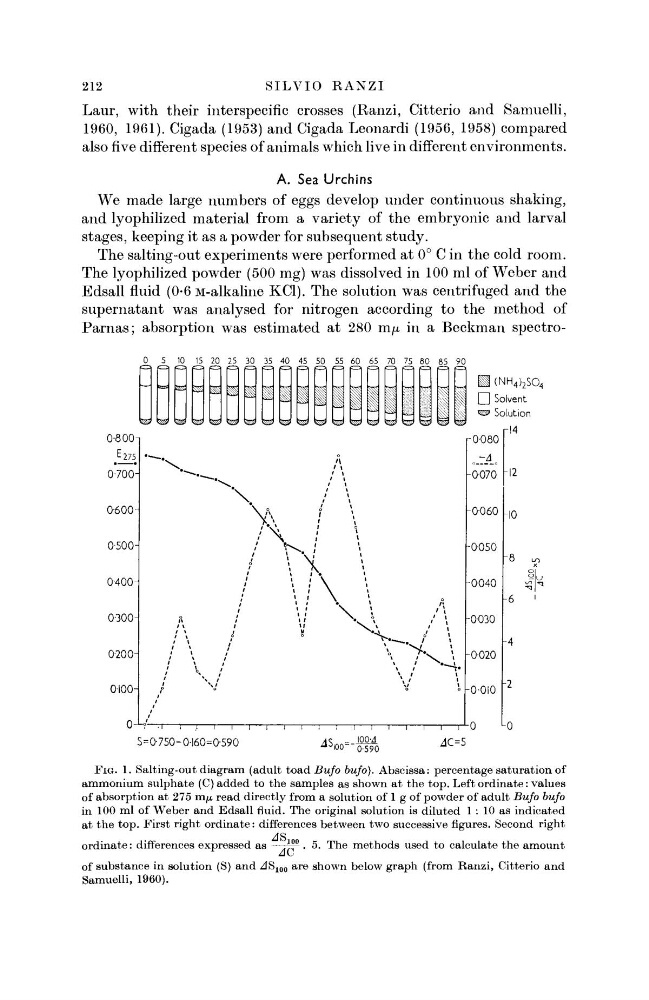
FIG. 1. Salting-out diagram (adult toad Bufo bufo). Abscissa: percentage saturation of
ammonium sulphate (C) added to the samples as shown at the top. Left ordinate: values
of absorption at 275 τημ read directly from a solution of 1 g of powder of adult Bufo bufo
in 100 ml of Weber and Edsall fluid. The original solution is diluted 1 : 10 as indicated
at the top. First right ordinate: differences between two successive figures. Second right
JS 1 0
ordinate: differences expressed as
:
AC
. 5 . The methods used to calculate the amount
of substance in solution (S) and JS 1 0 0 are shown below graph (from Ranzi, Citterio and
Samuelli, 1960).
S I L V I O R A N Z I
Laur, with their interspecific crosses (Ranzi, Citterio and Samuelli,
1960, 1961). Cigada (1953) and Cigada Leonardi (1956, 1958) compared
also five different species of animals which live in different environments.
A. Sea Urchins
We made large numbers of eggs develop under continuous shaking,
and lyophilized material from a variety of the embryonic and larval
stages, keeping it as a powder for subsequent study.
The salting-out experiments were performed at 0° C in the cold room.
The lyophilized powder (500 mg) was dissolved in 100 ml of Weber and
Edsall fluid (0-6 M-alkaline KC1). The solution was centrifuged and the
supernatant was analysed for nitrogen according to the method of
Parnas; absorption was estimated at 280 m/x in a Beckman spectro0
5
10 15
H
20
H
25 30
1
2 ^
35
M
ΓΊ
40
r n
45
1
50
■
55
1
*22
60
1
2 ^
65
Ρττ Λ
1
70 75 80
IP
85 90
N
^25
0-800E
275
0-6000-500-1
0-400-]
0-300
0-200
0100
\ .
X 1 \ '
; \
\i
\ 7v
0 (NH4)2S04
1 I Solvent
^ Solution
-14
■0-080
„-TA»
0070
h0060
■0050
0-040
0-030
hO-020
0-010
0
h6
S=0750-OI60=0-590
K
- 100-4
J5
I00—Ö59Ö
iC=5
FIG. 1. Salting-out diagram (adult toad Bufo bufo). Abscissa: percentage saturation of
ammonium sulphate (C) added to the samples as shown at the top. Left ordinate: values
of absorption at 275 τημ read directly from a solution of 1 g of powder of adult Bufo bufo
in 100 ml of Weber and Edsall fluid. The original solution is diluted 1 : 10 as indicated
at the top. First right ordinate: differences between two successive figures. Second right
JS 1 0
ordinate: differences expressed as
:
AC
. 5 . The methods used to calculate the amount
of substance in solution (S) and JS 1 0 0 are shown below graph (from Ranzi, Citterio and
Samuelli, 1960).