

1 7 0
B. M. SHAFFER
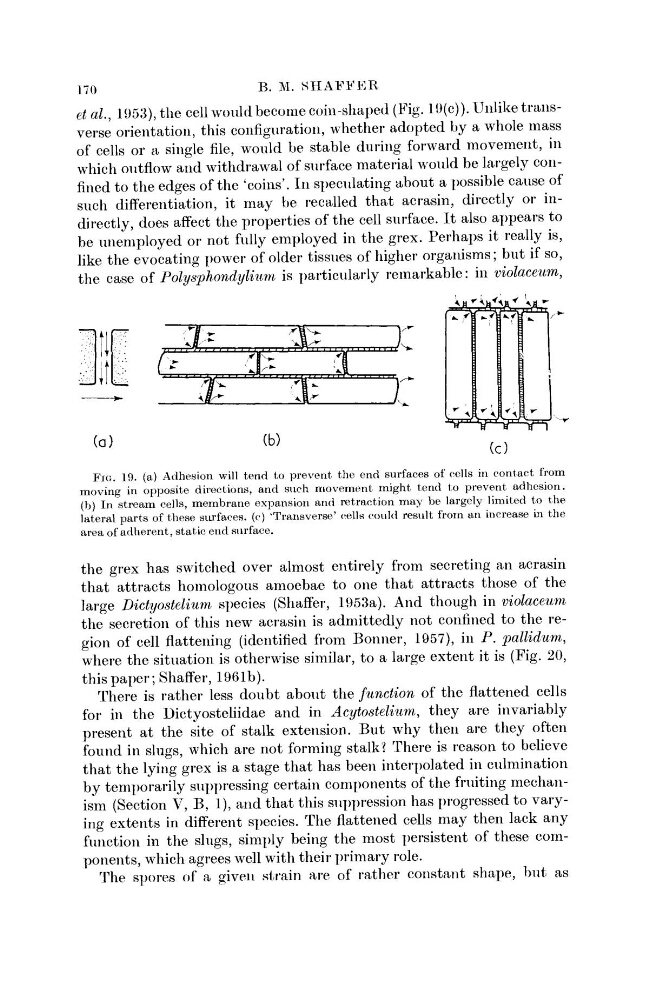
etal, 1953), the cell would become coin-shaped (Fig. 19(c)). Unlike transverse orientation, this configuration, whether adopted by a whole mass
of cells or a single file, would be stable during forward movement, in
which outflow and withdrawal of surface material would be largely confined to the edges of the 'coins'. In speculating about a possible cause of
such differentiation, it may be recalled that acrasin, directly or indirectly, does affect the properties of the cell surface. It also appears to
be unemployed or not fully employed in the grex. Perhaps it really is,
like the evocating power of older tissues of higher organisms; but if so,
the case of Polysphondylium is particularly remarkable: in violaceum,
ti
It!
/■ i J i °i I i i i i i i i i i i ι τ τ -
η i I I i i - 1 .
1
(a)
(b)
FIG. 19. (a) Adhesion will tend to prevent the end surfaces of cells in contact from
moving in opposite directions, and such movement might tend to prevent adhesion.
(b) In stream cells, membrane expansion and retraction may be largely limited to the
lateral parts of these surfaces, (c) 'Transverse' cells could result from an increase in the
area of adherent, static end surface.
the grex has switched over almost entirely from secreting an acrasin
that attracts homologous amoebae to one that attracts those of the
large Dictyostelium species (Shaffer, 1953a). And though in violaceum
the secretion of this new acrasin is admittedly not confined to the region of cell flattening (identified from Bonner, 1957), in P. pallidum,
where the situation is otherwise similar, to a large extent it is (Fig. 20,
this paper; Shaffer, 1961b).
There is rather less doubt about the function of the flattened cells
for in the Dictyosteliidae and in Acytostelium, they are invariably
present at the site of stalk extension. But why then are they often
found in slugs, which are not forming stalk? There is reason to believe
that the lying grex is a stage that has been interpolated in culmination
by temporarily suppressing certain components of the fruiting mechanism (Section V, B, 1), and that this suppression has progressed to varying extents in different species. The flattened cells may then lack any
function in the slugs, simply being the most persistent of these components, which agrees well with their primary role.
The spores of a given strain are of rather constant shape, but as
B. M. SHAFFER
etal, 1953), the cell would become coin-shaped (Fig. 19(c)). Unlike transverse orientation, this configuration, whether adopted by a whole mass
of cells or a single file, would be stable during forward movement, in
which outflow and withdrawal of surface material would be largely confined to the edges of the 'coins'. In speculating about a possible cause of
such differentiation, it may be recalled that acrasin, directly or indirectly, does affect the properties of the cell surface. It also appears to
be unemployed or not fully employed in the grex. Perhaps it really is,
like the evocating power of older tissues of higher organisms; but if so,
the case of Polysphondylium is particularly remarkable: in violaceum,
ti
It!
/■ i J i °i I i i i i i i i i i i ι τ τ -
η i I I i i - 1 .
1
(a)
(b)
FIG. 19. (a) Adhesion will tend to prevent the end surfaces of cells in contact from
moving in opposite directions, and such movement might tend to prevent adhesion.
(b) In stream cells, membrane expansion and retraction may be largely limited to the
lateral parts of these surfaces, (c) 'Transverse' cells could result from an increase in the
area of adherent, static end surface.
the grex has switched over almost entirely from secreting an acrasin
that attracts homologous amoebae to one that attracts those of the
large Dictyostelium species (Shaffer, 1953a). And though in violaceum
the secretion of this new acrasin is admittedly not confined to the region of cell flattening (identified from Bonner, 1957), in P. pallidum,
where the situation is otherwise similar, to a large extent it is (Fig. 20,
this paper; Shaffer, 1961b).
There is rather less doubt about the function of the flattened cells
for in the Dictyosteliidae and in Acytostelium, they are invariably
present at the site of stalk extension. But why then are they often
found in slugs, which are not forming stalk? There is reason to believe
that the lying grex is a stage that has been interpolated in culmination
by temporarily suppressing certain components of the fruiting mechanism (Section V, B, 1), and that this suppression has progressed to varying extents in different species. The flattened cells may then lack any
function in the slugs, simply being the most persistent of these components, which agrees well with their primary role.
The spores of a given strain are of rather constant shape, but as