

THE ACRASINA
165
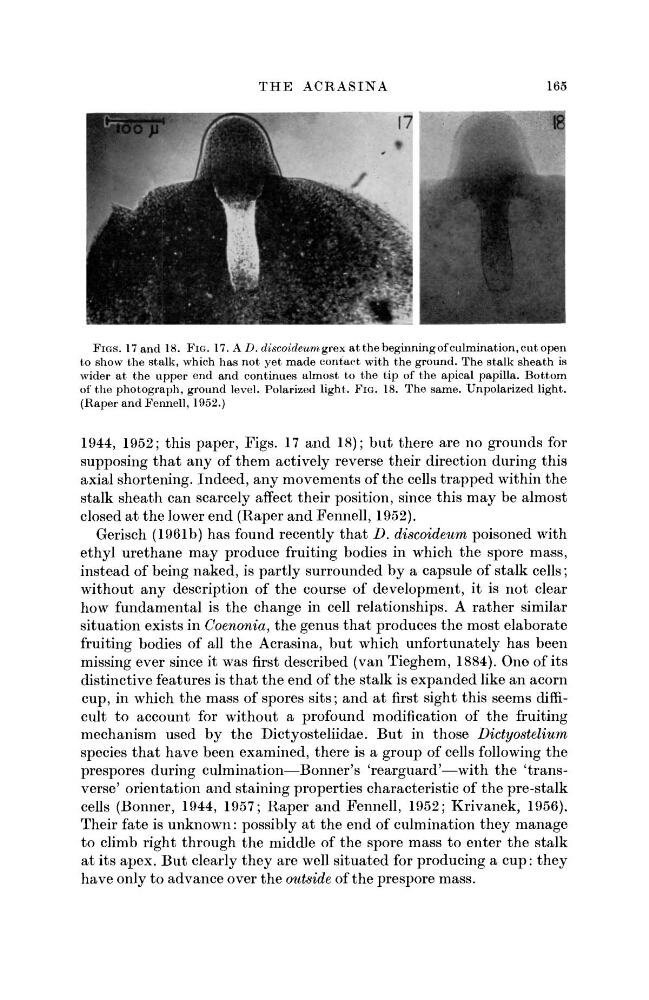
FIGS. 17 and 18. FIG. 17. A D. discoideum grex at the beginning of culmination, cut open
to show the stalk, which has not yet made contact with the ground. The stalk sheath is
wider at the upper end and continues almost to the tip of the apical papilla. Bottom
of the photograph, ground level. Polarized light. FIG. 18. The same. Unpolarized light.
(Raper and Fennell, 1952.)
1944, 1952; this paper, Figs. 17 and 18); but there are no grounds for
supposing that any of them actively reverse their direction during this
axial shortening. Indeed, any movements of the cells trapped within the
stalk sheath can scarcely affect their position, since this may be almost
closed at the lower end (Raper and Fennell, 1952).
Gerisch (1961b) has found recently that D. discoideum poisoned with
ethyl urethane may produce fruiting bodies in which the spore mass,
instead of being naked, is partly surrounded by a capsule of stalk cells;
without any description of the course of development, it is not clear
how fundamental is the change in cell relationships. A rather similar
situation exists in Coenonia, the genus that produces the most elaborate
fruiting bodies of all the Acrasina, but which unfortunately has been
missing ever since it was first described (van Tieghem, 1884). One of its
distinctive features is that the end of the stalk is expanded like an acorn
cup, in which the mass of spores sits; and at first sight this seems difficult to account for without a profound modification of the fruiting
mechanism used by the Dictyosteliidae. But in those Dictyostelium
species that have been examined, there is a group of cells following the
prespores during culmination—Bonner's 'rearguard'—with the 'transverse' orientation and staining properties characteristic of the pre-stalk
cells (Bonner, 1944, 1957; Raper and Fennell, 1952; Krivanek, 1956).
Their fate is unknown: possibly at the end of culmination they manage
to climb right through the middle of the spore mass to enter the stalk
at its apex. But clearly they are well situated for producing a cup: they
have only to advance over the outside of the prespore mass.
165
FIGS. 17 and 18. FIG. 17. A D. discoideum grex at the beginning of culmination, cut open
to show the stalk, which has not yet made contact with the ground. The stalk sheath is
wider at the upper end and continues almost to the tip of the apical papilla. Bottom
of the photograph, ground level. Polarized light. FIG. 18. The same. Unpolarized light.
(Raper and Fennell, 1952.)
1944, 1952; this paper, Figs. 17 and 18); but there are no grounds for
supposing that any of them actively reverse their direction during this
axial shortening. Indeed, any movements of the cells trapped within the
stalk sheath can scarcely affect their position, since this may be almost
closed at the lower end (Raper and Fennell, 1952).
Gerisch (1961b) has found recently that D. discoideum poisoned with
ethyl urethane may produce fruiting bodies in which the spore mass,
instead of being naked, is partly surrounded by a capsule of stalk cells;
without any description of the course of development, it is not clear
how fundamental is the change in cell relationships. A rather similar
situation exists in Coenonia, the genus that produces the most elaborate
fruiting bodies of all the Acrasina, but which unfortunately has been
missing ever since it was first described (van Tieghem, 1884). One of its
distinctive features is that the end of the stalk is expanded like an acorn
cup, in which the mass of spores sits; and at first sight this seems difficult to account for without a profound modification of the fruiting
mechanism used by the Dictyosteliidae. But in those Dictyostelium
species that have been examined, there is a group of cells following the
prespores during culmination—Bonner's 'rearguard'—with the 'transverse' orientation and staining properties characteristic of the pre-stalk
cells (Bonner, 1944, 1957; Raper and Fennell, 1952; Krivanek, 1956).
Their fate is unknown: possibly at the end of culmination they manage
to climb right through the middle of the spore mass to enter the stalk
at its apex. But clearly they are well situated for producing a cup: they
have only to advance over the outside of the prespore mass.