

THE ACRASINA
129
cance, if conditions could be found in which the largest cells were less
crippled than the others.
C. The Founders
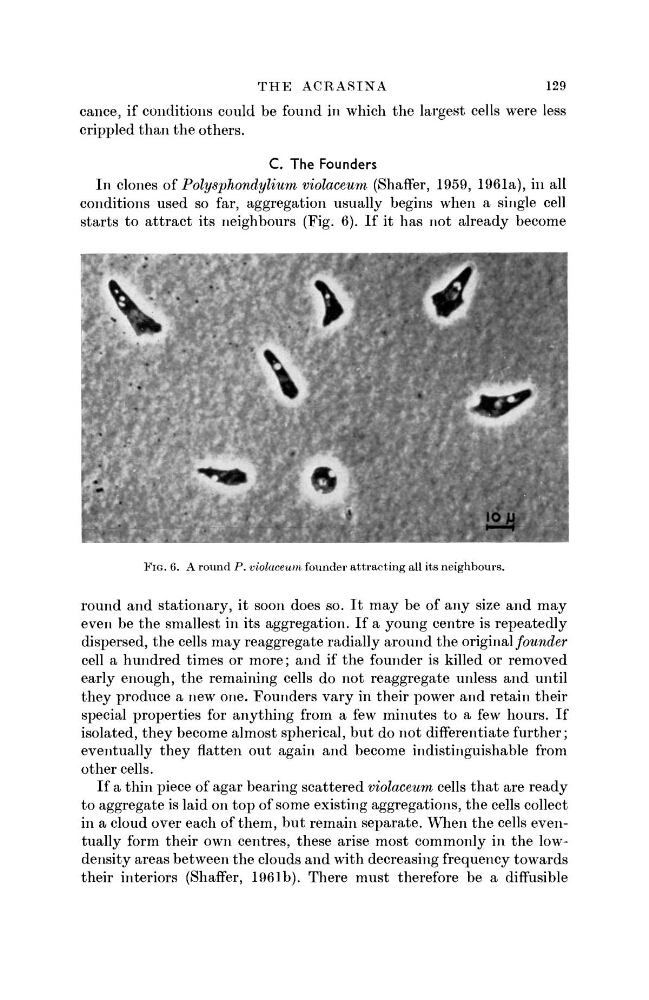
In clones of Polysphondylium violaceum (Shaffer, 1959, 1961a), in all
conditions used so far, aggregation usually begins when a single cell
starts to attract its neighbours (Fig. 6). If it has not already become
FIG. 6. A round P. violaceum founder attracting all its neighbours.
round and stationary, it soon does so. It may be of any size and may
even be the smallest in its aggregation. If a young centre is repeatedly
dispersed, the cells may reaggregate radially around the original founder
cell a hundred times or more; and if the founder is killed or removed
early enough, the remaining cells do not reaggregate unless and until
they produce a new one. Founders vary in their power and retain their
special properties for anything from a few minutes to a few hours. If
isolated, they become almost spherical, but do not differentiate further;
eventually they flatten out again and become indistinguishable from
other cells.
If a thin piece of agar bearing scattered violaceum cells that are ready
to aggregate is laid on top of some existing aggregations, the cells collect
in a cloud over each of them, but remain separate. When the cells eventually form their own centres, these arise most commonly in the lowdensity areas between the clouds and with decreasing frequency towards
their interiors (Shaffer, 1961b). There must therefore be a diffusible
129
cance, if conditions could be found in which the largest cells were less
crippled than the others.
C. The Founders
In clones of Polysphondylium violaceum (Shaffer, 1959, 1961a), in all
conditions used so far, aggregation usually begins when a single cell
starts to attract its neighbours (Fig. 6). If it has not already become
FIG. 6. A round P. violaceum founder attracting all its neighbours.
round and stationary, it soon does so. It may be of any size and may
even be the smallest in its aggregation. If a young centre is repeatedly
dispersed, the cells may reaggregate radially around the original founder
cell a hundred times or more; and if the founder is killed or removed
early enough, the remaining cells do not reaggregate unless and until
they produce a new one. Founders vary in their power and retain their
special properties for anything from a few minutes to a few hours. If
isolated, they become almost spherical, but do not differentiate further;
eventually they flatten out again and become indistinguishable from
other cells.
If a thin piece of agar bearing scattered violaceum cells that are ready
to aggregate is laid on top of some existing aggregations, the cells collect
in a cloud over each of them, but remain separate. When the cells eventually form their own centres, these arise most commonly in the lowdensity areas between the clouds and with decreasing frequency towards
their interiors (Shaffer, 1961b). There must therefore be a diffusible