

10
V A N C E T A R T A R
that in the sector of the cell subtended by the mouthparts there is a
region of contrasting stripes, fine stripes lying to the right of the widest
stripes. The oral primordium always begins in the fine-stripe area next
to the wide.
This association of the anläge with a region of sharply contrasting
pigment stripe widths is not adventitious. In a variety of experiments
designed to explore this matter it was found that whenever and wherever
wide-stripe areas were placed next to fine-stripe ones the progenitor of
the membranellar band always appeared in the adjacent fine stripes or
at the junction between the two contrast areas (Tartar, 1956a,b). To
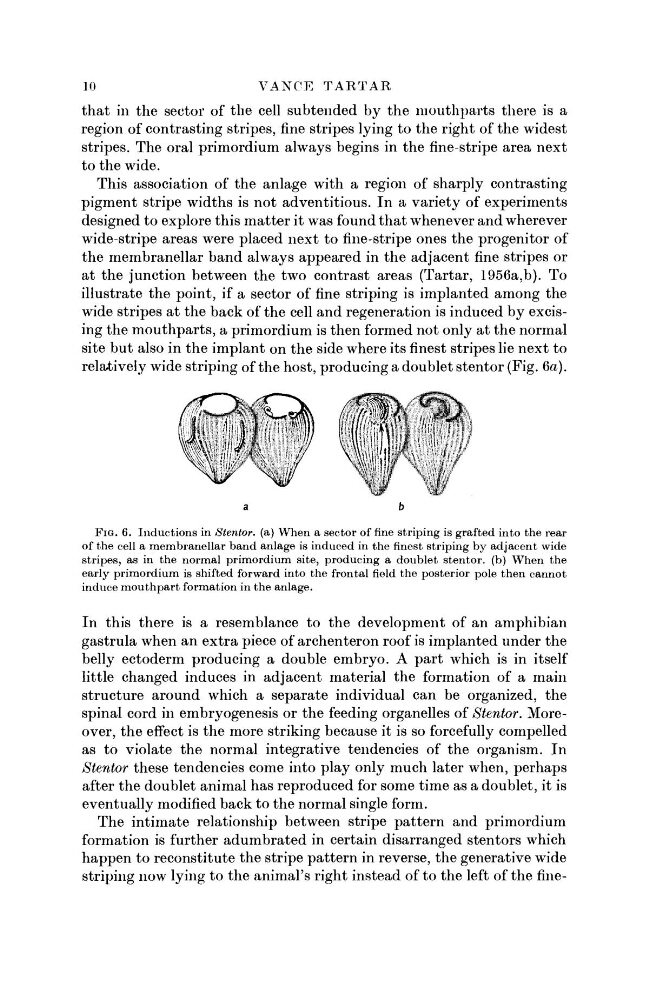
illustrate the point, if a sector of fine striping is implanted among the
wide stripes at the back of the cell and regeneration is induced by excising the mouthparts, a primordium is then formed not only at the normal
site but also in the implant on the side where its finest stripes lie next to
relatively wide striping of the host, producing a doublet stentor (Fig. 6a).
FIG. 6. Inductions in Stentor. (a) When a sector of fine striping is grafted into the rear
of the cell a membranellar band anläge is induced in the finest striping by adjacent wide
stripes, as in the normal primordium site, producing a doublet stentor. (b) When the
early primordium is shifted forward into the frontal field the posterior pole then cannot
induce mouthpart formation in the anläge.
In this there is a resemblance to the development of an amphibian
gastrula when an extra piece of archenteron roof is implanted under the
belly ectoderm producing a double embryo. A part which is in itself
little changed induces in adjacent material the formation of a main
structure around which a separate individual can be organized, the
spinal cord in embryogenesis or the feeding organelles of Stentor. Moreover, the effect is the more striking because it is so forcefully compelled
as to violate the normal integrative tendencies of the organism. In
Stentor these tendencies come into play only much later when, perhaps
after the doublet animal has reproduced for some time as a doublet, it is
eventually modified back to the normal single form.
The intimate relationship between stripe pattern and primordium
formation is further adumbrated in certain disarranged stentors which
happen to reconstitute the stripe pattern in reverse, the generative wide
striping now lying to the animal's right instead of to the left of the fine-
V A N C E T A R T A R
that in the sector of the cell subtended by the mouthparts there is a
region of contrasting stripes, fine stripes lying to the right of the widest
stripes. The oral primordium always begins in the fine-stripe area next
to the wide.
This association of the anläge with a region of sharply contrasting
pigment stripe widths is not adventitious. In a variety of experiments
designed to explore this matter it was found that whenever and wherever
wide-stripe areas were placed next to fine-stripe ones the progenitor of
the membranellar band always appeared in the adjacent fine stripes or
at the junction between the two contrast areas (Tartar, 1956a,b). To
illustrate the point, if a sector of fine striping is implanted among the
wide stripes at the back of the cell and regeneration is induced by excising the mouthparts, a primordium is then formed not only at the normal
site but also in the implant on the side where its finest stripes lie next to
relatively wide striping of the host, producing a doublet stentor (Fig. 6a).
FIG. 6. Inductions in Stentor. (a) When a sector of fine striping is grafted into the rear
of the cell a membranellar band anläge is induced in the finest striping by adjacent wide
stripes, as in the normal primordium site, producing a doublet stentor. (b) When the
early primordium is shifted forward into the frontal field the posterior pole then cannot
induce mouthpart formation in the anläge.
In this there is a resemblance to the development of an amphibian
gastrula when an extra piece of archenteron roof is implanted under the
belly ectoderm producing a double embryo. A part which is in itself
little changed induces in adjacent material the formation of a main
structure around which a separate individual can be organized, the
spinal cord in embryogenesis or the feeding organelles of Stentor. Moreover, the effect is the more striking because it is so forcefully compelled
as to violate the normal integrative tendencies of the organism. In
Stentor these tendencies come into play only much later when, perhaps
after the doublet animal has reproduced for some time as a doublet, it is
eventually modified back to the normal single form.
The intimate relationship between stripe pattern and primordium
formation is further adumbrated in certain disarranged stentors which
happen to reconstitute the stripe pattern in reverse, the generative wide
striping now lying to the animal's right instead of to the left of the fine-