

THE ACRASINA
115
consumed. Samuel (1961) measured the speed of separate cells in standard conditions, quantified the effect of bacteria, and demonstrated
the effects of a variety of other factors, some originating in the cells
themselves. Gradients of such factors may affect distribution even if
they cannot guide the cells: at equilibrium, in the absence of other factors, density will be inversely proportional to speed. This—'orthokinesis'
(Gunn et al., 1937)—should lead to accumulation of the cells in the drier
parts of the culture, as Samuel has found that speed increases markedly
with humidity. But in a sufficiently steep gradient, we should expect
the cells to show positive hydrotaxis. Neither response has yet been
demonstrated.
3. Shape
Raper (1960) has emphasized that different social amoebae characteristically have different types of pseudopodia; but undoubtedly the
environment is extremely influential, as it is for many solitary amoebae
(Ray and Hayes, 1954). For example (Shaffer, 1961b), myxamoebae
that invade agar become so highly lobulated and sublobulated that they
may easily be mistaken for debris; and those that are partly or completely free in water produce large fingerlike pseudopodia, which may
be waved about.
Some forms I have so far seen most commonly in certain species.
On an ordinary agar plate, though more conspicuously under a thin agar
overlay, the tendency for some of the roughly triangular cells behind
the feeding front to have the rear drawn out into a marked tail is
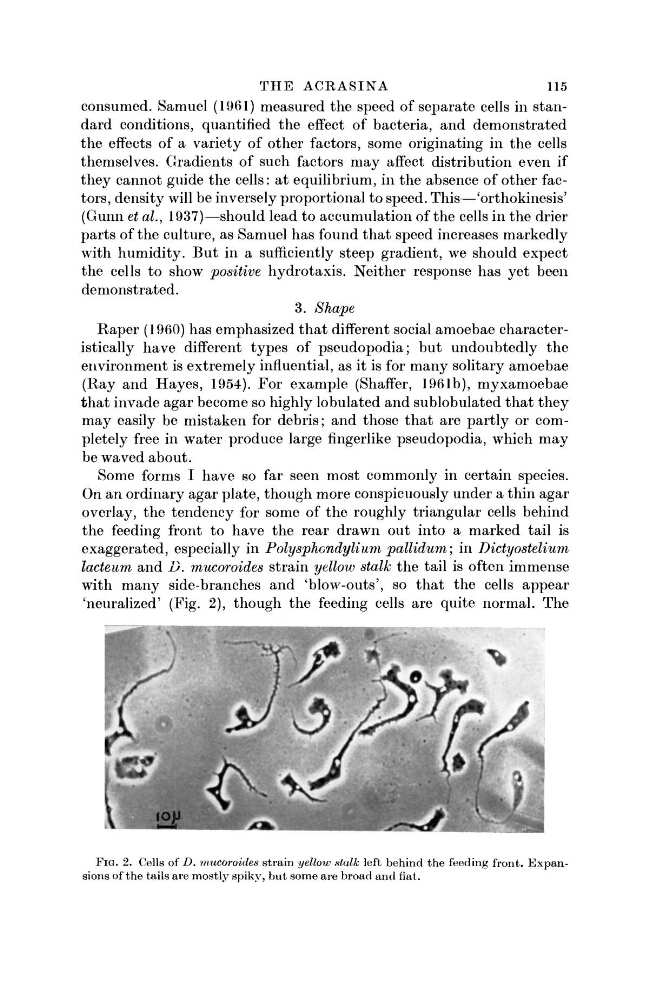
exaggerated, especially in Polysphcndylium pallidum; in Dictyostelium
lacteum and D. mucoroides strain yellow stalk the tail is often immense
with many side-branches and 'blow-outs', so that the cells appear
'neuralized' (Fig. 2), though the feeding cells are quite normal. The
FIG. 2. Cells of D. mucoroides strain yellow stalk left behind the feeding front. Expansions of the tails are mostly spiky, but some are broad and flat.
115
consumed. Samuel (1961) measured the speed of separate cells in standard conditions, quantified the effect of bacteria, and demonstrated
the effects of a variety of other factors, some originating in the cells
themselves. Gradients of such factors may affect distribution even if
they cannot guide the cells: at equilibrium, in the absence of other factors, density will be inversely proportional to speed. This—'orthokinesis'
(Gunn et al., 1937)—should lead to accumulation of the cells in the drier
parts of the culture, as Samuel has found that speed increases markedly
with humidity. But in a sufficiently steep gradient, we should expect
the cells to show positive hydrotaxis. Neither response has yet been
demonstrated.
3. Shape
Raper (1960) has emphasized that different social amoebae characteristically have different types of pseudopodia; but undoubtedly the
environment is extremely influential, as it is for many solitary amoebae
(Ray and Hayes, 1954). For example (Shaffer, 1961b), myxamoebae
that invade agar become so highly lobulated and sublobulated that they
may easily be mistaken for debris; and those that are partly or completely free in water produce large fingerlike pseudopodia, which may
be waved about.
Some forms I have so far seen most commonly in certain species.
On an ordinary agar plate, though more conspicuously under a thin agar
overlay, the tendency for some of the roughly triangular cells behind
the feeding front to have the rear drawn out into a marked tail is
exaggerated, especially in Polysphcndylium pallidum; in Dictyostelium
lacteum and D. mucoroides strain yellow stalk the tail is often immense
with many side-branches and 'blow-outs', so that the cells appear
'neuralized' (Fig. 2), though the feeding cells are quite normal. The
FIG. 2. Cells of D. mucoroides strain yellow stalk left behind the feeding front. Expansions of the tails are mostly spiky, but some are broad and flat.