

NON-FILAMENTOUS AQUATIC FUNGI
63
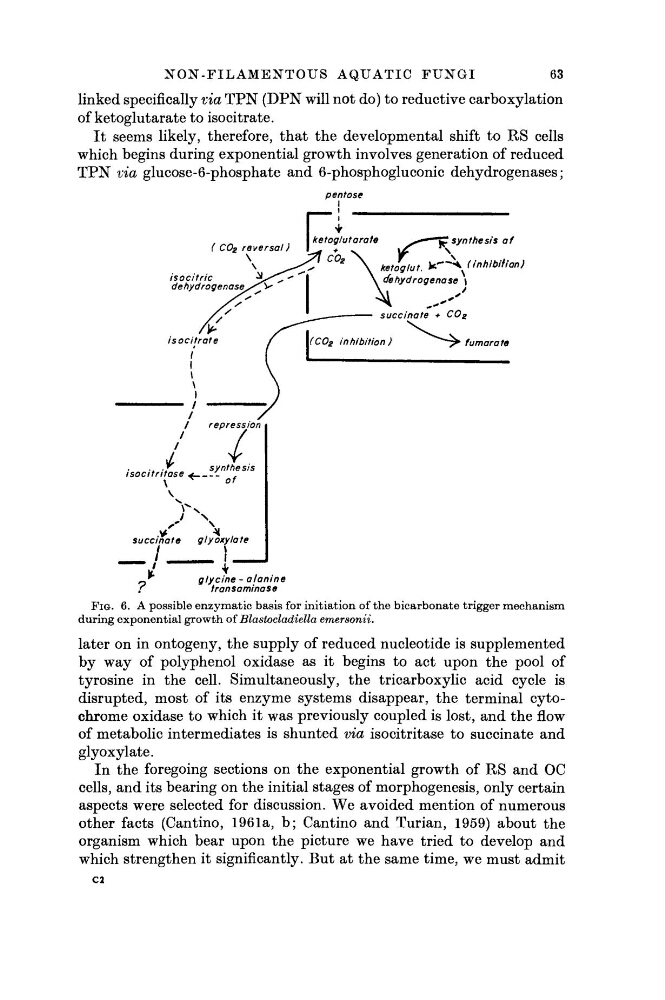
linked specifically via TPN (DPN will not do) to reductive carboxylation
of ketoglutarate to isocitrate.
It seems likely, therefore, that the developmental shift to RS cells
which begins during exponential growth involves generation of reduced
TPN via glucose-6-phosphate and 6-phosphogluconic dehydrogenases;
pentose
ι
succinate
glyoxylate
0 *
glycine - alanine
f
transaminase
FIG. 6. A possible enzymatic basis for initiation of the bicarbonate trigger mechanism
during exponential growth of Blastocladiella emersonii.
later on in ontogeny, the supply of reduced nucleotide is supplemented
by way of polyphenol oxidase as it begins to act upon the pool of
tyrosine in the cell. Simultaneously, the tricarboxylic acid cycle is
disrupted, most of its enzyme systems disappear, the terminal cytochrome oxidase to which it was previously coupled is lost, and the flow
of metabolic intermediates is shunted via isocitritase to succinate and
glyoxylate.
In the foregoing sections on the exponential growth of RS and OC
cells, and its bearing on the initial stages of morphogenesis, only certain
aspects were selected for discussion. We avoided mention of numerous
other facts (Cantino, 1961a, b; Cantino and Turian, 1959) about the
organism which bear upon the picture we have tried to develop and
which strengthen it significantly. But at the same time, we must admit
C2
63
linked specifically via TPN (DPN will not do) to reductive carboxylation
of ketoglutarate to isocitrate.
It seems likely, therefore, that the developmental shift to RS cells
which begins during exponential growth involves generation of reduced
TPN via glucose-6-phosphate and 6-phosphogluconic dehydrogenases;
pentose
ι
succinate
glyoxylate
0 *
glycine - alanine
f
transaminase
FIG. 6. A possible enzymatic basis for initiation of the bicarbonate trigger mechanism
during exponential growth of Blastocladiella emersonii.
later on in ontogeny, the supply of reduced nucleotide is supplemented
by way of polyphenol oxidase as it begins to act upon the pool of
tyrosine in the cell. Simultaneously, the tricarboxylic acid cycle is
disrupted, most of its enzyme systems disappear, the terminal cytochrome oxidase to which it was previously coupled is lost, and the flow
of metabolic intermediates is shunted via isocitritase to succinate and
glyoxylate.
In the foregoing sections on the exponential growth of RS and OC
cells, and its bearing on the initial stages of morphogenesis, only certain
aspects were selected for discussion. We avoided mention of numerous
other facts (Cantino, 1961a, b; Cantino and Turian, 1959) about the
organism which bear upon the picture we have tried to develop and
which strengthen it significantly. But at the same time, we must admit
C2