

NON-FILAMENTOUS AQUATIC FUNGI
43
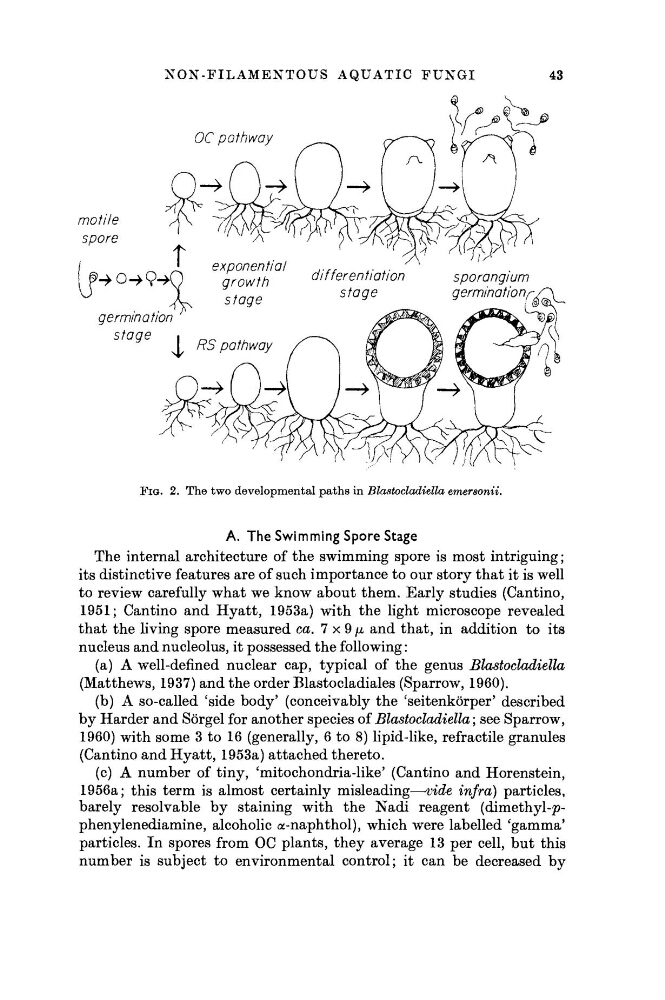
FIG. 2. The two developmental paths in Blastocladiella emersonii.
A. The Swimming Spore Stage
The internal architecture of the swimming spore is most intriguing ;
its distinctive features are of such importance to our story that it is well
to review carefully what we know about them. Early studies (Cantino,
1951; Cantino and Hyatt, 1953a) with the light microscope revealed
that the living spore measured ca. 7 χ 9 μ and that, in addition to its
nucleus and nucleolus, it possessed the following :
(a) A well-defined nuclear cap, typical of the genus
Blastocladiella
(Matthews, 1937) and the order Blastocladiales (Sparrow, 1960).
(b) A so-called 'side body' (conceivably the 'seitenkörper' described
by Harder and Sörgel for another species of Blastocladiella ; see Sparrow,
1960) with some 3 to 16 (generally, 6 to 8) lipid-like, refractile granules
(Cantino and Hyatt, 1953a) attached thereto.
(c) A number of tiny, 'mitochondria-like' (Cantino and Horenstein,
1956a; this term is almost certainly misleading—vide infra) particles,
barely resolvable by staining with the Nadi reagent (dimethyl-pphenylenediamine, alcoholic a-naphthol), which were labelled 'gamma'
particles. In spores from OC plants, they average 13 per cell, but this
number is subject to environmental control; it can be decreased by
43
FIG. 2. The two developmental paths in Blastocladiella emersonii.
A. The Swimming Spore Stage
The internal architecture of the swimming spore is most intriguing ;
its distinctive features are of such importance to our story that it is well
to review carefully what we know about them. Early studies (Cantino,
1951; Cantino and Hyatt, 1953a) with the light microscope revealed
that the living spore measured ca. 7 χ 9 μ and that, in addition to its
nucleus and nucleolus, it possessed the following :
(a) A well-defined nuclear cap, typical of the genus
Blastocladiella
(Matthews, 1937) and the order Blastocladiales (Sparrow, 1960).
(b) A so-called 'side body' (conceivably the 'seitenkörper' described
by Harder and Sörgel for another species of Blastocladiella ; see Sparrow,
1960) with some 3 to 16 (generally, 6 to 8) lipid-like, refractile granules
(Cantino and Hyatt, 1953a) attached thereto.
(c) A number of tiny, 'mitochondria-like' (Cantino and Horenstein,
1956a; this term is almost certainly misleading—vide infra) particles,
barely resolvable by staining with the Nadi reagent (dimethyl-pphenylenediamine, alcoholic a-naphthol), which were labelled 'gamma'
particles. In spores from OC plants, they average 13 per cell, but this
number is subject to environmental control; it can be decreased by