

40
EDWARD C. CANTINO AND JAMES S. LOVETT
synchrony with which these swarmers will germinate and grow into
mature plants. But judging from the behaviour of spores of Blastocladiella, a close relative (see Section III, C), it seems reasonable to
suppose that stumbling blocks which might arise will be minor and not
insurmountable.
<
ZOO//
>
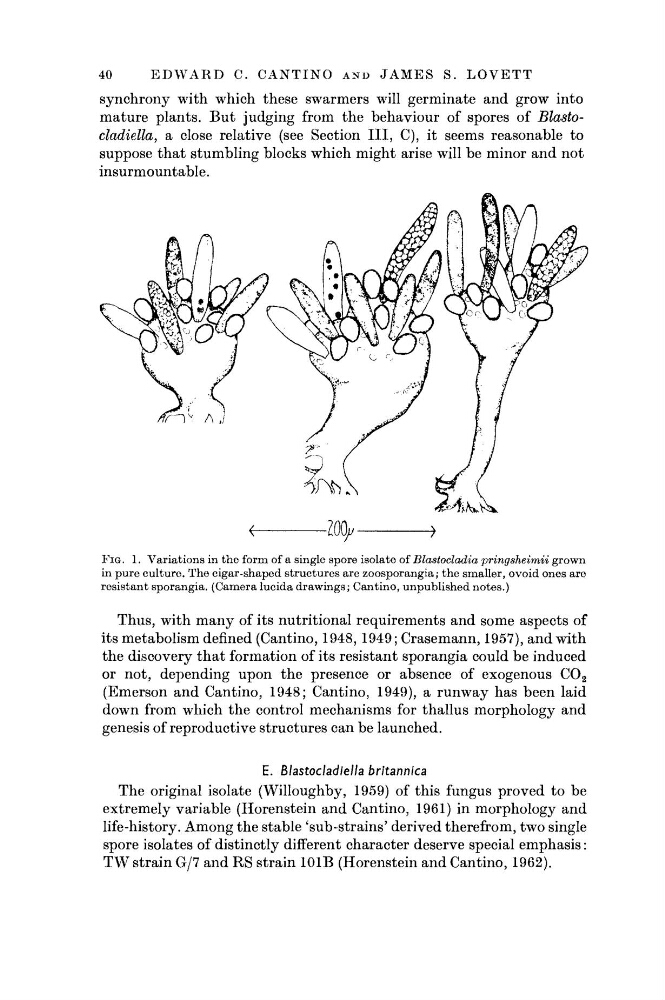
FIG. 1. Variations in the form of a single spore isolate of Blastocladia pringsheimii grown
in pure culture. The cigar-shaped structures are zoosporangia ; the smaller, ovoid ones are
resistant sporangia. (Camera lucida drawings; Cantino, unpublished notes.)
Thus, with many of its nutritional requirements and some aspects of
its metabolism defined (Cantino, 1948, 1949; Crasemann, 1957), and with
the discovery that formation of its resistant sporangia could be induced
or not, depending upon the presence or absence of exogenous C0 2
(Emerson and Cantino, 1948; Cantino, 1949), a runway has been laid
down from which the control mechanisms for thallus morphology and
genesis of reproductive structures can be launched.
E. Blastocladiella
britannica
The original isolate (Willoughby, 1959) of this fungus proved to be
extremely variable (Horenstein and Cantino, 1961) in morphology and
life-history. Among the stable 'sub-strains' derived therefrom, two single
spore isolates of distinctly different character deserve special emphasis:
TW strain G/7 and RS strain 101B (Horenstein and Cantino, 1962).
EDWARD C. CANTINO AND JAMES S. LOVETT
synchrony with which these swarmers will germinate and grow into
mature plants. But judging from the behaviour of spores of Blastocladiella, a close relative (see Section III, C), it seems reasonable to
suppose that stumbling blocks which might arise will be minor and not
insurmountable.
<
ZOO//
>
FIG. 1. Variations in the form of a single spore isolate of Blastocladia pringsheimii grown
in pure culture. The cigar-shaped structures are zoosporangia ; the smaller, ovoid ones are
resistant sporangia. (Camera lucida drawings; Cantino, unpublished notes.)
Thus, with many of its nutritional requirements and some aspects of
its metabolism defined (Cantino, 1948, 1949; Crasemann, 1957), and with
the discovery that formation of its resistant sporangia could be induced
or not, depending upon the presence or absence of exogenous C0 2
(Emerson and Cantino, 1948; Cantino, 1949), a runway has been laid
down from which the control mechanisms for thallus morphology and
genesis of reproductive structures can be launched.
E. Blastocladiella
britannica
The original isolate (Willoughby, 1959) of this fungus proved to be
extremely variable (Horenstein and Cantino, 1961) in morphology and
life-history. Among the stable 'sub-strains' derived therefrom, two single
spore isolates of distinctly different character deserve special emphasis:
TW strain G/7 and RS strain 101B (Horenstein and Cantino, 1962).