

CELL DIVISIONS
339
of τ η /τ 0 in sturgeons and sevruga (according to the data of Dettlaff and
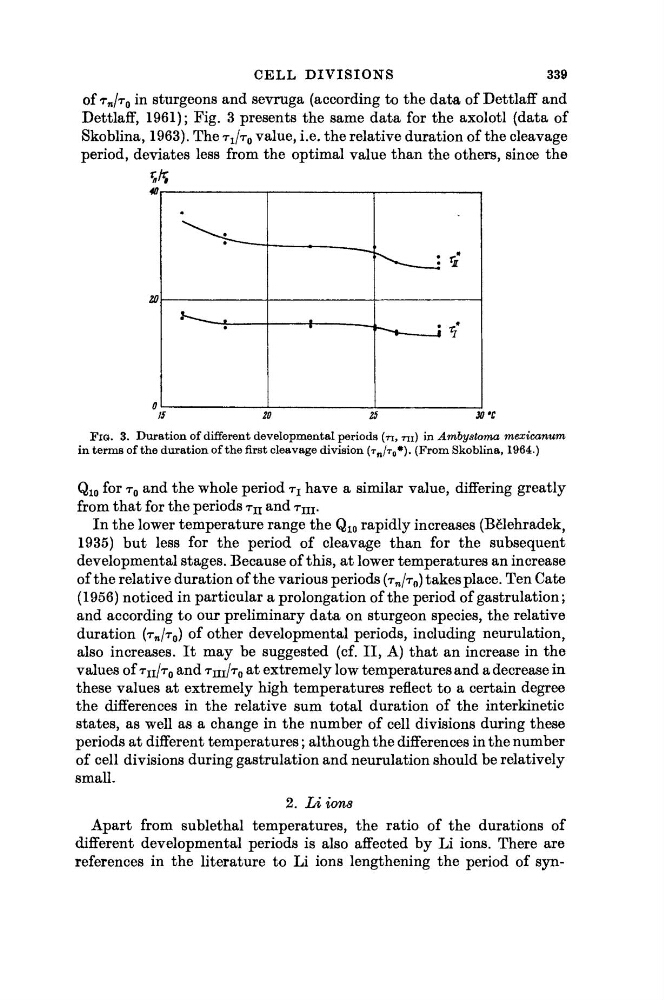
Dettlaff, 1961); Fig. 3 presents the same data for the axolotl (data of
Skoblina, 1963). The TJT Q value, i.e. the relative duration of the cleavage
period, deviates less from the optimal value than the others, since the
<0\
20\
f
•
1
·
*
15
20
25
30 °C
FIG. 3. Duration of different developmental periods (n, m) in Ambystoma mexicanum
in terms of the duration of the first cleavage division (τ η /τ 0
# ). (From Skoblina, 1964.)
Q 10 for r 0 and the whole period r x have a similar value, differing greatly
from that for the periods τ π and τ ΠΙ .
In the lower temperature range the Q 10 rapidly increases (Bëlehradek,
1935) but less for the period of cleavage than for the subsequent
developmental stages. Because of this, at lower temperatures an increase
of the relative duration of the various periods (τ η /τ 0 ) takes place. Ten Cate
(1956) noticed in particular a prolongation of the period of gastrulation;
and according to our preliminary data on sturgeon species, the relative
duration (r n /r 0 ) of other developmental periods, including neurulation,
also increases. It may be suggested (cf. II, A) that an increase in the
values of τ π /τ 0 and τ ΙΠ /τ 0 at extremely low temperatures and a decrease in
these values at extremely high temperatures reflect to a certain degree
the differences in the relative sum total duration of the interkinetic
states, as well as a change in the number of cell divisions during these
periods at different temperatures ; although the differences in the number
of cell divisions during gastrulation and neurulation should be relatively
small.
2. Li ions
Apart from sublethal temperatures, the ratio of the durations of
different developmental periods is also affected by Li ions. There are
references in the literature to Li ions lengthening the period of syn-
339
of τ η /τ 0 in sturgeons and sevruga (according to the data of Dettlaff and
Dettlaff, 1961); Fig. 3 presents the same data for the axolotl (data of
Skoblina, 1963). The TJT Q value, i.e. the relative duration of the cleavage
period, deviates less from the optimal value than the others, since the
<0\
20\
f
•
1
·
*
15
20
25
30 °C
FIG. 3. Duration of different developmental periods (n, m) in Ambystoma mexicanum
in terms of the duration of the first cleavage division (τ η /τ 0
# ). (From Skoblina, 1964.)
Q 10 for r 0 and the whole period r x have a similar value, differing greatly
from that for the periods τ π and τ ΠΙ .
In the lower temperature range the Q 10 rapidly increases (Bëlehradek,
1935) but less for the period of cleavage than for the subsequent
developmental stages. Because of this, at lower temperatures an increase
of the relative duration of the various periods (τ η /τ 0 ) takes place. Ten Cate
(1956) noticed in particular a prolongation of the period of gastrulation;
and according to our preliminary data on sturgeon species, the relative
duration (r n /r 0 ) of other developmental periods, including neurulation,
also increases. It may be suggested (cf. II, A) that an increase in the
values of τ π /τ 0 and τ ΙΠ /τ 0 at extremely low temperatures and a decrease in
these values at extremely high temperatures reflect to a certain degree
the differences in the relative sum total duration of the interkinetic
states, as well as a change in the number of cell divisions during these
periods at different temperatures ; although the differences in the number
of cell divisions during gastrulation and neurulation should be relatively
small.
2. Li ions
Apart from sublethal temperatures, the ratio of the durations of
different developmental periods is also affected by Li ions. There are
references in the literature to Li ions lengthening the period of syn-