

DEVELOPMENT OF GASTROPODS
25
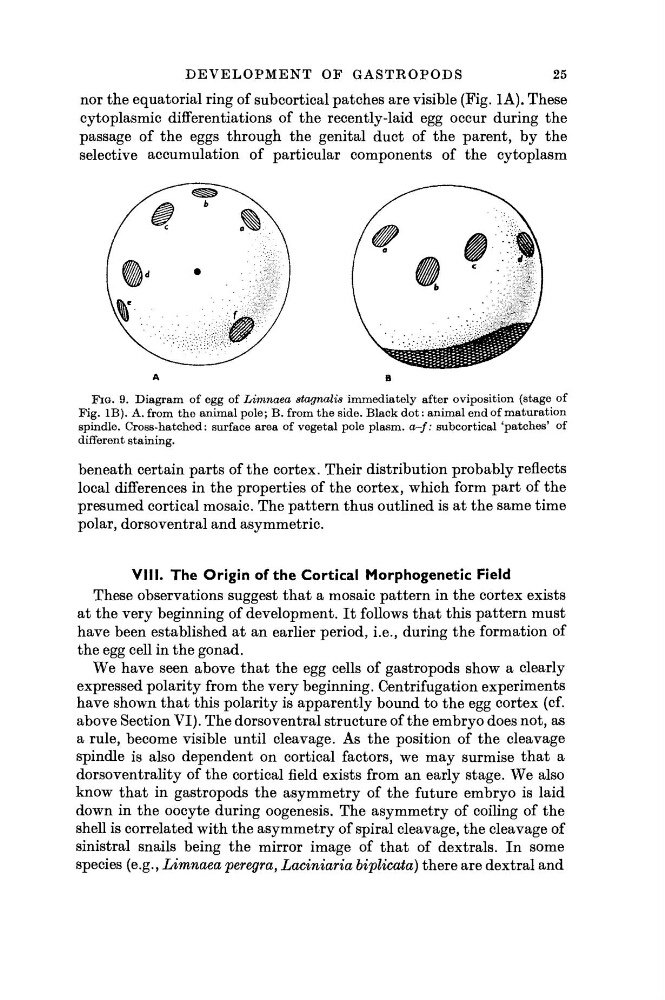
nor the equatorial ring of subcortical patches are visible (Fig. 1A). These
cytoplasmic differentiations of the recently-laid egg occur during the
passage of the eggs through the genital duct of the parent, by the
selective accumulation of particular components of the cytoplasm
FIG. 9. Diagram of egg of Limnaea stagnalis immediately after oviposition (stage of
Fig. IB). A. from the animal pole; B. from the side. Black dot: animal end of maturation
spindle. Cross-hatched: surface area of vegetal pole plasm, a-f: subcortical 'patches' of
different staining.
beneath certain parts of the cortex. Their distribution probably reflects
local differences in the properties of the cortex, which form part of the
presumed cortical mosaic. The pattern thus outlined is at the same time
polar, dorsoventral and asymmetric.
VIII. The Origin of the Cortical Morphogenetic Field
These observations suggest that a mosaic pattern in the cortex exists
at the very beginning of development. It follows that this pattern must
have been established at an earlier period, i.e., during the formation of
the egg cell in the gonad.
We have seen above that the egg cells of gastropods show a clearly
expressed polarity from the very beginning. Centrifugation experiments
have shown that this polarity is apparently bound to the egg cortex (cf.
above Section VI). The dorsoventral structure of the embryo does not, as
a rule, become visible until cleavage. As the position of the cleavage
spindle is also dependent on cortical factors, we may surmise that a
dorsoventrality of the cortical field exists from an early stage. We also
know that in gastropods the asymmetry of the future embryo is laid
down in the oocyte during oogenesis. The asymmetry of coiling of the
shell is correlated with the asymmetry of spiral cleavage, the cleavage of
sinistral snails being the mirror image of that of dextrals. In some
species (e.g., Limnaea peregra, Laciniaria biplicata) there are dextral and
A
Β
25
nor the equatorial ring of subcortical patches are visible (Fig. 1A). These
cytoplasmic differentiations of the recently-laid egg occur during the
passage of the eggs through the genital duct of the parent, by the
selective accumulation of particular components of the cytoplasm
FIG. 9. Diagram of egg of Limnaea stagnalis immediately after oviposition (stage of
Fig. IB). A. from the animal pole; B. from the side. Black dot: animal end of maturation
spindle. Cross-hatched: surface area of vegetal pole plasm, a-f: subcortical 'patches' of
different staining.
beneath certain parts of the cortex. Their distribution probably reflects
local differences in the properties of the cortex, which form part of the
presumed cortical mosaic. The pattern thus outlined is at the same time
polar, dorsoventral and asymmetric.
VIII. The Origin of the Cortical Morphogenetic Field
These observations suggest that a mosaic pattern in the cortex exists
at the very beginning of development. It follows that this pattern must
have been established at an earlier period, i.e., during the formation of
the egg cell in the gonad.
We have seen above that the egg cells of gastropods show a clearly
expressed polarity from the very beginning. Centrifugation experiments
have shown that this polarity is apparently bound to the egg cortex (cf.
above Section VI). The dorsoventral structure of the embryo does not, as
a rule, become visible until cleavage. As the position of the cleavage
spindle is also dependent on cortical factors, we may surmise that a
dorsoventrality of the cortical field exists from an early stage. We also
know that in gastropods the asymmetry of the future embryo is laid
down in the oocyte during oogenesis. The asymmetry of coiling of the
shell is correlated with the asymmetry of spiral cleavage, the cleavage of
sinistral snails being the mirror image of that of dextrals. In some
species (e.g., Limnaea peregra, Laciniaria biplicata) there are dextral and
A
Β