

234
LEO LEMEZ
survival curve, therefore, in Fig. 10A is much smaller than the corresponding area in Fig. 10B where turnover is included in total destruction.
While the preceding data are relatively well established, we lack
values for the cryptogenic turnover of definitive erythrocytes with oval
and oblong nuclei (E II 2 ). Only their maximal value—about 7-9
milliards—on the 18th day is known; they fall in number by some
750 million between the 18th and 20th days of incubation and rise by
140 million on the 1st postembryonic day. This is supplemented by
another 200 million, an allowance for their cryptogenic turnover after
the 18th day calculated in an analogous way to that for the turnover of
Ε II X erythrocytes. As a rough approximation, the cryptogenic turnover
of Ε II2 erythrocytes could be based on their average life span, which
might be supposed to be comparable to that of primitive erythrocytes
(8 days) and the definitive Ε II X erythrocytes (4-7-5-7 days). Let us take
a median value of 7 days for the average life span of Ε II 2 erythrocytes,
at least for those produced in the first two-thirds of the incubation
period, which are comparable with erythrocytes of type Ε II X in their
reticulocyte rate (Lemez, 1953). This implies that all Ε II 2 erythrocytes
produced up to the 13th day of incubation, some 3-8 milliards (Fig. 10B),
will be destroyed by the 1st day after hatching. This number includes,
of course, the observed decrease by 750 million and turnover of 200
million referred to above. Because the cryptogenic turnover was not
estimated directly, its area in Fig. 10B is marked by a question-mark.
The sum total of Ε II 2 produced during the period concerned would thus
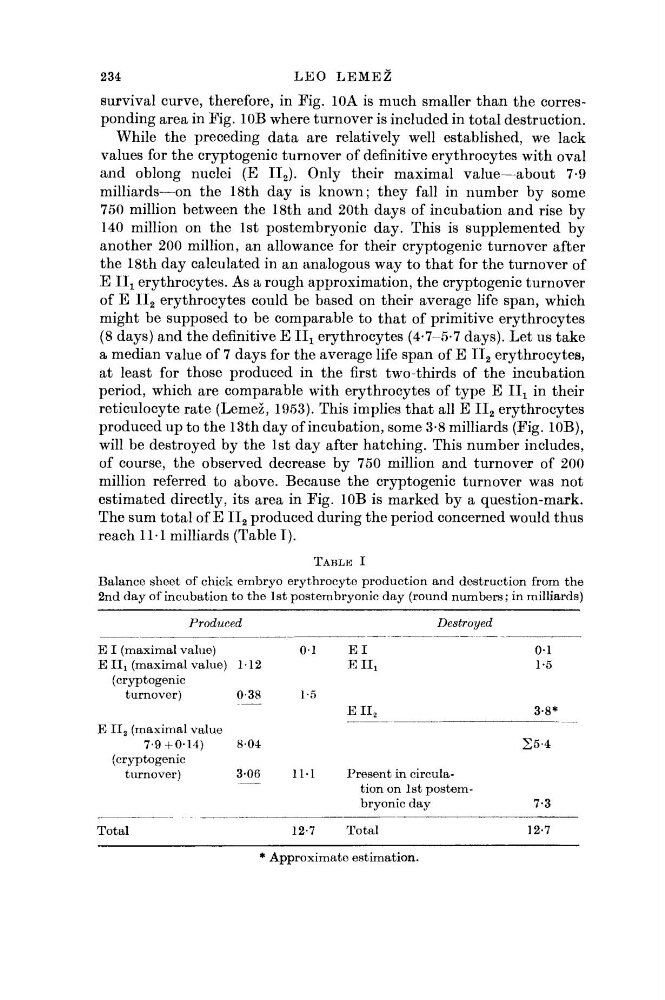
reach 11-1 milliards (Table I).
TABLE I
Balance sheet of chick embryo erythrocyte production and destruction from the
2nd day of incubation to the 1st postembryonic day (round numbers; in milliards)
Produced
Destroyed
Ε I (maximal value)
01
EI
01
Ε II,. (maximal value) 112
E IIj
1-5
(cryptogenic
turnover)
0-38
1-5
EII 2
3-8*
Ε II 2 (maximal value
7-9+014)
804
Σ5-4
(cryptogenic
turnover)
306
111
Present in circulation on 1st postembryonic day
7-3
Total
12-7
Total
12-7
Approximate estimation.
LEO LEMEZ
survival curve, therefore, in Fig. 10A is much smaller than the corresponding area in Fig. 10B where turnover is included in total destruction.
While the preceding data are relatively well established, we lack
values for the cryptogenic turnover of definitive erythrocytes with oval
and oblong nuclei (E II 2 ). Only their maximal value—about 7-9
milliards—on the 18th day is known; they fall in number by some
750 million between the 18th and 20th days of incubation and rise by
140 million on the 1st postembryonic day. This is supplemented by
another 200 million, an allowance for their cryptogenic turnover after
the 18th day calculated in an analogous way to that for the turnover of
Ε II X erythrocytes. As a rough approximation, the cryptogenic turnover
of Ε II2 erythrocytes could be based on their average life span, which
might be supposed to be comparable to that of primitive erythrocytes
(8 days) and the definitive Ε II X erythrocytes (4-7-5-7 days). Let us take
a median value of 7 days for the average life span of Ε II 2 erythrocytes,
at least for those produced in the first two-thirds of the incubation
period, which are comparable with erythrocytes of type Ε II X in their
reticulocyte rate (Lemez, 1953). This implies that all Ε II 2 erythrocytes
produced up to the 13th day of incubation, some 3-8 milliards (Fig. 10B),
will be destroyed by the 1st day after hatching. This number includes,
of course, the observed decrease by 750 million and turnover of 200
million referred to above. Because the cryptogenic turnover was not
estimated directly, its area in Fig. 10B is marked by a question-mark.
The sum total of Ε II 2 produced during the period concerned would thus
reach 11-1 milliards (Table I).
TABLE I
Balance sheet of chick embryo erythrocyte production and destruction from the
2nd day of incubation to the 1st postembryonic day (round numbers; in milliards)
Produced
Destroyed
Ε I (maximal value)
01
EI
01
Ε II,. (maximal value) 112
E IIj
1-5
(cryptogenic
turnover)
0-38
1-5
EII 2
3-8*
Ε II 2 (maximal value
7-9+014)
804
Σ5-4
(cryptogenic
turnover)
306
111
Present in circulation on 1st postembryonic day
7-3
Total
12-7
Total
12-7
Approximate estimation.