

228
LEO LEMEZ
clear that the calculated mitotic time must be much shorter than the
measured in order to allow for cell immigration.
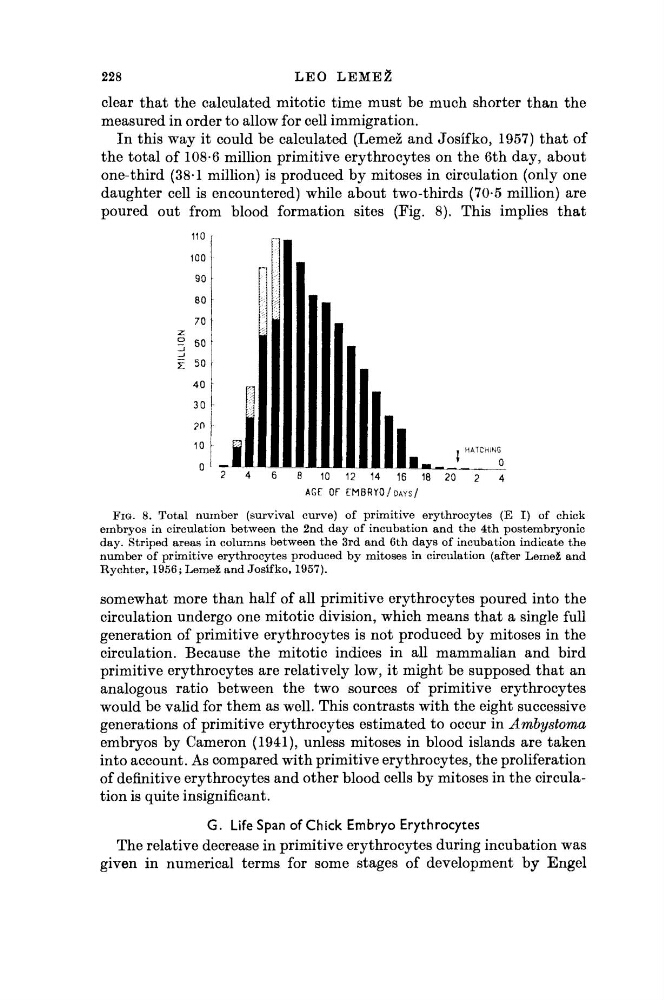
In this way it could be calculated (Lemez and Josifko, 1957) that of
the total of 108-6 million primitive erythrocytes on the 6th day, about
one-third (38-1 million) is produced by mitoses in circulation (only one
daughter cell is encountered) while about two-thirds (70-5 million) are
poured out from blood formation sites (Fig. 8). This implies that
!
miiiiiiiiiiii
-••••••miiiiii1
ο
2
4
6
8
10
12
14
16
18
20
2
4
AGE OF EMBRYO/days/
FIG. 8. Total number (survival curve) of primitive erythrocytes (Ε I) of chick
embryos in circulation between the 2nd day of incubation and the 4th postembryonic
day. Striped areas in columns between the 3rd and 6th days of incubation indicate the
number of primitive erythrocytes produced by mitoses in circulation (after Lemei and
Rychter, 1956; Lemei and Josifko, 1957).
somewhat more than half of all primitive erythrocytes poured into the
circulation undergo one mitotic division, which means that a single full
generation of primitive erythrocytes is not produced by mitoses in the
circulation. Because the mitotic indices in all mammalian and bird
primitive erythrocytes are relatively low, it might be supposed that an
analogous ratio between the two sources of primitive erythrocytes
would be valid for them as well. This contrasts with the eight successive
generations of primitive erythrocytes estimated to occur in Ambystoma
embryos by Cameron (1941), unless mitoses in blood islands are taken
into account. As compared with primitive erythrocytes, the proliferation
of definitive erythrocytes and other blood cells by mitoses in the circulation is quite insignificant.
G. Life Span of Chick Embryo Erythrocytes
The relative decrease in primitive erythrocytes during incubation was
given in numerical terms for some stages of development by Engel
LEO LEMEZ
clear that the calculated mitotic time must be much shorter than the
measured in order to allow for cell immigration.
In this way it could be calculated (Lemez and Josifko, 1957) that of
the total of 108-6 million primitive erythrocytes on the 6th day, about
one-third (38-1 million) is produced by mitoses in circulation (only one
daughter cell is encountered) while about two-thirds (70-5 million) are
poured out from blood formation sites (Fig. 8). This implies that
!
miiiiiiiiiiii
-••••••miiiiii1
ο
2
4
6
8
10
12
14
16
18
20
2
4
AGE OF EMBRYO/days/
FIG. 8. Total number (survival curve) of primitive erythrocytes (Ε I) of chick
embryos in circulation between the 2nd day of incubation and the 4th postembryonic
day. Striped areas in columns between the 3rd and 6th days of incubation indicate the
number of primitive erythrocytes produced by mitoses in circulation (after Lemei and
Rychter, 1956; Lemei and Josifko, 1957).
somewhat more than half of all primitive erythrocytes poured into the
circulation undergo one mitotic division, which means that a single full
generation of primitive erythrocytes is not produced by mitoses in the
circulation. Because the mitotic indices in all mammalian and bird
primitive erythrocytes are relatively low, it might be supposed that an
analogous ratio between the two sources of primitive erythrocytes
would be valid for them as well. This contrasts with the eight successive
generations of primitive erythrocytes estimated to occur in Ambystoma
embryos by Cameron (1941), unless mitoses in blood islands are taken
into account. As compared with primitive erythrocytes, the proliferation
of definitive erythrocytes and other blood cells by mitoses in the circulation is quite insignificant.
G. Life Span of Chick Embryo Erythrocytes
The relative decrease in primitive erythrocytes during incubation was
given in numerical terms for some stages of development by Engel