

224
LEO LEMEJ2
5 r
I
AGE OF EMBRYO/DAYS/
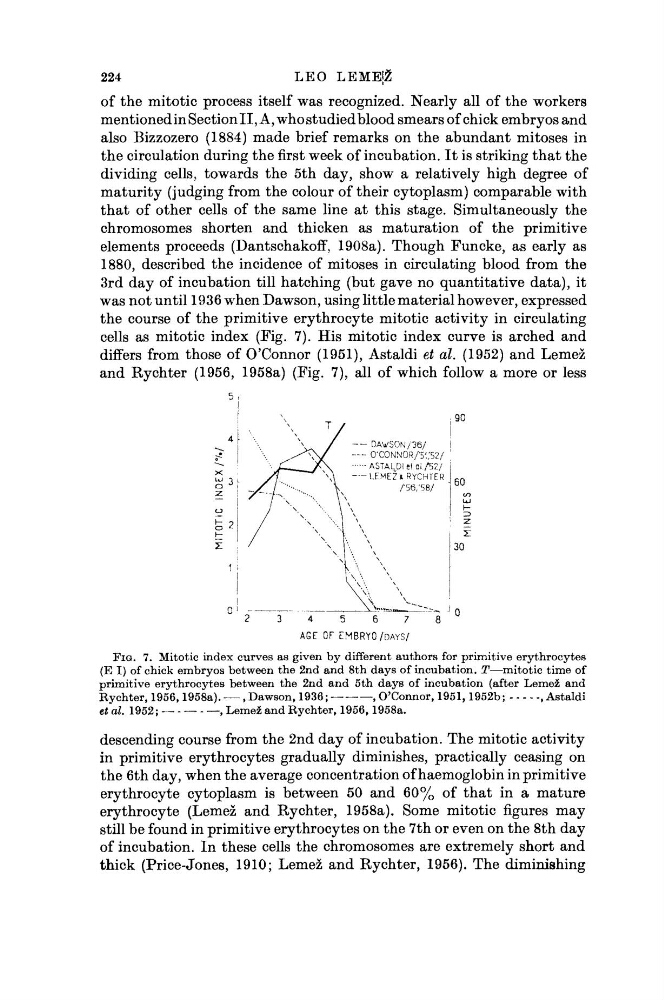
FIG. 7. Mitotic index curves as given by different authors for primitive erythrocytes
(Ε I) of chick embryos between the 2nd and 8th days of incubation. Τ—mitotic time of
primitive erythrocytes between the 2nd and 5th days of incubation (after Lemei and
Rychter, 1956,1958a). — , Dawson, 1936;
, O'Connor, 1951,1952b;
, Astaldi
et al. 1952;
, Lemei and Rychter, 1956, 1958a.
descending course from the 2nd day of incubation. The mitotic activity
in primitive erythrocytes gradually diminishes, practically ceasing on
the 6th day, when the average concentration of haemoglobin in primitive
erythrocyte cytoplasm is between 50 and 60% of that in a mature
erythrocyte (Lemez and Rychter, 1958a). Some mitotic figures may
still be found in primitive erythrocytes on the 7th or even on the 8th day
of incubation. In these cells the chromosomes are extremely short and
thick (Price-Jones, 1910; Lemez and Rychter, 1956). The diminishing
of the mitotic process itself was recognized. Nearly all of the workers
mentioned in Section II, A, who studied blood smears of chick embryos and
also Bizzozero (1884) made brief remarks on the abundant mitoses in
the circulation during the first week of incubation. It is striking that the
dividing cells, towards the 5th day, show a relatively high degree of
maturity (judging from the colour of their cytoplasm) comparable with
that of other cells of the same line at this stage. Simultaneously the
chromosomes shorten and thicken as maturation of the primitive
elements proceeds (Dantschakoff, 1908a). Though Funcke, as early as
1880, described the incidence of mitoses in circulating blood from the
3rd day of incubation till hatching (but gave no quantitative data), it
was not until 1936 when Dawson, using little material however, expressed
the course of the primitive erythrocyte mitotic activity in circulating
cells as mitotic index (Fig. 7). His mitotic index curve is arched and
differs from those of O'Connor (1951), Astaldi et al. (1952) and Lemez
and Rychter (1956, 1958a) (Fig. 7), all of which follow a more or less
LEO LEMEJ2
5 r
I
AGE OF EMBRYO/DAYS/
FIG. 7. Mitotic index curves as given by different authors for primitive erythrocytes
(Ε I) of chick embryos between the 2nd and 8th days of incubation. Τ—mitotic time of
primitive erythrocytes between the 2nd and 5th days of incubation (after Lemei and
Rychter, 1956,1958a). — , Dawson, 1936;
, O'Connor, 1951,1952b;
, Astaldi
et al. 1952;
, Lemei and Rychter, 1956, 1958a.
descending course from the 2nd day of incubation. The mitotic activity
in primitive erythrocytes gradually diminishes, practically ceasing on
the 6th day, when the average concentration of haemoglobin in primitive
erythrocyte cytoplasm is between 50 and 60% of that in a mature
erythrocyte (Lemez and Rychter, 1958a). Some mitotic figures may
still be found in primitive erythrocytes on the 7th or even on the 8th day
of incubation. In these cells the chromosomes are extremely short and
thick (Price-Jones, 1910; Lemez and Rychter, 1956). The diminishing
of the mitotic process itself was recognized. Nearly all of the workers
mentioned in Section II, A, who studied blood smears of chick embryos and
also Bizzozero (1884) made brief remarks on the abundant mitoses in
the circulation during the first week of incubation. It is striking that the
dividing cells, towards the 5th day, show a relatively high degree of
maturity (judging from the colour of their cytoplasm) comparable with
that of other cells of the same line at this stage. Simultaneously the
chromosomes shorten and thicken as maturation of the primitive
elements proceeds (Dantschakoff, 1908a). Though Funcke, as early as
1880, described the incidence of mitoses in circulating blood from the
3rd day of incubation till hatching (but gave no quantitative data), it
was not until 1936 when Dawson, using little material however, expressed
the course of the primitive erythrocyte mitotic activity in circulating
cells as mitotic index (Fig. 7). His mitotic index curve is arched and
differs from those of O'Connor (1951), Astaldi et al. (1952) and Lemez
and Rychter (1956, 1958a) (Fig. 7), all of which follow a more or less