

EARLY DEVELOPMENT OF THE SEA URCHIN
131
be due to the removal of some inhibitor responsible for the blocking of a
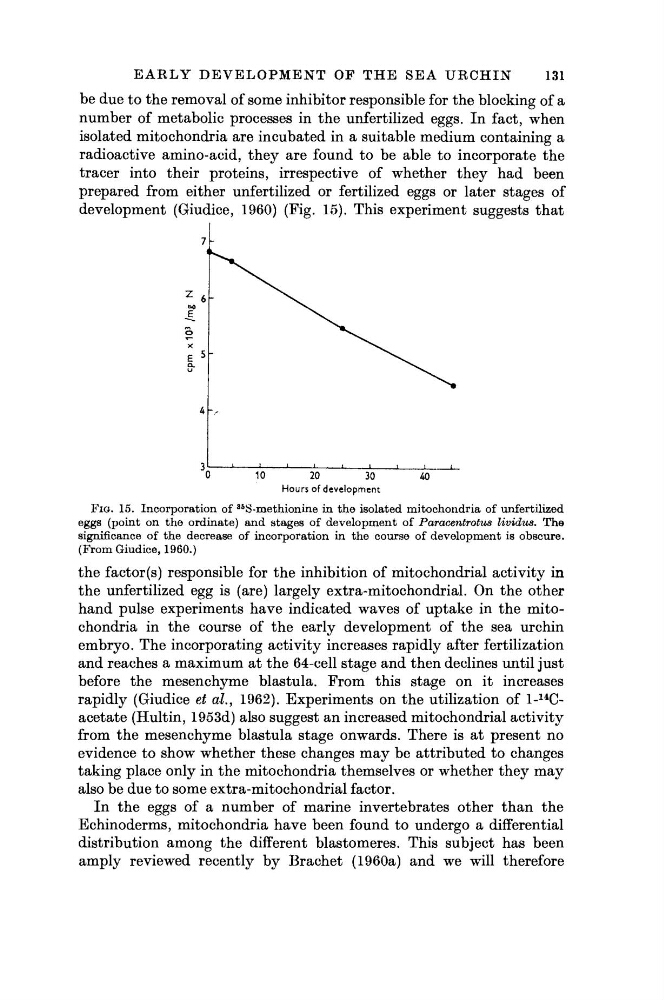
number of metabolic processes in the unfertilized eggs. In fact, when
isolated mitochondria are incubated in a suitable medium containing a
radioactive amino-acid, they are found to be able to incorporate the
tracer into their proteins, irrespective of whether they had been
prepared from either unfertilized or fertilized eggs or later stages of
development (Giudice, 1960) (Fig. 15). This experiment suggests that
7h
4 Κ
3
1
1
1
1
1
1
1
1
ι
ίΟ
10
20
30
40
Hours of development
FIG. 15. Incorporation of
a5
S-methionine in the isolated mitochondria of unfertilized
eggs (point on the ordinate) and stages of development of Paracentrotus lividus. The
significance of the decrease of incorporation in the course of development is obscure.
(From Giudice, 1960.)
the factor(s) responsible for the inhibition of mitochondrial activity in
the unfertilized egg is (are) largely extra-mitochondrial. On the other
hand pulse experiments have indicated waves of uptake in the mitochondria in the course of the early development of the sea urchin
embryo. The incorporating activity increases rapidly after fertilization
and reaches a maximum at the 64-cell stage and then declines until just
before the mesenchyme blastula. From this stage on it increases
rapidly (Giudice et al., 1962). Experiments on the utilization of 114
Cacetate (Hultin, 1953d) also suggest an increased mitochondrial activity
from the mesenchyme blastula stage onwards. There is at present no
evidence to show whether these changes may be attributed to changes
taking place only in the mitochondria themselves or whether they may
also be due to some extra-mitochondrial factor.
In the eggs of a number of marine invertebrates other than the
Echinoderms, mitochondria have been found to undergo a differential
distribution among the different blastomeres. This subject has been
amply reviewed recently by Brächet (1960a) and we will therefore
131
be due to the removal of some inhibitor responsible for the blocking of a
number of metabolic processes in the unfertilized eggs. In fact, when
isolated mitochondria are incubated in a suitable medium containing a
radioactive amino-acid, they are found to be able to incorporate the
tracer into their proteins, irrespective of whether they had been
prepared from either unfertilized or fertilized eggs or later stages of
development (Giudice, 1960) (Fig. 15). This experiment suggests that
7h
4 Κ
3
1
1
1
1
1
1
1
1
ι
ίΟ
10
20
30
40
Hours of development
FIG. 15. Incorporation of
a5
S-methionine in the isolated mitochondria of unfertilized
eggs (point on the ordinate) and stages of development of Paracentrotus lividus. The
significance of the decrease of incorporation in the course of development is obscure.
(From Giudice, 1960.)
the factor(s) responsible for the inhibition of mitochondrial activity in
the unfertilized egg is (are) largely extra-mitochondrial. On the other
hand pulse experiments have indicated waves of uptake in the mitochondria in the course of the early development of the sea urchin
embryo. The incorporating activity increases rapidly after fertilization
and reaches a maximum at the 64-cell stage and then declines until just
before the mesenchyme blastula. From this stage on it increases
rapidly (Giudice et al., 1962). Experiments on the utilization of 114
Cacetate (Hultin, 1953d) also suggest an increased mitochondrial activity
from the mesenchyme blastula stage onwards. There is at present no
evidence to show whether these changes may be attributed to changes
taking place only in the mitochondria themselves or whether they may
also be due to some extra-mitochondrial factor.
In the eggs of a number of marine invertebrates other than the
Echinoderms, mitochondria have been found to undergo a differential
distribution among the different blastomeres. This subject has been
amply reviewed recently by Brächet (1960a) and we will therefore