

126
ALBERTO MONROY AND RACHELE MAGGIO
By serological methods it has further been shown that in the hybrid
crossing Paracentrotus $ χ Psammechinus $ it is also at the mesenchyme
blastula stage that paternal antigens can be detected (Harding et al.,
1954). Hence, all these investigations point to the blastula stage as the
real turning point in sea urchin morphogenesis.
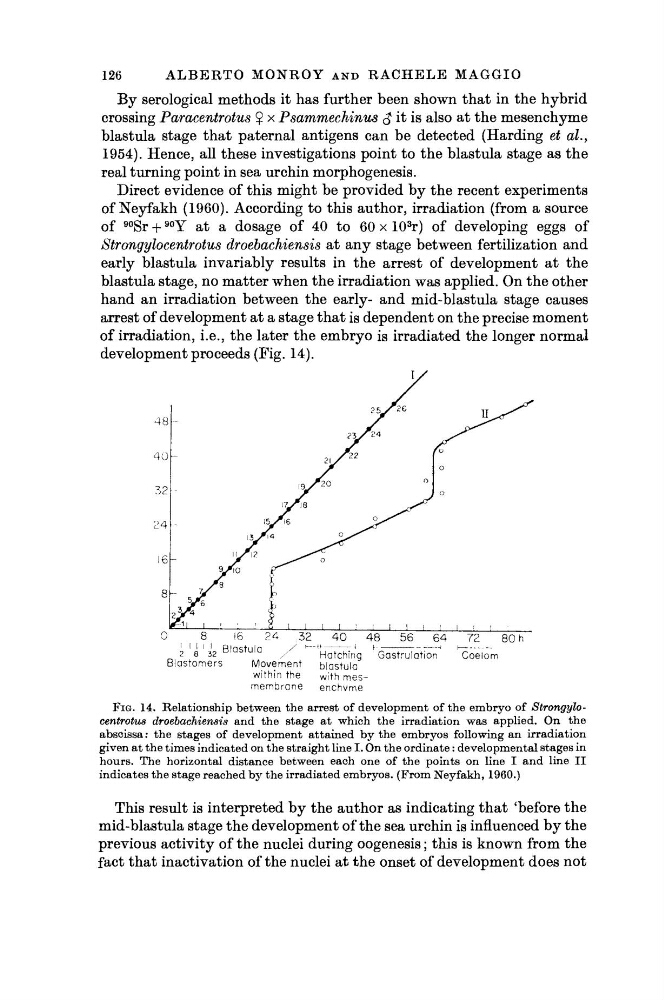
Direct evidence of this might be provided by the recent experiments
of Neyfakh (1960). According to this author, irradiation (from a source
of
90
Sr +
9 0
Y at a dosage of 40 to 60 χ 10
3 r) of developing eggs of
Strongylocentrotus
droebachiensis at any stage between fertilization and
early blastula invariably results in the arrest of development at the
blastula stage, no matter when the irradiation was applied. On the other
hand an irradiation between the early- and mid-blastula stage causes
arrest of development at a stage that is dependent on the precise moment
of irradiation, i.e., the later the embryo is irradiated the longer normal
development proceeds (Fig. 14).
within the
with mesmembrane
enchvme
FIG. 14. Relationship between the arrest of development of the embryo of Strongylocentrotus droebachiensis and the stage at which the irradiation was applied. On the
abscissa : the stages of development attained by the embryos following an irradiation
given at the times indicated on the straight line I. On the ordinate : developmental stages in
hours. The horizontal distance between each one of the points on line I and line II
indicates the stage reached by the irradiated embryos. (From Neyfakh, 1960.)
This result is interpreted by the author as indicating that 'before the
mid-blastula stage the development of the sea urchin is influenced by the
previous activity of the nuclei during oogenesis ; this is known from the
fact that inactivation of the nuclei at the onset of development does not
ALBERTO MONROY AND RACHELE MAGGIO
By serological methods it has further been shown that in the hybrid
crossing Paracentrotus $ χ Psammechinus $ it is also at the mesenchyme
blastula stage that paternal antigens can be detected (Harding et al.,
1954). Hence, all these investigations point to the blastula stage as the
real turning point in sea urchin morphogenesis.
Direct evidence of this might be provided by the recent experiments
of Neyfakh (1960). According to this author, irradiation (from a source
of
90
Sr +
9 0
Y at a dosage of 40 to 60 χ 10
3 r) of developing eggs of
Strongylocentrotus
droebachiensis at any stage between fertilization and
early blastula invariably results in the arrest of development at the
blastula stage, no matter when the irradiation was applied. On the other
hand an irradiation between the early- and mid-blastula stage causes
arrest of development at a stage that is dependent on the precise moment
of irradiation, i.e., the later the embryo is irradiated the longer normal
development proceeds (Fig. 14).
within the
with mesmembrane
enchvme
FIG. 14. Relationship between the arrest of development of the embryo of Strongylocentrotus droebachiensis and the stage at which the irradiation was applied. On the
abscissa : the stages of development attained by the embryos following an irradiation
given at the times indicated on the straight line I. On the ordinate : developmental stages in
hours. The horizontal distance between each one of the points on line I and line II
indicates the stage reached by the irradiated embryos. (From Neyfakh, 1960.)
This result is interpreted by the author as indicating that 'before the
mid-blastula stage the development of the sea urchin is influenced by the
previous activity of the nuclei during oogenesis ; this is known from the
fact that inactivation of the nuclei at the onset of development does not