

DEVELOPMENT OF GASTROPODS
9
If the eggs of Physa or Limnaea are centrifugea, at the 2- or 4-cell stage,
many abnormal embryos are produced (Clement, 1938; Raven and van
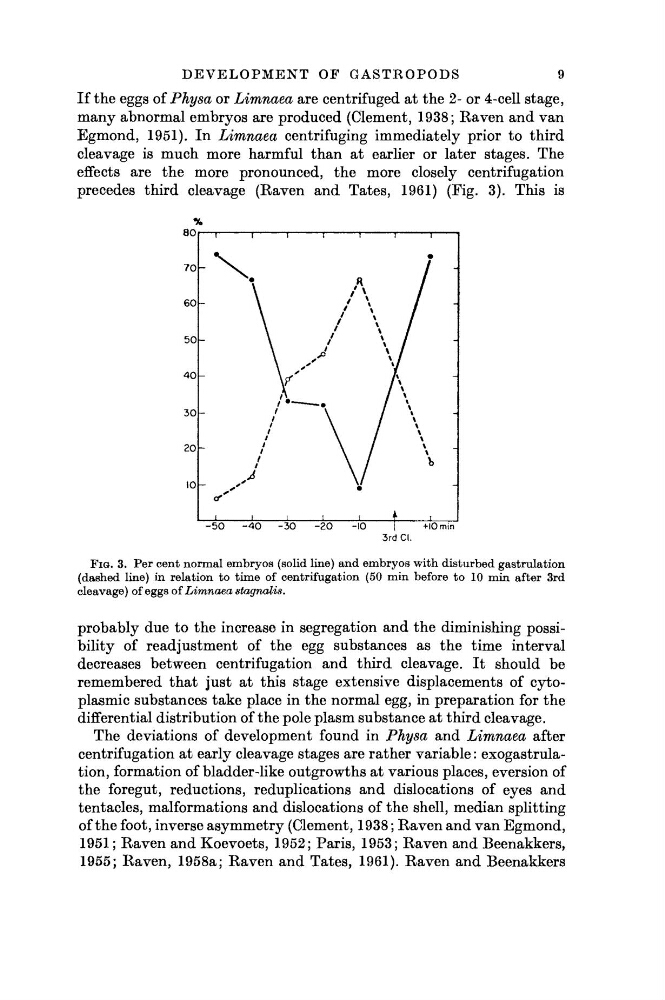
Egmond, 1951). In Limnaea centrifuging immediately prior to third
cleavage is much more harmful than at earlier or later stages. The
effects are the more pronounced, the more closely centrifugation
precedes third cleavage (Raven and Tates, 1961) (Fig. 3). This is
3rd CI.
Fio. 3. Per cent normal embryos (solid line) and embryos with disturbed gastrulation
(dashed line) in relation to time of centrifugation (50 min before to 10 min after 3rd
cleavage) of eggs of Limnaea stagnalis.
probably due to the increase in segregation and the diminishing possibility of readjustment of the egg substances as the time interval
decreases between centrifugation and third cleavage. It should be
remembered that just at this stage extensive displacements of cytoplasmic substances take place in the normal egg, in preparation for the
differential distribution of the pole plasm substance at third cleavage.
The deviations of development found in Physa and Limnaea after
centrifugation at early cleavage stages are rather variable : exogastrulation, formation of bladder-like outgrowths at various places, eversion of
the foregut, reductions, reduplications and dislocations of eyes and
tentacles, malformations and dislocations of the shell, median splitting
of the foot, inverse asymmetry (Clement, 1938 ; Raven and van Egmond,
1951 ; Raven and Koevoets, 1952; Paris, 1953; Raven and Beenakkers,
1955; Raven, 1958a; Raven and Tates, 1961). Raven and Beenakkers
9
If the eggs of Physa or Limnaea are centrifugea, at the 2- or 4-cell stage,
many abnormal embryos are produced (Clement, 1938; Raven and van
Egmond, 1951). In Limnaea centrifuging immediately prior to third
cleavage is much more harmful than at earlier or later stages. The
effects are the more pronounced, the more closely centrifugation
precedes third cleavage (Raven and Tates, 1961) (Fig. 3). This is
3rd CI.
Fio. 3. Per cent normal embryos (solid line) and embryos with disturbed gastrulation
(dashed line) in relation to time of centrifugation (50 min before to 10 min after 3rd
cleavage) of eggs of Limnaea stagnalis.
probably due to the increase in segregation and the diminishing possibility of readjustment of the egg substances as the time interval
decreases between centrifugation and third cleavage. It should be
remembered that just at this stage extensive displacements of cytoplasmic substances take place in the normal egg, in preparation for the
differential distribution of the pole plasm substance at third cleavage.
The deviations of development found in Physa and Limnaea after
centrifugation at early cleavage stages are rather variable : exogastrulation, formation of bladder-like outgrowths at various places, eversion of
the foregut, reductions, reduplications and dislocations of eyes and
tentacles, malformations and dislocations of the shell, median splitting
of the foot, inverse asymmetry (Clement, 1938 ; Raven and van Egmond,
1951 ; Raven and Koevoets, 1952; Paris, 1953; Raven and Beenakkers,
1955; Raven, 1958a; Raven and Tates, 1961). Raven and Beenakkers