

232
GEORGE G. LATIES
quenee, the subsequent oxidative steps in the cycle would be suppressed,
and the net result would be an inordinately large contribution to the
respiration by the single-step oxidation of one substrate alone, and a very
slow accumulation of those components of the cycle one or two steps
removed from the substrate being oxidized. When either hexokinase or
substrate quantities of ADP was added to increase the level of the common intermediate, namely, the phosphate acceptor, malonate inhibition
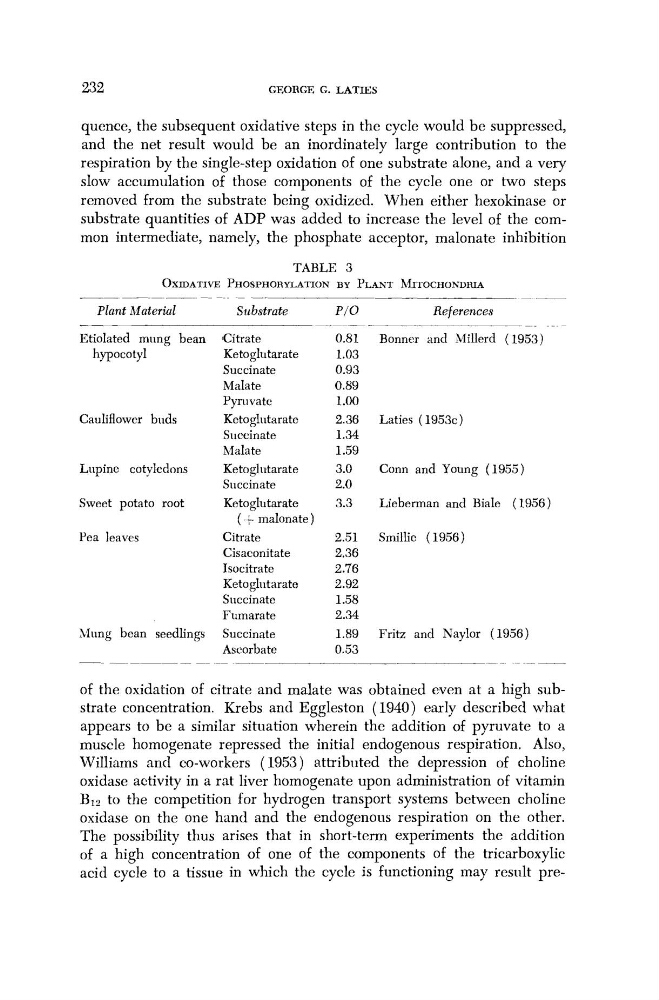
TABLE 3
OXIDATIVE PHOSPHORYLATION BY PLANT MITOCHONDRIA
Plant Material
Substrate
P/O
References
Etiolated mung bean Citrate
0.81
Bonner and Millerd (1953)
hypocotyl
Ketoglutarate
1.03
Succinate
0.93
Malate
0.89
Pyruvate
1.00
Cauliflower buds
Ketoglutarate
2.36
Laties (1953c)
Succinate
1.34
Malate
1.59
Lupine cotyledons
Ketoglutarate
3.0
Conn and Young (1955)
Succinate
2.0
Sweet potato root
Ketoglutarate
3.3
Lieberman and Biale (1956)
(+ malonate)
Pea leaves
Citrate
2.51
Smillie (1956)
Cisaconitate
2.36
Isocitrate
2.76
Ketoglutarate
2.92
Succinate
1.58
Fumarate
2.34
Mung bean seedlings Succinate
1.89
Fritz and Naylor (1956)
Ascorbate
0.53
of the oxidation of citrate and malate was obtained even at a high substrate concentration. Krebs and Eggleston (1940) early described what
appears to be a similar situation wherein the addition of pyruvate to a
muscle homogenate repressed the initial endogenous respiration. Also,
Williams and co-workers (1953) attributed the depression of choline
oxidase activity in a rat liver homogenate upon administration of vitamin
Βi2 to the competition for hydrogen transport systems between choline
oxidase on the one hand and the endogenous respiration on the other.
The possibility thus arises that in short-term experiments the addition
of a high concentration of one of the components of the tricarboxylic
acid cycle to a tissue in which the cycle is functioning may result pre-
GEORGE G. LATIES
quenee, the subsequent oxidative steps in the cycle would be suppressed,
and the net result would be an inordinately large contribution to the
respiration by the single-step oxidation of one substrate alone, and a very
slow accumulation of those components of the cycle one or two steps
removed from the substrate being oxidized. When either hexokinase or
substrate quantities of ADP was added to increase the level of the common intermediate, namely, the phosphate acceptor, malonate inhibition
TABLE 3
OXIDATIVE PHOSPHORYLATION BY PLANT MITOCHONDRIA
Plant Material
Substrate
P/O
References
Etiolated mung bean Citrate
0.81
Bonner and Millerd (1953)
hypocotyl
Ketoglutarate
1.03
Succinate
0.93
Malate
0.89
Pyruvate
1.00
Cauliflower buds
Ketoglutarate
2.36
Laties (1953c)
Succinate
1.34
Malate
1.59
Lupine cotyledons
Ketoglutarate
3.0
Conn and Young (1955)
Succinate
2.0
Sweet potato root
Ketoglutarate
3.3
Lieberman and Biale (1956)
(+ malonate)
Pea leaves
Citrate
2.51
Smillie (1956)
Cisaconitate
2.36
Isocitrate
2.76
Ketoglutarate
2.92
Succinate
1.58
Fumarate
2.34
Mung bean seedlings Succinate
1.89
Fritz and Naylor (1956)
Ascorbate
0.53
of the oxidation of citrate and malate was obtained even at a high substrate concentration. Krebs and Eggleston (1940) early described what
appears to be a similar situation wherein the addition of pyruvate to a
muscle homogenate repressed the initial endogenous respiration. Also,
Williams and co-workers (1953) attributed the depression of choline
oxidase activity in a rat liver homogenate upon administration of vitamin
Βi2 to the competition for hydrogen transport systems between choline
oxidase on the one hand and the endogenous respiration on the other.
The possibility thus arises that in short-term experiments the addition
of a high concentration of one of the components of the tricarboxylic
acid cycle to a tissue in which the cycle is functioning may result pre-