

RESPIRATION RATE IN PLANTS
227
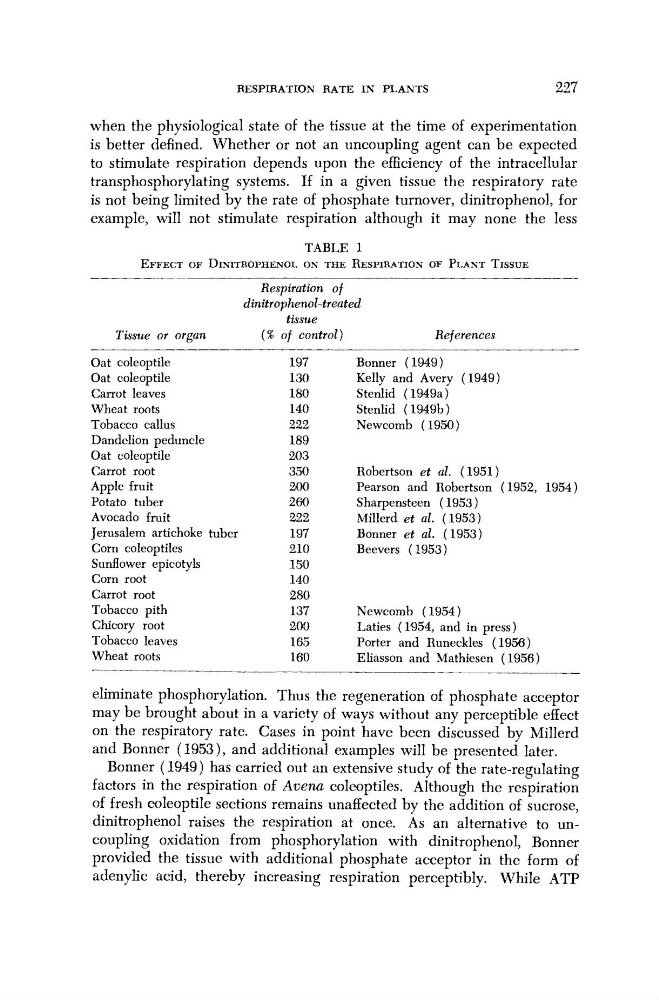
when the physiological state of the tissue at the time of experimentation
is better defined. Whether or not an uncoupling agent can be expected
to stimulate respiration depends upon the efficiency of the intracellular
transphosphorylating systems. If in a given tissue the respiratory rate
is not being limited by the rate of phosphate turnover, dinitrophenol, for
example, will not stimulate respiration although it may none the less
TABLE 1
EFFECT OF DINITROPHENOL ON THE RESPIRATION OF PLANT TISSUE
Respiration of
dinitrophenol-treated
tissue
Tissue or organ
(% of control)
References
Oat coleoptile
197
Bonner (1949)
Oat coleoptile
130
Kelly and Avery (1949)
Carrot leaves
ISO
Stenlid (1949a)
Wheat roots
140
Stenlid (1949b)
Tobacco callus
222
Newcomb (1950)
Dandelion peduncle
189
Oat coleoptile
203
Carrot root
350
Robertson et al. (1951)
Apple fruit
200
Pearson and Robertson (1952, 1954)
Potato tuber
260
Sharpensteen (1953)
Avocado fruit
222
Millerd et al. (1953)
Jerusalem artichoke tuber
197
Bonner et al. (1953)
Corn coleoptiles
210
Beevers (1953)
Sunflower epicotyls
150
Corn root
140
Carrot root
280
Tobacco pith
137
Newcomb (1954)
Chicory root
200
Laties (1954, and in press)
Tobacco leaves
165
Porter and Runeckles (1956)
Wheat roots
160
Eliasson and Mathiesen (1956)
eliminate phosphorylation. Thus the regeneration of phosphate acceptor
may be brought about in a variety of ways without any perceptible effect
on the respiratory rate. Cases in point have been discussed by Millerd
and Bonner (1953), and additional examples will be presented later.
Bonner (1949) has carried out an extensive study of the rate-regulating
factors in the respiration of Avena coleoptiles. Although the respiration
of fresh coleoptile sections remains unaffected by the addition of sucrose,
dinitrophenol raises the respiration at once. As an alternative to uncoupling oxidation from phosphorylation with dinitrophenol, Bonner
provided the tissue with additional phosphate acceptor in the form of
adenylic acid, thereby increasing respiration perceptibly. While ATP
227
when the physiological state of the tissue at the time of experimentation
is better defined. Whether or not an uncoupling agent can be expected
to stimulate respiration depends upon the efficiency of the intracellular
transphosphorylating systems. If in a given tissue the respiratory rate
is not being limited by the rate of phosphate turnover, dinitrophenol, for
example, will not stimulate respiration although it may none the less
TABLE 1
EFFECT OF DINITROPHENOL ON THE RESPIRATION OF PLANT TISSUE
Respiration of
dinitrophenol-treated
tissue
Tissue or organ
(% of control)
References
Oat coleoptile
197
Bonner (1949)
Oat coleoptile
130
Kelly and Avery (1949)
Carrot leaves
ISO
Stenlid (1949a)
Wheat roots
140
Stenlid (1949b)
Tobacco callus
222
Newcomb (1950)
Dandelion peduncle
189
Oat coleoptile
203
Carrot root
350
Robertson et al. (1951)
Apple fruit
200
Pearson and Robertson (1952, 1954)
Potato tuber
260
Sharpensteen (1953)
Avocado fruit
222
Millerd et al. (1953)
Jerusalem artichoke tuber
197
Bonner et al. (1953)
Corn coleoptiles
210
Beevers (1953)
Sunflower epicotyls
150
Corn root
140
Carrot root
280
Tobacco pith
137
Newcomb (1954)
Chicory root
200
Laties (1954, and in press)
Tobacco leaves
165
Porter and Runeckles (1956)
Wheat roots
160
Eliasson and Mathiesen (1956)
eliminate phosphorylation. Thus the regeneration of phosphate acceptor
may be brought about in a variety of ways without any perceptible effect
on the respiratory rate. Cases in point have been discussed by Millerd
and Bonner (1953), and additional examples will be presented later.
Bonner (1949) has carried out an extensive study of the rate-regulating
factors in the respiration of Avena coleoptiles. Although the respiration
of fresh coleoptile sections remains unaffected by the addition of sucrose,
dinitrophenol raises the respiration at once. As an alternative to uncoupling oxidation from phosphorylation with dinitrophenol, Bonner
provided the tissue with additional phosphate acceptor in the form of
adenylic acid, thereby increasing respiration perceptibly. While ATP