

224
GEORGE G. LATIES
phorylation, both during glycolysis (Clowes and Keltch, 1951) and within the tricarboxylic acid cycle (Hunter, 1951), has been shown to be
resistant to dinitrophenol. Thus although C in equation 1 may represent
a common mediator in all of the phosphorylations within the respiratory
chain, C cannot be the same component for both substrate-level and
respiratory-chain phosphorylations. Entirely in accord with the observaOXIDATIVE
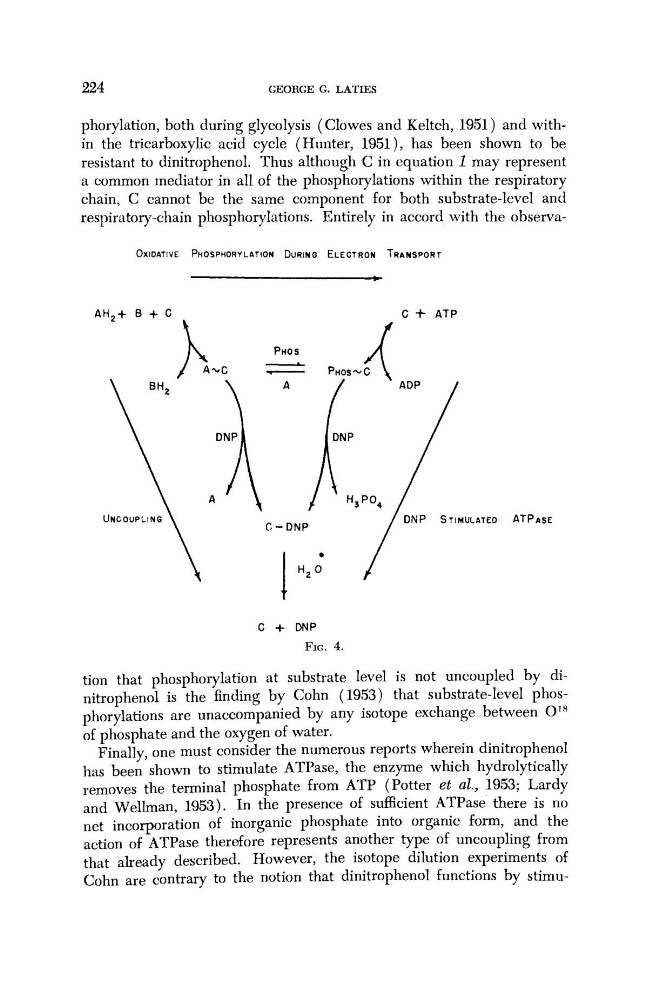
PHOSPHORYLATION DURING ELECTRON
TRANSPORT
C +
DNP
FIG. 4.
tion that phosphorylation at substrate level is not uncoupled by dinitrophenol is the finding by Cohn (1953) that substrate-level phosphorylations are unaccompanied by any isotope exchange between 0
18
of phosphate and the oxygen of water.
Finally, one must consider the numerous reports wherein dinitrophenol
has been shown to stimulate ATPase, the enzyme which hydrolytically
removes the terminal phosphate from ATP (Potter et al, 1953; Lardy
and Wellman, 1953). In the presence of sufficient ATPase there is no
net incorporation of inorganic phosphate into organic form, and the
action of ATPase therefore represents another type of uncoupling from
that already described. However, the isotope dilution experiments of
Cohn are contrary to the notion that dinitrophenol functions by stimu-
GEORGE G. LATIES
phorylation, both during glycolysis (Clowes and Keltch, 1951) and within the tricarboxylic acid cycle (Hunter, 1951), has been shown to be
resistant to dinitrophenol. Thus although C in equation 1 may represent
a common mediator in all of the phosphorylations within the respiratory
chain, C cannot be the same component for both substrate-level and
respiratory-chain phosphorylations. Entirely in accord with the observaOXIDATIVE
PHOSPHORYLATION DURING ELECTRON
TRANSPORT
C +
DNP
FIG. 4.
tion that phosphorylation at substrate level is not uncoupled by dinitrophenol is the finding by Cohn (1953) that substrate-level phosphorylations are unaccompanied by any isotope exchange between 0
18
of phosphate and the oxygen of water.
Finally, one must consider the numerous reports wherein dinitrophenol
has been shown to stimulate ATPase, the enzyme which hydrolytically
removes the terminal phosphate from ATP (Potter et al, 1953; Lardy
and Wellman, 1953). In the presence of sufficient ATPase there is no
net incorporation of inorganic phosphate into organic form, and the
action of ATPase therefore represents another type of uncoupling from
that already described. However, the isotope dilution experiments of
Cohn are contrary to the notion that dinitrophenol functions by stimu-