

222
GEORGE G. LATIES
3) designed to account for oxidative phosphorylation during election
transfer within the respiratory chain as well as during substrate oxidation.
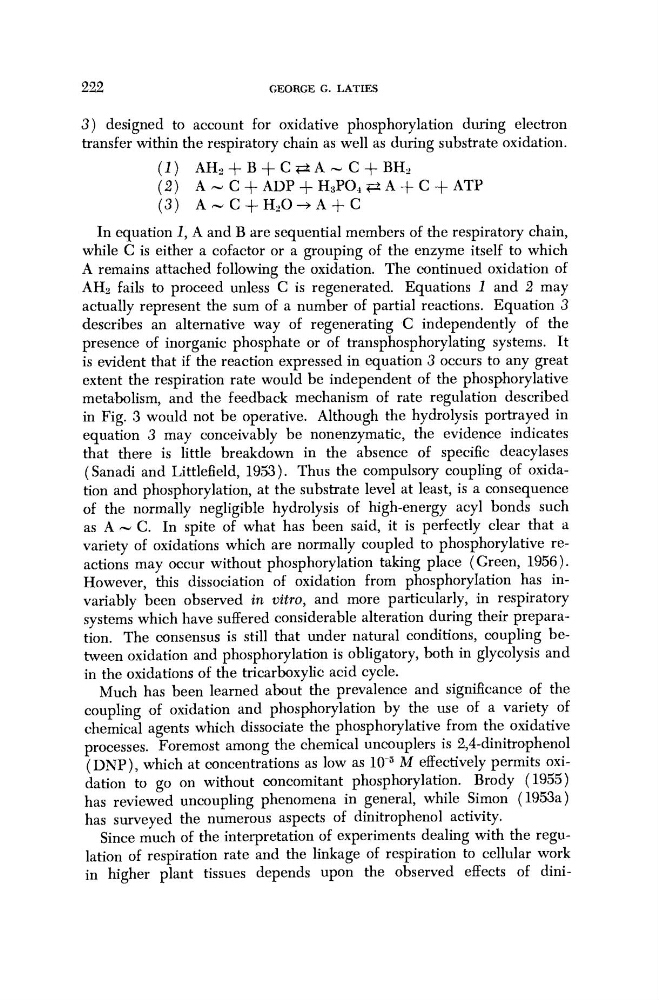
(1) AH 2 + Β + C
A ~ C + BH 2
(2)
A - C + ADP + H 3 P0 4 <=± A + C + ATP
(3) A~C + H 2 0 —A-f C
In equation 1, A and Β are sequential members of the respiratory chain,
while C is either a cofactor or a grouping of the enzyme itself to which
A remains attached following the oxidation. The continued oxidation of
AH 2 fails to proceed unless C is regenerated. Equations 1 and 2 may
actually represent the sum of a number of partial reactions. Equation 3
describes an alternative way of regenerating C independently of the
presence of inorganic phosphate or of transphosphorylating systems. It
is evident that if the reaction expressed in equation 3 occurs to any great
extent the respiration rate would be independent of the phosphorylative
metabolism, and the feedback mechanism of rate regulation described
in Fig. 3 would not be operative. Although the hydrolysis portrayed in
equation 3 may conceivably be nonenzymatic, the evidence indicates
that there is little breakdown in the absence of specific deacylases
(Sanadi and Littlefield, 1953). Thus the compulsory coupling of oxidation and phosphorylation, at the substrate level at least, is a consequence
of the normally negligible hydrolysis of high-energy acyl bonds such
as A ~ C. In spite of what has been said, it is perfectly clear that a
variety of oxidations which are normally coupled to phosphorylative reactions may occur without phosphorylation taking place (Green, 1956).
However, this dissociation of oxidation from phosphorylation has invariably been observed in vitro, and more particularly, in respiratory
systems which have suffered considerable alteration during their preparation. The consensus is still that under natural conditions, coupling between oxidation and phosphorylation is obligatory, both in glycolysis and
in the oxidations of the tricarboxylic acid cycle.
Much has been learned about the prevalence and significance of the
coupling of oxidation and phosphorylation by the use of a variety of
chemical agents which dissociate the phosphorylative from the oxidative
processes. Foremost among the chemical uncouplers is 2,4-dinitrophenol
(DNP), which at concentrations as low as 10~
5 Μ effectively permits oxidation to go on without concomitant phosphorylation. Brody (1955)
has reviewed uncoupling phenomena in general, while Simon (1953a)
has surveyed the numerous aspects of dinitrophenol activity.
Since much of the interpretation of experiments dealing with the regulation of respiration rate and the linkage of respiration to cellular work
in higher plant tissues depends upon the observed effects of dini-
GEORGE G. LATIES
3) designed to account for oxidative phosphorylation during election
transfer within the respiratory chain as well as during substrate oxidation.
(1) AH 2 + Β + C
A ~ C + BH 2
(2)
A - C + ADP + H 3 P0 4 <=± A + C + ATP
(3) A~C + H 2 0 —A-f C
In equation 1, A and Β are sequential members of the respiratory chain,
while C is either a cofactor or a grouping of the enzyme itself to which
A remains attached following the oxidation. The continued oxidation of
AH 2 fails to proceed unless C is regenerated. Equations 1 and 2 may
actually represent the sum of a number of partial reactions. Equation 3
describes an alternative way of regenerating C independently of the
presence of inorganic phosphate or of transphosphorylating systems. It
is evident that if the reaction expressed in equation 3 occurs to any great
extent the respiration rate would be independent of the phosphorylative
metabolism, and the feedback mechanism of rate regulation described
in Fig. 3 would not be operative. Although the hydrolysis portrayed in
equation 3 may conceivably be nonenzymatic, the evidence indicates
that there is little breakdown in the absence of specific deacylases
(Sanadi and Littlefield, 1953). Thus the compulsory coupling of oxidation and phosphorylation, at the substrate level at least, is a consequence
of the normally negligible hydrolysis of high-energy acyl bonds such
as A ~ C. In spite of what has been said, it is perfectly clear that a
variety of oxidations which are normally coupled to phosphorylative reactions may occur without phosphorylation taking place (Green, 1956).
However, this dissociation of oxidation from phosphorylation has invariably been observed in vitro, and more particularly, in respiratory
systems which have suffered considerable alteration during their preparation. The consensus is still that under natural conditions, coupling between oxidation and phosphorylation is obligatory, both in glycolysis and
in the oxidations of the tricarboxylic acid cycle.
Much has been learned about the prevalence and significance of the
coupling of oxidation and phosphorylation by the use of a variety of
chemical agents which dissociate the phosphorylative from the oxidative
processes. Foremost among the chemical uncouplers is 2,4-dinitrophenol
(DNP), which at concentrations as low as 10~
5 Μ effectively permits oxidation to go on without concomitant phosphorylation. Brody (1955)
has reviewed uncoupling phenomena in general, while Simon (1953a)
has surveyed the numerous aspects of dinitrophenol activity.
Since much of the interpretation of experiments dealing with the regulation of respiration rate and the linkage of respiration to cellular work
in higher plant tissues depends upon the observed effects of dini-