

RESPIRATION RATE IN PLANTS
217
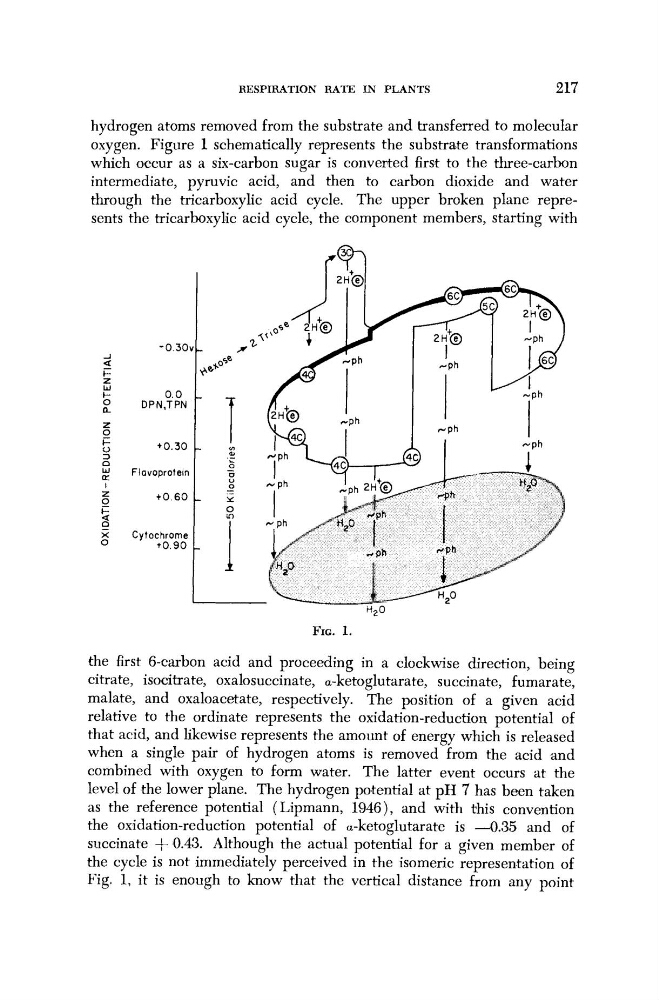
hydrogen atoms removed from the substrate and transferred to molecular
oxygen. Figure 1 schematically represents the substrate transformations
which occur as a six-carbon sugar is converted first to the three-carbon
intermediate, pyruvic acid, and then to carbon dioxide and water
through the tricarboxylic acid cycle. The upper broken plane represents the tricarboxylic acid cycle, the component members, starting with
H 2 0
FIG. 1.
the first 6-carbon acid and proceeding in a clockwise direction, being
citrate, isocitrate, oxalosuccinate, α-ketoglutarate, succinate, fumarate,
malate, and oxaloacetate, respectively. The position of a given acid
relative to the ordinate represents the oxidation-reduction potential of
that acid, and likewise represents the amount of energy which is released
when a single pair of hydrogen atoms is removed from the acid and
combined with oxygen to form water. The latter event occurs at the
level of the lower plane. The hydrogen potential at pH 7 has been taken
as the reference potential (Lipmann, 1946), and with this convention
the oxidation-reduction potential of α-ketoglutarate is —0.35 and of
succinate + 0.43. Although the actual potential for a given member of
the cycle is not immediately perceived in the isomeric representation of
Fig. 1, it is enough to know that the vertical distance from any point
217
hydrogen atoms removed from the substrate and transferred to molecular
oxygen. Figure 1 schematically represents the substrate transformations
which occur as a six-carbon sugar is converted first to the three-carbon
intermediate, pyruvic acid, and then to carbon dioxide and water
through the tricarboxylic acid cycle. The upper broken plane represents the tricarboxylic acid cycle, the component members, starting with
H 2 0
FIG. 1.
the first 6-carbon acid and proceeding in a clockwise direction, being
citrate, isocitrate, oxalosuccinate, α-ketoglutarate, succinate, fumarate,
malate, and oxaloacetate, respectively. The position of a given acid
relative to the ordinate represents the oxidation-reduction potential of
that acid, and likewise represents the amount of energy which is released
when a single pair of hydrogen atoms is removed from the acid and
combined with oxygen to form water. The latter event occurs at the
level of the lower plane. The hydrogen potential at pH 7 has been taken
as the reference potential (Lipmann, 1946), and with this convention
the oxidation-reduction potential of α-ketoglutarate is —0.35 and of
succinate + 0.43. Although the actual potential for a given member of
the cycle is not immediately perceived in the isomeric representation of
Fig. 1, it is enough to know that the vertical distance from any point