

MECHANISMS OF HORMONE ACTIONS
203
phate, were limiting in the breakdown of liver glycogen to free glucose.
2. Phosphorylase, the enzyme catalyzing the interconversion of glucose-l-phosphate and glycogen, could be the limiting system.
3. With time, a liver slice in vitro shows a progressive diminution in
Phosphorylase activity.
4. This loss in activity is due to a reversible "inactivation" of the
Phosphorylase protein. The active enzyme is itself a phosphoprotein,
and loss of Ρ from it leads jtp "inactivation."
Glycogen
Phosphorylase
Glucose-l-phosphate
Phosphoglucomutase
G l u c o s
e
Glucose-6-phosphate
p
^
h a t a s e
, Glucose
"
+,
(absent in
;!
muscle)
!*
To other reactions
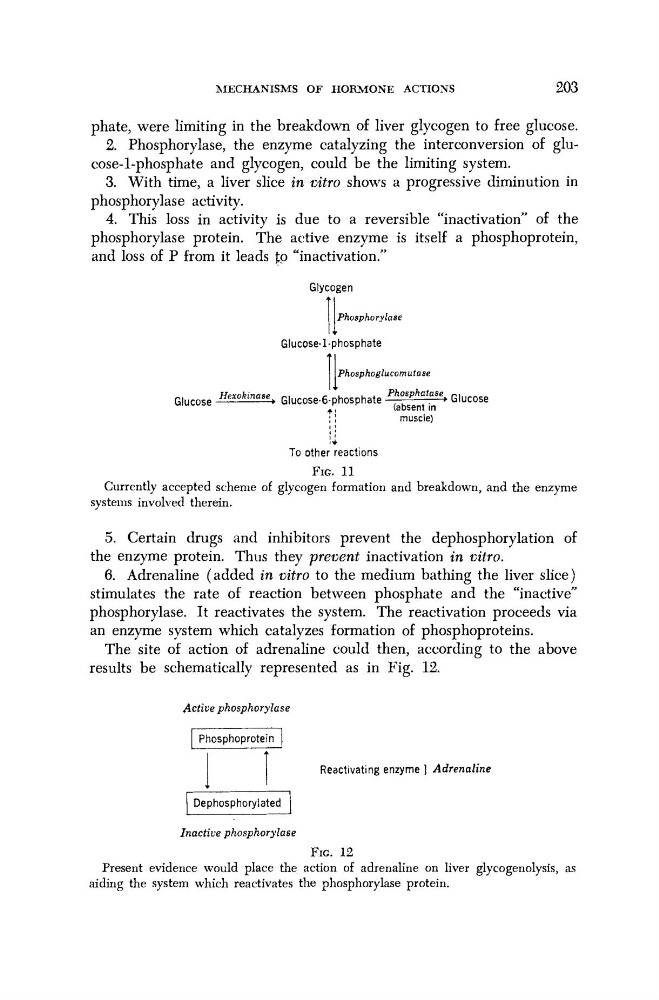
FIG. 11
Currently accepted scheme of glycogen formation and breakdown, and the enzyme
systems involved therein.
5. Certain drugs and inhibitors prevent the dephosphorylation of
the enzyme protein. Thus they prevent inactivation in vitro.
6. Adrenaline (added in vitro to the medium bathing the liver slice)
stimulates the rate of reaction between phosphate and the "inactive"
Phosphorylase. It reactivates the system. The reactivation proceeds via
an enzyme system which catalyzes formation of phosphoproteins.
The site of action of adrenaline could then, according to the above
results be schematically represented as in Fig. 12.
Active Phosphorylase
Phosphoprotein
Reactivating enzyme ] Adrenaline
Dephosphorylated
Inactive Phosphorylase
FIG. 12
Present evidence would place the action of adrenaline on liver glycogenolysis, as
aiding the system which reactivates the Phosphorylase protein.
203
phate, were limiting in the breakdown of liver glycogen to free glucose.
2. Phosphorylase, the enzyme catalyzing the interconversion of glucose-l-phosphate and glycogen, could be the limiting system.
3. With time, a liver slice in vitro shows a progressive diminution in
Phosphorylase activity.
4. This loss in activity is due to a reversible "inactivation" of the
Phosphorylase protein. The active enzyme is itself a phosphoprotein,
and loss of Ρ from it leads jtp "inactivation."
Glycogen
Phosphorylase
Glucose-l-phosphate
Phosphoglucomutase
G l u c o s
e
Glucose-6-phosphate
p
^
h a t a s e
, Glucose
"
+,
(absent in
;!
muscle)
!*
To other reactions
FIG. 11
Currently accepted scheme of glycogen formation and breakdown, and the enzyme
systems involved therein.
5. Certain drugs and inhibitors prevent the dephosphorylation of
the enzyme protein. Thus they prevent inactivation in vitro.
6. Adrenaline (added in vitro to the medium bathing the liver slice)
stimulates the rate of reaction between phosphate and the "inactive"
Phosphorylase. It reactivates the system. The reactivation proceeds via
an enzyme system which catalyzes formation of phosphoproteins.
The site of action of adrenaline could then, according to the above
results be schematically represented as in Fig. 12.
Active Phosphorylase
Phosphoprotein
Reactivating enzyme ] Adrenaline
Dephosphorylated
Inactive Phosphorylase
FIG. 12
Present evidence would place the action of adrenaline on liver glycogenolysis, as
aiding the system which reactivates the Phosphorylase protein.