

196
RACHMIEL LEVINE
mg/g/hour. In the absence of insulin, galactose did not enter the lens.
In its presence, there was an appreciable rate of galactose uptake
(0.11 mg/g/hour).
Wick and Drury (1953) using galactose-C
14 in eviscerated rabbits,
showed that although in this species there is some oxidation of the
galactose, the principal effect of insulin was to increase the rate of
1. Responsive to insulin
CHO
I
H-C-OH
I
HO-^-H
HO-C-H
I
H-C-OH
I
CH 2 0H
d-Galactose
CHO
I
H-C-OH
I
HO-C-H
I
H-C-OH
I
CH2OH
I
H-C-OH
I
HO-CJ-H
HO-C-H
1
CH2OH
J-Arabinose
CHO
I
H-C-OH
I
HO-C-H
H-C-OH
I
H-C-OH
I
CH £ 0H
d-Glucose
2. Not responsive to insulin
CHO
HO-C-H
I
HO-C-H
I
H-
I
CH 2 0H
d-Mannose
CHO
I
HO-C-H
I
H-C-OH
I
H-C-OH
I
CH 2 0H
d-Arabinose
CH 2 0H
C=0
I
HO-C-H
I
H-C-OH
I
H-C-OH
I
CH 2 0H
d-Fructose
CHO
I
H-C-OH
I
H-
I
H0-(j:-H
CH 3
/-Rhamnose
CH2OH
I
c=o
I
HO-C-H
I
H-C-OH
I
HO-C-H
I
CH 2 OH
/-Sorbose
CH 2 0H
H-C-OH
I
HO-C-H
I
H-C-OH
I
H-C-OH
I
CH 2 OH
d-Sorbitol
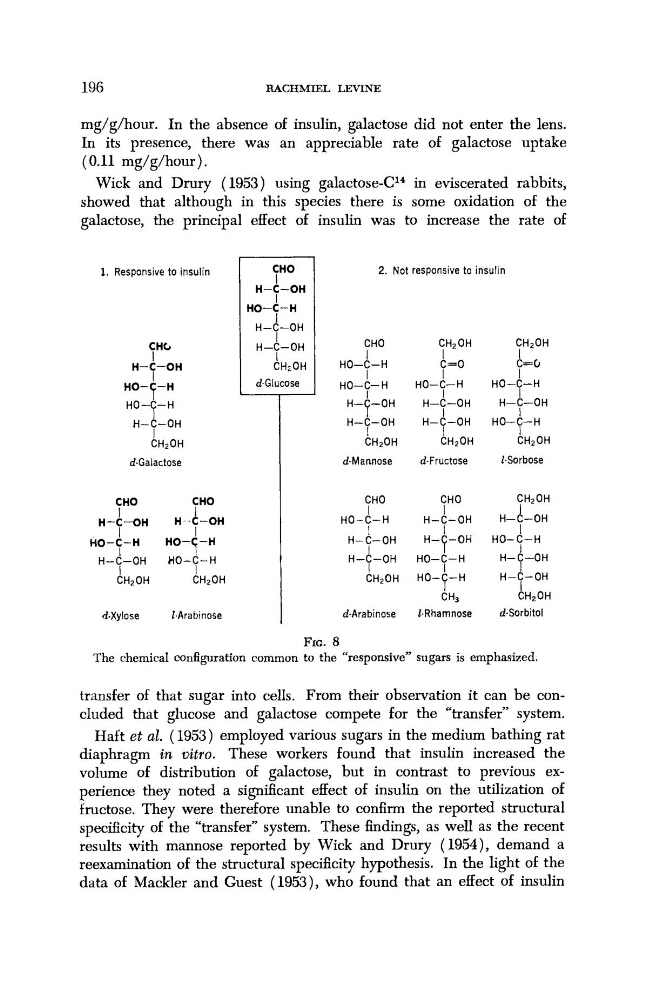
FIG. 8
The chemical configuration common to the "responsive" sugars is emphasized.
transfer of that sugar into cells. From their observation it can be concluded that glucose and galactose compete for the "transfer" system.
Haft et al. (1953) employed various sugars in the medium bathing rat
diaphragm in vitro. These workers found that insulin increased the
volume of distribution of galactose, but in contrast to previous experience they noted a significant effect of insulin on the utilization of
fructose. They were therefore unable to confirm the reported structural
specificity of the "transfer" system. These findings, as well as the recent
results with mannose reported by Wick and Drury (1954), demand a
reexamination of the structural specificity hypothesis. In the light of the
data of Mackler and Guest (1953), who found that an effect of insulin
RACHMIEL LEVINE
mg/g/hour. In the absence of insulin, galactose did not enter the lens.
In its presence, there was an appreciable rate of galactose uptake
(0.11 mg/g/hour).
Wick and Drury (1953) using galactose-C
14 in eviscerated rabbits,
showed that although in this species there is some oxidation of the
galactose, the principal effect of insulin was to increase the rate of
1. Responsive to insulin
CHO
I
H-C-OH
I
HO-^-H
HO-C-H
I
H-C-OH
I
CH 2 0H
d-Galactose
CHO
I
H-C-OH
I
HO-C-H
I
H-C-OH
I
CH2OH
I
H-C-OH
I
HO-CJ-H
HO-C-H
1
CH2OH
J-Arabinose
CHO
I
H-C-OH
I
HO-C-H
H-C-OH
I
H-C-OH
I
CH £ 0H
d-Glucose
2. Not responsive to insulin
CHO
HO-C-H
I
HO-C-H
I
H-
I
CH 2 0H
d-Mannose
CHO
I
HO-C-H
I
H-C-OH
I
H-C-OH
I
CH 2 0H
d-Arabinose
CH 2 0H
C=0
I
HO-C-H
I
H-C-OH
I
H-C-OH
I
CH 2 0H
d-Fructose
CHO
I
H-C-OH
I
H-
I
H0-(j:-H
CH 3
/-Rhamnose
CH2OH
I
c=o
I
HO-C-H
I
H-C-OH
I
HO-C-H
I
CH 2 OH
/-Sorbose
CH 2 0H
H-C-OH
I
HO-C-H
I
H-C-OH
I
H-C-OH
I
CH 2 OH
d-Sorbitol
FIG. 8
The chemical configuration common to the "responsive" sugars is emphasized.
transfer of that sugar into cells. From their observation it can be concluded that glucose and galactose compete for the "transfer" system.
Haft et al. (1953) employed various sugars in the medium bathing rat
diaphragm in vitro. These workers found that insulin increased the
volume of distribution of galactose, but in contrast to previous experience they noted a significant effect of insulin on the utilization of
fructose. They were therefore unable to confirm the reported structural
specificity of the "transfer" system. These findings, as well as the recent
results with mannose reported by Wick and Drury (1954), demand a
reexamination of the structural specificity hypothesis. In the light of the
data of Mackler and Guest (1953), who found that an effect of insulin