

CHEMORECEPTION AND THE BEHAVIOR OF INSECTS
155
(Lep.)
300-360
(2) Fly larva blood with larval blood of Graduaría
syringella (Lep.)
50-120
(3) Fly larva blood plus sucrose
270
(4) Fly larva blood plus a trace of acetic acid
1-2
(5) Fly larva blood plus a trace of soda
40
(6) Larva of Pteronidea pavida without fly blood
4
(7) P. pavida without fly blood
3-20
(8) Larva of G. syringela without fly blood
2-4
In other words, items numbered (1) to (3) were accepted, while (4) to
(8) were refused. Jacobi could not induce the wasps to oviposit in a
puparium stuffed with a mixture of agar and the blood of Calliphora
pupae. Edwards, repeating the experiment, also failed. He believed
that the chemoreceptors on the ovipositor are concerned not so much
with detecting a suitable host as with detecting an unsuitable one. Whatever the details may be, there is no doubt whatsoever that the ovipositors
of many hymenopterous parasites bear chemoreceptors. The physiological characteristics, thresholds, discrimination, etc., of these receptors, as
exemplified by those of the parasite Nemeritis canescens, resemble in a
striking degree the characteristics of many chemoreceptors associated
with the mouthparts (Dethier, 1947b).
Despite minor discrepancies reported by the different workers, the
picture of host-selection, recognition, and discrimination by the various
pupal odor; drilling is released by a chemical stimulus, although touch
stimuli and the size of the object are also of some importance. Larger
objects are preferred to smaller ones; the absolute limits are 0.001 cc. to
2.5 cc. (Jacobi, 1939). Wasps attempt to drill into little stones contaminated with pupal odor. Up to this point the parasite cannot discriminate between live, dead, empty, and parasitized pupae. Edwards
was unable to demonstrate the importance of a chemical stimulus for
releasing drumming, but he was convinced that there is some intrinsic
property (puparium factor) by which the wasp recognizes its host.
Shape, specifically roundness, and moisture are of some importance in
releasing drilling. Once the ovipositor has entered the puparium the
wasp can distinguish between live and dead hosts and suitable and unsuitable ones. Jacobi demonstrated the chemical sensitivity of the ovipositor by a series of ingenious experiments in which he stuffed empty
puparia with different materials and recorded the length of time the
ovipositor remained inserted. These are the results:
Seconds
(1) Fly larva blood with larval blood of Pteronidea
pavida
155
(Lep.)
300-360
(2) Fly larva blood with larval blood of Graduaría
syringella (Lep.)
50-120
(3) Fly larva blood plus sucrose
270
(4) Fly larva blood plus a trace of acetic acid
1-2
(5) Fly larva blood plus a trace of soda
40
(6) Larva of Pteronidea pavida without fly blood
4
(7) P. pavida without fly blood
3-20
(8) Larva of G. syringela without fly blood
2-4
In other words, items numbered (1) to (3) were accepted, while (4) to
(8) were refused. Jacobi could not induce the wasps to oviposit in a
puparium stuffed with a mixture of agar and the blood of Calliphora
pupae. Edwards, repeating the experiment, also failed. He believed
that the chemoreceptors on the ovipositor are concerned not so much
with detecting a suitable host as with detecting an unsuitable one. Whatever the details may be, there is no doubt whatsoever that the ovipositors
of many hymenopterous parasites bear chemoreceptors. The physiological characteristics, thresholds, discrimination, etc., of these receptors, as
exemplified by those of the parasite Nemeritis canescens, resemble in a
striking degree the characteristics of many chemoreceptors associated
with the mouthparts (Dethier, 1947b).
Despite minor discrepancies reported by the different workers, the
picture of host-selection, recognition, and discrimination by the various
pupal odor; drilling is released by a chemical stimulus, although touch
stimuli and the size of the object are also of some importance. Larger
objects are preferred to smaller ones; the absolute limits are 0.001 cc. to
2.5 cc. (Jacobi, 1939). Wasps attempt to drill into little stones contaminated with pupal odor. Up to this point the parasite cannot discriminate between live, dead, empty, and parasitized pupae. Edwards
was unable to demonstrate the importance of a chemical stimulus for
releasing drumming, but he was convinced that there is some intrinsic
property (puparium factor) by which the wasp recognizes its host.
Shape, specifically roundness, and moisture are of some importance in
releasing drilling. Once the ovipositor has entered the puparium the
wasp can distinguish between live and dead hosts and suitable and unsuitable ones. Jacobi demonstrated the chemical sensitivity of the ovipositor by a series of ingenious experiments in which he stuffed empty
puparia with different materials and recorded the length of time the
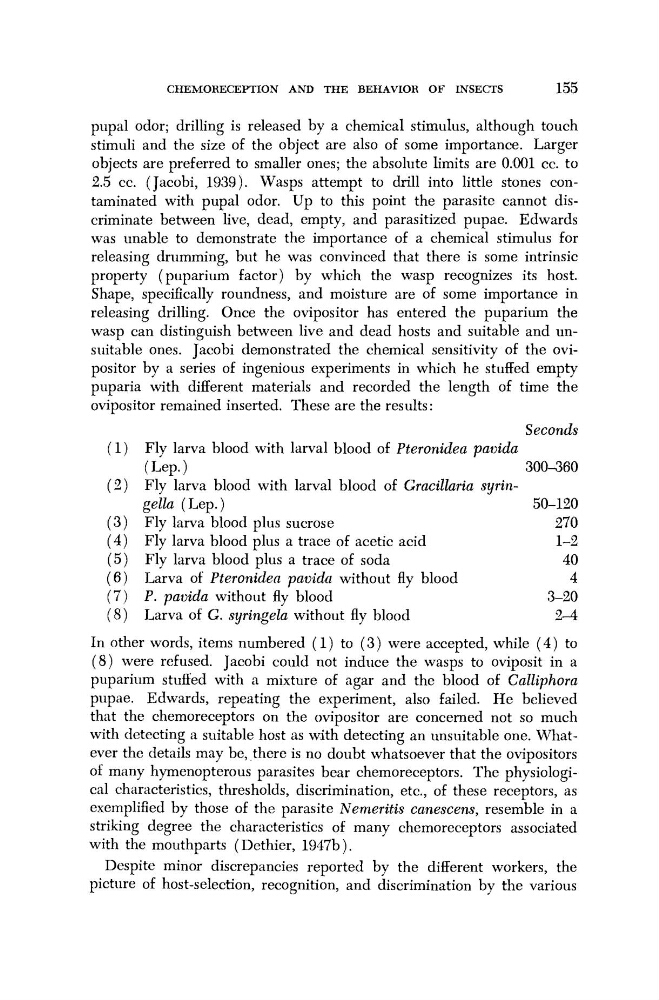
ovipositor remained inserted. These are the results:
Seconds
(1) Fly larva blood with larval blood of Pteronidea
pavida