

132
Μ. J. D. WHITE
with 8 autosomal pairs has the simplest sex chromosome mechanism
known in the genus, namely, XiX 2 Y). It is not evident what aspect of
this case suggested a tetraploid condition to Gates (Guénin made no
such assumption). Just how the sex chromosome mechanisms of this
genus have arisen is, however, far from clear.
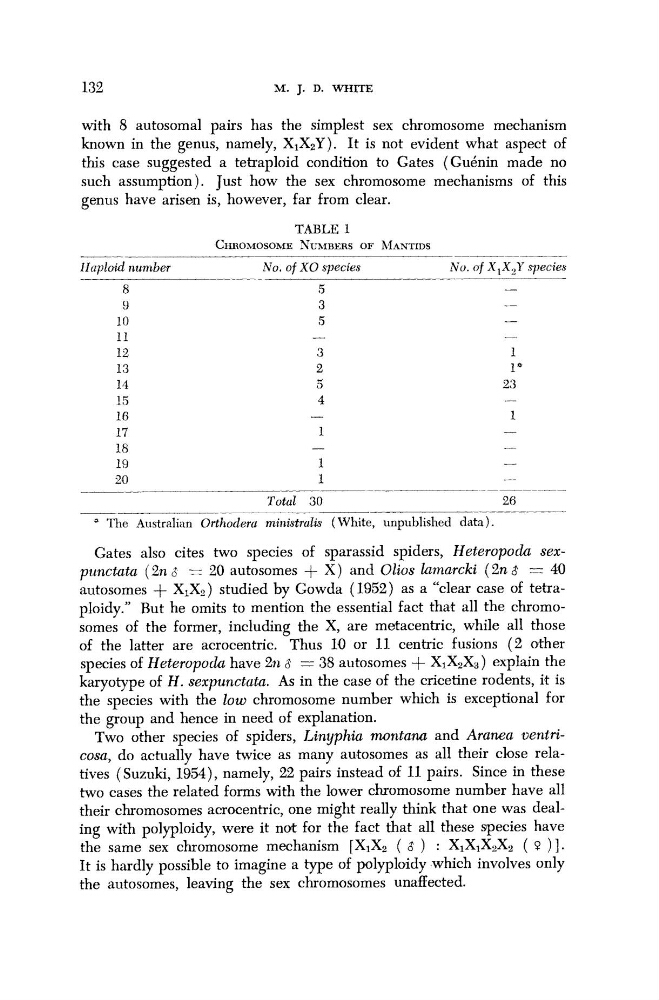
TABLE 1
CHROMOSOME NUMBERS OF MANTIDS
Haploid number
No. of XO species
No. of XjXoY species
8
5
—
9
3
—
10
5
—
11
—
—
12
3
1
13
2
1*
14
5
23
15
4
—
16
—
1
17
1
—
18
—
19
1
—
20
1
—
Total 30
26
* The Australian Orthodera ministralis (White, unpublished data).
Gates also cites two species of sparassid spiders, Heteropoda
sexpunctata (2n$ =20 autosomes -f X) and Olios lamarcki (2n $ — 40
autosomes + X1X2) studied by Gowda (1952) as a "clear case of tetraploidy." But he omits to mention the essential fact that all the chromosomes of the former, including the X, are metacentric, while all those
of the latter are acrocentric. Thus 10 or 11 centric fusions (2 other
species of Heteropoda have 2n $ = 38 autosomes + X1X2X3) explain the
karyotype of H. sexpunctata. As in the case of the cricetine rodents, it is
the species with the low chromosome number which is exceptional for
the group and hence in need of explanation.
Two other species of spiders, Linyphia montana and Aranea ventricosa, do actually have twice as many autosomes as all their close relatives (Suzuki, 1954), namely, 22 pairs instead of 11 pairs. Since in these
two cases the related forms with the lower chromosome number have all
their chromosomes acrocentric, one might really think that one was dealing with polyploidy, were it not for the fact that all these species have
the same sex chromosome mechanism [X1X2 ( $ ) : X1X1X2X2 ( 9 )].
It is hardly possible to imagine a type of polyploidy which involves only
the autosomes, leaving the sex chromosomes unaffected.
Μ. J. D. WHITE
with 8 autosomal pairs has the simplest sex chromosome mechanism
known in the genus, namely, XiX 2 Y). It is not evident what aspect of
this case suggested a tetraploid condition to Gates (Guénin made no
such assumption). Just how the sex chromosome mechanisms of this
genus have arisen is, however, far from clear.
TABLE 1
CHROMOSOME NUMBERS OF MANTIDS
Haploid number
No. of XO species
No. of XjXoY species
8
5
—
9
3
—
10
5
—
11
—
—
12
3
1
13
2
1*
14
5
23
15
4
—
16
—
1
17
1
—
18
—
19
1
—
20
1
—
Total 30
26
* The Australian Orthodera ministralis (White, unpublished data).
Gates also cites two species of sparassid spiders, Heteropoda
sexpunctata (2n$ =20 autosomes -f X) and Olios lamarcki (2n $ — 40
autosomes + X1X2) studied by Gowda (1952) as a "clear case of tetraploidy." But he omits to mention the essential fact that all the chromosomes of the former, including the X, are metacentric, while all those
of the latter are acrocentric. Thus 10 or 11 centric fusions (2 other
species of Heteropoda have 2n $ = 38 autosomes + X1X2X3) explain the
karyotype of H. sexpunctata. As in the case of the cricetine rodents, it is
the species with the low chromosome number which is exceptional for
the group and hence in need of explanation.
Two other species of spiders, Linyphia montana and Aranea ventricosa, do actually have twice as many autosomes as all their close relatives (Suzuki, 1954), namely, 22 pairs instead of 11 pairs. Since in these
two cases the related forms with the lower chromosome number have all
their chromosomes acrocentric, one might really think that one was dealing with polyploidy, were it not for the fact that all these species have
the same sex chromosome mechanism [X1X2 ( $ ) : X1X1X2X2 ( 9 )].
It is hardly possible to imagine a type of polyploidy which involves only
the autosomes, leaving the sex chromosomes unaffected.