

130
Μ. J. D. WHITE
II.
GERBILS
2n
Tatera brantsii draco
44
Tatera afra
44
Tatera schinzii
42
Tatera indica ceylonica
72
III. COREGONID FISHES
2n
Coregonus asperi maraenoides
ca. 36
Coregonus schinzii duplex
ca. 72
Coregonus wartmanni caeruleus
72
Coregonus exiguus albellus
"at least 72'
Coregonus lavaretus
80
Coregonus albula
80
The claim of Darlington and Gates that Mesocricetus
auratus is an
allopolyploid has been strongly criticized by Matthey (1953, 1954a,b)
and White (1954), and the evidence against it need not be repeated
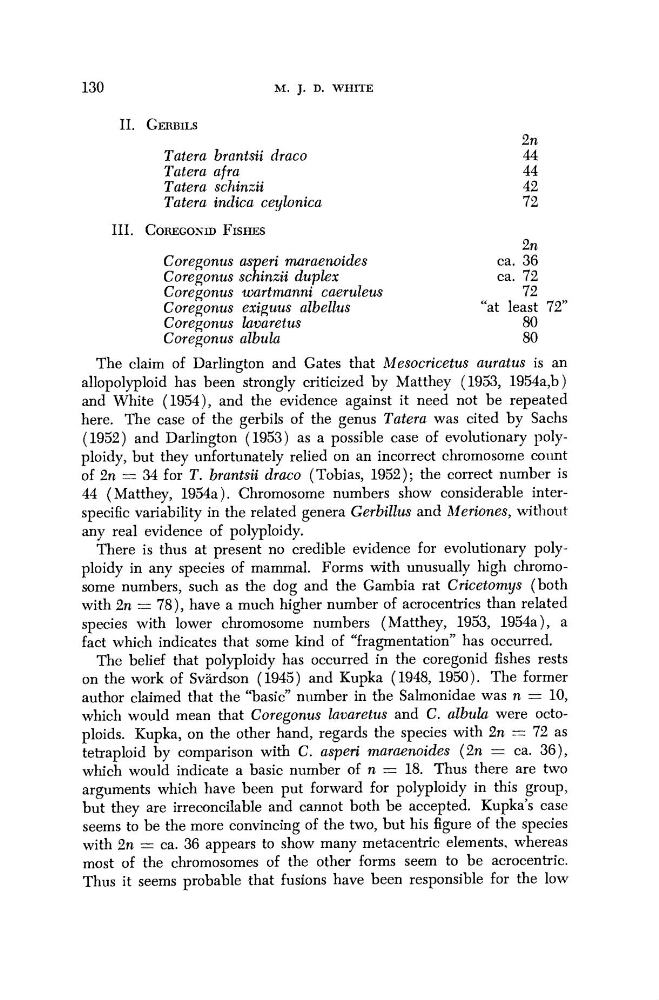
here. The case of the gerbils of the genus Tatera was cited by Sachs
(1952) and Darlington (1953) as a possible case of evolutionary polyploidy, but they unfortunately relied on an incorrect chromosome count
of 2n = 34 for T. brantsii draco (Tobias, 1952); the correct number is
44 (Matthey, 1954a). Chromosome numbers show considerable interspecific variability in the related genera Gerbillus and Meriones, without
any real evidence of polyploidy.
There is thus at present no credible evidence for evolutionary polyploidy in any species of mammal. Forms with unusually high chromosome numbers, such as the dog and the Gambia rat Cricetomys
(both
with 2n
78), have a much higher number of acrocentrics than related
species with lower chromosome numbers (Matthey, 1953, 1954a), a
fact which indicates that some kind of "fragmentation" has occurred.
The belief that polyploidy has occurred in the coregonid fishes rests
on the work of Svärdson (1945) and Kupka (1948, 1950). The former
author claimed that the "basic" number in the Salmonidae was η = 10,
which would mean that Coregonus lavaretus and C. albula were octoploids. Kupka, on the other hand, regards the species with 2n = 72 as
tetraploid by comparison with C. asperi maraenoides
(2n = ca. 36),
which would indicate a basic number of η = 18. Thus there are two
arguments which have been put forward for polyploidy in this group,
but they are irreconcilable and cannot both be accepted. Kupka's case
seems to be the more convincing of the two, but his figure of the species
with 2n = ca. 36 appears to show many metacentric elements, whereas
most of the chromosomes of the other forms seem to be acrocentric.
Thus it seems probable that fusions have been responsible for the low
Μ. J. D. WHITE
II.
GERBILS
2n
Tatera brantsii draco
44
Tatera afra
44
Tatera schinzii
42
Tatera indica ceylonica
72
III. COREGONID FISHES
2n
Coregonus asperi maraenoides
ca. 36
Coregonus schinzii duplex
ca. 72
Coregonus wartmanni caeruleus
72
Coregonus exiguus albellus
"at least 72'
Coregonus lavaretus
80
Coregonus albula
80
The claim of Darlington and Gates that Mesocricetus
auratus is an
allopolyploid has been strongly criticized by Matthey (1953, 1954a,b)
and White (1954), and the evidence against it need not be repeated
here. The case of the gerbils of the genus Tatera was cited by Sachs
(1952) and Darlington (1953) as a possible case of evolutionary polyploidy, but they unfortunately relied on an incorrect chromosome count
of 2n = 34 for T. brantsii draco (Tobias, 1952); the correct number is
44 (Matthey, 1954a). Chromosome numbers show considerable interspecific variability in the related genera Gerbillus and Meriones, without
any real evidence of polyploidy.
There is thus at present no credible evidence for evolutionary polyploidy in any species of mammal. Forms with unusually high chromosome numbers, such as the dog and the Gambia rat Cricetomys
(both
with 2n
78), have a much higher number of acrocentrics than related
species with lower chromosome numbers (Matthey, 1953, 1954a), a
fact which indicates that some kind of "fragmentation" has occurred.
The belief that polyploidy has occurred in the coregonid fishes rests
on the work of Svärdson (1945) and Kupka (1948, 1950). The former
author claimed that the "basic" number in the Salmonidae was η = 10,
which would mean that Coregonus lavaretus and C. albula were octoploids. Kupka, on the other hand, regards the species with 2n = 72 as
tetraploid by comparison with C. asperi maraenoides
(2n = ca. 36),
which would indicate a basic number of η = 18. Thus there are two
arguments which have been put forward for polyploidy in this group,
but they are irreconcilable and cannot both be accepted. Kupka's case
seems to be the more convincing of the two, but his figure of the species
with 2n = ca. 36 appears to show many metacentric elements, whereas
most of the chromosomes of the other forms seem to be acrocentric.
Thus it seems probable that fusions have been responsible for the low